Go-to-Market Sequencing for Vertical Agent Products
Prove one workflow with one customer before you scale, or lose your edge.
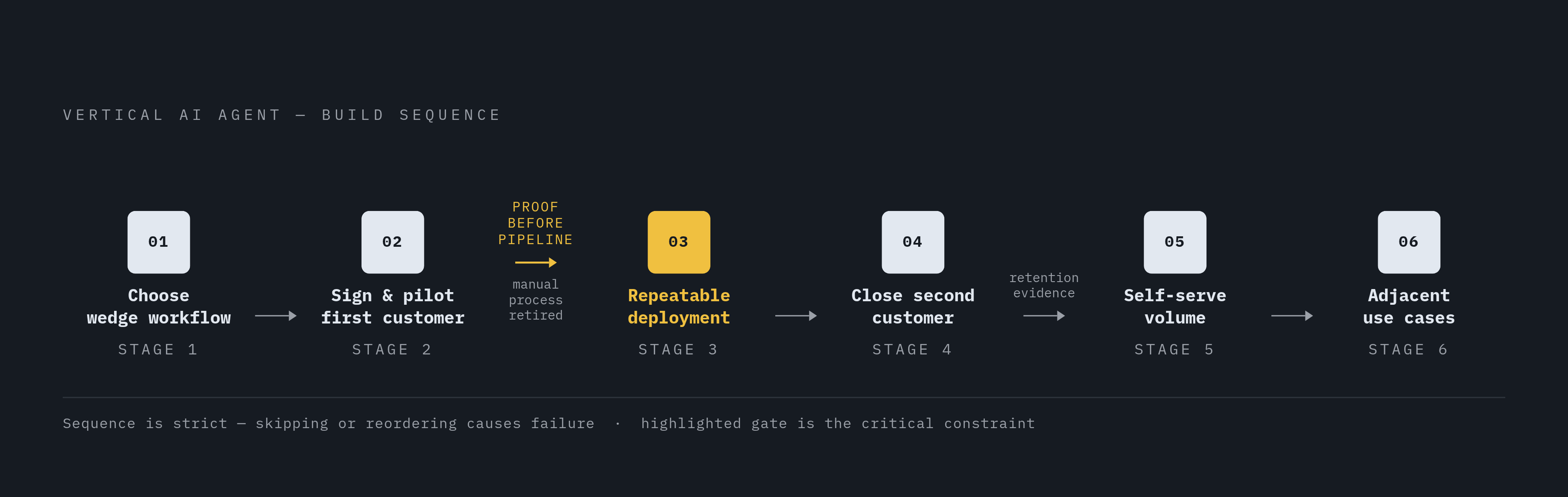
A solo founder can deploy an AI agent without software operations or infrastructure knowledge by using a managed platform that handles provisioning, persistent customer instances, integration credentials, monitoring, and recovery. But managed deployment does not prove a product is ready to sell. Go-to-market sequencing for vertical agent products means proving one narrow workflow with one customer, making deployment and sales repeatable, and only then expanding acquisition or use cases.
Why vertical agent products fail in the right direction but the wrong order
A founder can choose the right vertical, identify a real buyer, build a useful agent, and still lose. The failure starts after the first customer signs. Instead of proving that customer's workflow is repeatable, the founder pursues adjacent customers with slightly different needs. Each opportunity looks reasonable on its own. Together, they pull the product away from the specific problem that made it worth buying.
That loss of specificity weakens the advantage vertical AI is supposed to build. Its moat comes from proprietary workflow data and specialized process logic. Both grow from doing the same kind of work over and over in a narrow setting. A product that moves between workflows too early spreads its learning across different problems before it has depth in any one.
The damage reaches beyond the product itself. Different workflows need different sales explanations, while different customer segments dilute the domain credibility earned with the first buyer. Retention suffers as the product becomes less definite about what it does well. The founder ends up with more possible markets and a weaker story in each. The direction was sound, but the order undermined it.
Choosing the wedge workflow: the one task that earns the right to everything else
The first decision is therefore what to leave out. Choose the most painful, repeatable task the first buyer would pay to stop doing manually, rather than the most impressive capability the agent can demonstrate. A task with a good-enough solution is a weak starting point even if the agent performs it slightly better.
Frequency and measurable output make that choice concrete. The task should recur daily or weekly, giving the agent regular opportunities to earn its value. The buyer should also be able to tell whether it succeeded without debating the quality of the result. If people disagree on what counts as success, it is harder to prove that the agent has replaced manual work.
Scope is the next filter to apply. The agent should complete the task end-to-end without human intervention on most runs, rather than depend on judgment calls throughout the process. Repeated completion should also generate workflow-specific data it can learn from. That data exhaust is part of the defense against a horizontal competitor. A task that requires constant human judgment leaves the agent functioning more as an interface than as an autonomous worker.
A law firm's contract review intake illustrates the boundary. Extracting clause types, flagging missing provisions, and routing work to the right associate defines a contained workflow with recognizable outputs. An agent that “helps lawyers work smarter” defines neither the task nor the finish line. The narrower description gives the buyer a way to judge the product and gives the founder a boundary to protect.
Signing the first customer: why proof before pipeline is the non-negotiable first gate
Once the wedge is chosen, the first customer becomes a test of whether it survives real work. Payment alone cannot answer that question. The agent needs to run against production data and real edge cases. The purpose of this engagement is to establish whether the buyer's operational pain actually disappears.
Structure the pilot around a success criterion agreed in advance. With a vague trial, both sides can call activity progress without deciding whether the agent has taken over the task. Weekly check-ins should put the founder and customer in front of the agent's outputs together. The work itself needs scrutiny, including the runs the customer has to correct.
Proof requires more than the customer liking the agent. It should complete the workflow without intervention on the majority of runs, and the customer should retire the manual process for that task. At the end of the pilot, ask what changed, what did not, and what would need to change before the customer recommended it to a peer. The customer's own explanation supplies the language for the next sale.
Starting more sales conversations before that pilot runs means making promises before there is proof. The founder is selling an onboarding process, integration set, and operational result that are still being discovered. A completed pilot instead reveals what deployment requires and which integrations are essential in the vertical's tech stack. It also produces a credible case study grounded in the buyer's work.
How can a founder deploy an AI agent without DevOps before selling to customer two?
First-customer proof does not automatically make deployment repeatable. Before pitching the second customer, the founder needs a platform that handles provisioning, integration configuration, monitoring, and recovery without turning each new account into a manual operations project. The founder still owns the workflow promise, but should not have to operate the underlying platform to keep that promise.
The readiness criteria are specific enough to evaluate. Each customer needs an isolated, persistent agent instance so that one customer's data, sessions, and failures cannot touch another's. Integrations need to authenticate once and stay authenticated, without the founder handling repeated OAuth approval or credential rotation. Monitoring and restart logic belong with the platform. The founder should learn about trouble from a dashboard before hearing about it in a customer support email.
Sound model logic is not enough if the agent cannot stay connected to the email, CRM, project management, or communication tools through which the workflow runs. A successful demonstration does not establish that those connections will hold in production. Choosing how to deploy the agent means planning both how to get it running and how to keep it running.
Each hand-provisioned customer adds responsibility for uptime, incident response, and configuration drift, so the founder's operational burden grows with every account. Managed deployment is useful because those duties otherwise compete with product work and selling. Before customer two, the test is whether the platform can repeat the deployment without repeating the founder's manual work.
Building the repeatable sales motion from two customers, not twenty
With a proven workflow and deployable product, the next job is to understand how the first two customers bought. Their value is not just two signed contracts. A second engagement lets the founder compare the language, objections, and decision process against the first. Something that seemed key to one sale may have mattered only to that buyer, but a concern both buyers share may be the start of a pattern.
Document the motion in ordinary working materials. Keep a call recording, an objection log, and a written sequence of steps from first contact to signed contract. Record what buyers doubted first, whether they then questioned data safety, and what they needed to explain the purchase internally. Capture their words for the pain rather than substituting the founder's description of the solution. Also note who joined the buying decision in the second sale but was absent from the first.
This is observation before it is automation. A CRM template cannot supply the missing explanation of why a buyer moved forward, and a generic sales methodology cannot replace the actual sequence. The repeatability test is whether a salesperson who took part in neither pilot could close a third customer using the record of those engagements. If that person still needs the founder to explain the key reasons behind the sale, the motion still depends on the founder.
At this stage, direct outreach should target named accounts in the same vertical, company size, and workflow profile as the first two customers. Similarity makes the emerging sales process easier to test without changing the problem at the same time. Content marketing, paid acquisition, and self-serve come later. Automating outreach before the manual motion is repeatable only spreads inconsistency faster.
When and how to introduce self-serve and volume acquisition
Self-serve becomes useful when a buyer can reach a successful first agent run without founder involvement. It is a channel within a sales strategy. The customer must be able to connect integrations, configure the agent, and complete the wedge workflow independently. At the same time, the proof must be clear enough for someone who has never spoken to the founder to understand the operational change.
Retention is the other condition for opening that channel. Customers need to stay for volume acquisition to bring growth that lasts. The business needs to add new customers faster than it loses them, even if the signup flow draws attention. Without retention evidence, acquisition spending gets ahead of what the business knows about customer value.
The onboarding path has to deliver on that independence. Integration authentication should finish in one session, and a pre-configured agent template should cover the wedge workflow. The buyer must get the first useful result before losing interest. Pricing also needs to stand on its own, with transparent per-customer or per-agent tiers that fit how the buyer values the task. Otherwise, the buyer still needs a sales conversation to get through a process that is supposed to be self-serve.
Content and SEO fit once the wedge and buyer language are settled, because the product can address the problem in the words buyers use. Paid acquisition comes after customer acquisition cost can be compared with a known lifetime value from the existing customer base. Community and referral offer the highest return at this stage for vertical products, where existing customers are peers of prospective buyers and their recommendations have more weight than a content asset.
Self-serve is the reward for getting the earlier stages right. A founder with proof, a repeatable sales motion, and a deployable product can open the channel on a sound basis. Opening it too soon means paying to find customers the product cannot yet serve reliably.
Expanding to adjacent use cases without losing the moat
Expansion beyond the wedge needs a separate decision, even after acquisition starts working. The new use case should inherit proprietary data or process credibility that the product has already earned in the original workflow. Investor pressure for growth does not establish that inheritance. Neither does a request from a large prospect for a feature outside the proven task.
Test the connection through the buyer, the data, and the workflow context. Buyer adjacency means the same decision-maker owns the new problem, so the product does not need a new sales motion. Data adjacency means the accumulated workflow data is directly useful in the new task. Workflow adjacency means extending upstream or downstream within the same operational process. These connections distinguish an extension of the wedge from a fresh problem that needs its own proof.
Existing customers can provide the clearest expansion signal. When they informally ask the agent to handle an adjacent task outside its configured scope, the demand grows out of use. That is different from adding a second use case for a large prospect before the first is proven. The latter risks producing something mediocre at two tasks and sacrificing the chance to be definitive at one.
New use cases bring new agent instances per customer, integration sets, and monitoring requirements, making isolation and managed deployment more important as the product grows. Sequencing governs whether each new use case after the first success deepens the vertical moat or breaks it apart.