Designing a Free Trial That Converts for Agent SaaS Products
Agent trials convert when the first session finishes real work.

A solo founder can get an agent product in front of paying customers without managing servers by using managed infrastructure for per-user environments, usage tracking, and billing controls, plus managed authentication for tool access. But infrastructure alone does not make a trial convert. An agent SaaS trial should be designed backward from one event, which is the agent completing real work in the user’s own tools.
Why the median conversion rate tells agent SaaS founders almost nothing useful
A median conversion rate blends products, traffic sources, and trial models that do not share the same buying journey. The ChartMogul/ProductLed Conversion Report, published in January 2026, covers 200 B2B software products whose typical respondent earns $50–$249/month per customer. That pricing range makes it relevant to agent SaaS. It does not make the pooled median a useful target. The report’s tenfold gap between the top and bottom fifth of self-serve products makes trial design hard to dismiss, though the spread alone does not prove that design outweighs product quality.
Agent products add two distortions to that comparison. AI-native products have above-average conversion, so a rate that looks good against the broader SaaS median may look less good next to other AI-native products. Signups also include both people and automated agents. Counting non-human signups as failed human trials depresses the rate without explaining anything about the buying experience. Before changing features to chase a benchmark, founders need to look at how the trial is set up, who it lets in, and what those users can do.
How the choice of trial gate — credit card or no card — changes the entire funnel math
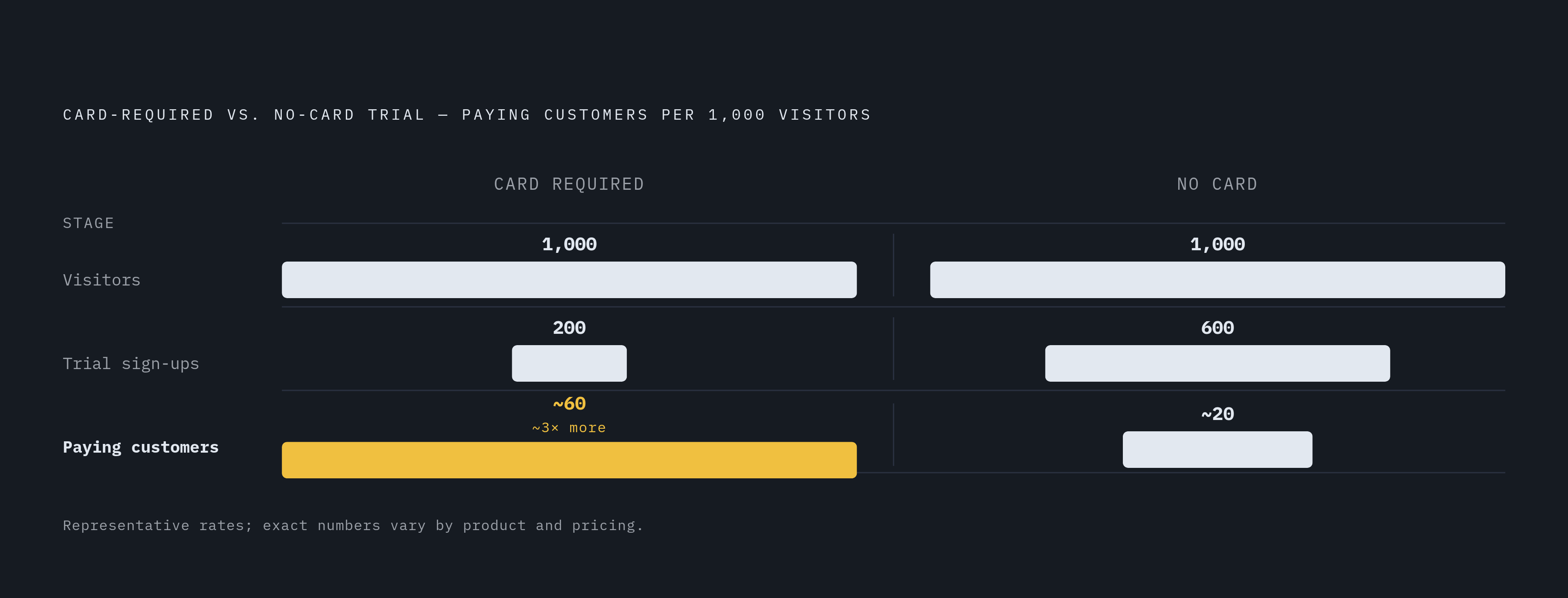
A credit-card requirement changes both the population entering a trial and the percentage that eventually pays. The same report finds that, per 1,000 website visitors, a card-required trial brings in roughly three times as many paying customers as a standard no-card trial. Requiring a card filters for purchase intent before a user consumes onboarding resources. The two funnels therefore contain different groups from the start.
For agent SaaS, that distinction has an immediate cost. Every free user running an agent burns tokens, whether or not that person ever intends to buy. More signups can mean less runway. A no-card funnel full of curious non-buyers is not free distribution when each exploration generates a bill. The gate decision needs to account for both paying customers produced from the same traffic and the cost of serving the users who never pay.
That does not make a card requirement universally right. Developer-led growth relies on making the product easy to try, so the risk that asking for payment details keeps developers from trying it at all deserves consideration. The practical choice is to match the gate to the buyer type, including enterprise buyers and developers exploring a product-led offering. Full-funnel numbers should settle that choice rather than a blanket belief that frictionless signup always wins.
Why trial length is a weaker lever than the first session
Once the gate is set, trial length can look like the next big decision. But the first session is the tighter constraint. A 30-day trial does not buy 30 days of attention from someone who disengaged by day three. It can leave the company supporting a trial after its chance to show what the product can do has passed. More calendar time does not fix an empty first encounter.
For an agent product, that first encounter fails when the agent does no real work. A configuration screen asks the user to put in work before seeing whether the agent can help. A working agent reverses that order. If the product gets categorized as “too hard” during the first session, tooltip tours, blank dashboards, and later drip emails cannot be relied on to undo the judgment.
What "time-to-value" means for an agent product and how to engineer it below five minutes
Time-to-value for an agent product ends when the agent completes a real task in the user’s actual environment. Understanding the interface is not enough, and finishing a tour is not activation. A coding agent that opens a PR gives the user something real to judge. A Gmail agent drafting a reply does the same.
To design for that moment in under five minutes, start with the user’s intent. A signup prompt such as “what are you trying to automate today?” can route the user into a pre-configured agent context. That answer gives onboarding a specific destination. Irrelevant features can stay hidden because they do not help complete the first task. The trial becomes a path toward an outcome.
The next step is autonomous setup that uses whatever context the product already has, such as the user’s domain, what they said they want to do, or a connected tool. The agent should pre-fill its first task so that the user’s first action is approving or sending. This is where the time saving becomes tangible. Rather than requiring users to translate their goal into a setup form, the product prepares a task they can recognize and assess. The agent’s work becomes the center of the session.
Progressive disclosure keeps that path short by showing only what is needed to reach activation. Multi-field setup forms belong outside the critical path when their answers are not needed for the first task. The same principle can shape the trial offer itself. An outcome-based offer such as “free premium access until you've successfully automated 10 invoices” ties the upgrade point to experienced value. It still needs a usage budget, but the promise is completed work.
Why integration friction is the hidden killer of agent trial activation
Even a short onboarding flow fails if the agent cannot use the user’s tools. An OAuth wall can stop activation before any useful work happens. Each integration needs authentication, token management, and refresh logic, and asking a trial user to configure five connections consumes the very session meant to demonstrate value. The agent’s promised outcome depends on access the product has not yet secured.
Managed authentication removes much of that burden from the builder. The user authenticates once per tool, while the platform stores and refreshes the credential so later agent calls can reuse it without another user action. Composio offers this model and advertises 1,700+ managed integrations, including Gmail, Slack, GitHub, Notion, Jira, Linear, Salesforce, HubSpot, Google Calendar, and Discord. Its tools let an agent act without the builder writing or managing the OAuth layer. That infrastructure job covers only one part of the agent product.
For trial design, the connection step belongs in signup. One live integration is the immediate goal. It gives the agent access to an environment where it can complete the activation task, without demanding every possible connection upfront. The first interaction with the agent can then focus on its action.
How usage caps and credit limits should be set to protect margin without killing activation
The token costs that shape the gate decision return as an operational constraint on usage. An uncapped trial can spend money on users who have no intention of buying, while an overly tight cap can stop a willing buyer before the product proves itself. Neither extreme serves the trial’s purpose. The cap should be above the activation threshold and below the abuse threshold.
In practice, define the task completion that predicts conversion and allow enough usage to reach it at least once. Set the cap immediately above that floor, with additional usage becoming part of the paid offer. Calendar limits cannot do this job alone. A heavy user can generate costs far beyond the trial budget within a 14-day window, because elapsed time says little about consumption.
Why per-user agent isolation is a trial feature, not just a production architecture
A trial needs to feel like access to the user’s own agent. Per-user isolation gives each person a persistent, private instance containing their files, conversation history, connected tools, and configured behavior. None of that should be visible or accessible to other users. It should also remain available when the user returns. Persistence makes the trial an ongoing working relationship with the agent rather than a session that starts from nothing each time.
Sandboxing lowers the risks that come with unrestricted shared access, and enterprise security reviewers may check isolation while they try the product. Security is part of the trial experience. A shared environment can block an enterprise deal before the agent gets a chance to show enough of what it can do.
Self-hosting isolated environments can be manageable in a small pilot, but operational cost and complexity compound as more users arrive. Managed infrastructure offers a way to avoid taking on that growing burden. For a founder without an operations background, the relevant criteria include persistent per-user environments, privacy between users, and the usage and billing controls needed to operate the trial.
Turning trial-to-paid into a repeatable motion: what to instrument and what to act on
A trial becomes repeatable when measurement centers on whether the agent completed the activation task in the first session. Time-on-site and feature clicks cannot answer that question. The conversion denominator also needs to distinguish human users from automated agent signups. Automated signups should be tracked separately and directed toward API pricing conversations.
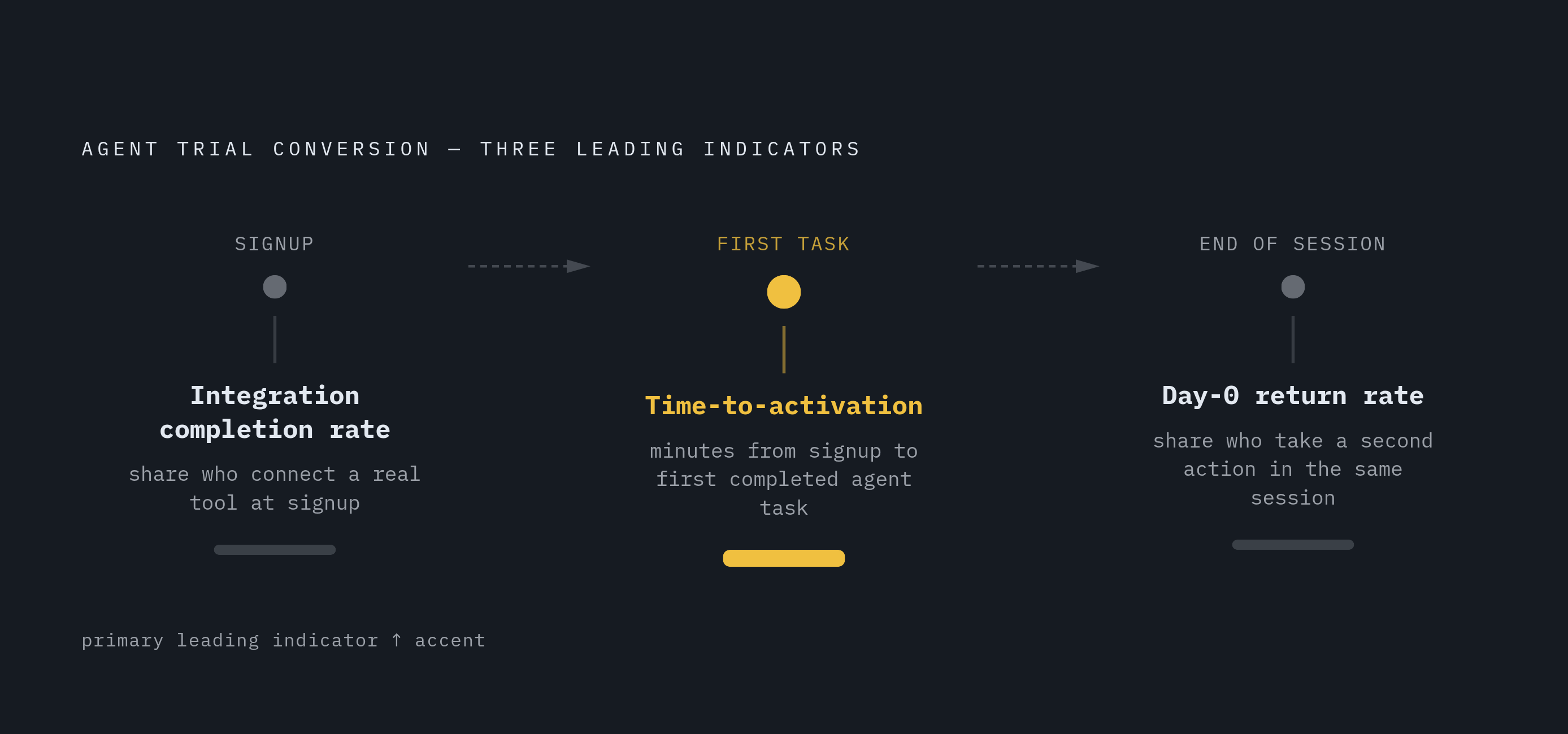
At the cohort level, time-to-activation measures the minutes from signup to the first completed agent task. It is the primary leading indicator of conversion. Integration completion rate measures the share of trial users who connect at least one real tool during signup, which indicates whether the agent has somewhere to act. Day-0 return rate measures the share who take a second action in that same first session and is correlated with whether they return at all.
The upgrade prompt should follow usage proximity to the cap. A user who has completed the activation task and is approaching the limit has a concrete reason to consider paying. A disengaged user receiving “your trial expires in 3 days” does not. Managed infrastructure can provide activation telemetry, usage tracking, and per-user billing controls at the platform level, leaving the founder to define the activation event and set the limits.
Founders who convert well get the agent to do real work for a real user before that user disengages.