Self-Hosting AI Agents Costs More Than a Server Bill When You Factor in Founder Time
Founder hours, not server fees, decide what an agent really costs.

For a solo founder who wants to deploy AI agents without software operations or infrastructure knowledge, managed hosting is usually the better starting point. Self-hosting costs more than a server bill because setup, recovery, updates, and security consume founder time that belongs in the budget. The useful comparison covers the full cost of running a production agent under each hosting option.
Why the server bill is the wrong number to budget from
One documented team moved from a prototype running on a small API credit to production costs in the thousands in month one and nearly five figures in month two. The agent worked exactly as designed. The surprise was entirely in the cost, because the prototype budget had not captured what running the agent in production would require.
A chatbot budget built around a prompt and a response does not describe an agent that plans, retrieves information, calls tools, checks results, and retries. Its cost is best measured as cost per completed task. Budgeting from the server bill misses that workload before it even reaches the question of who will operate it.
Why agentic workloads amplify token costs before you add anything else
A single agentic task is a chain of model calls. Each call includes the context built up so far, so later steps can make the model process information from earlier steps again. Multi-agent workflows compound that consumption through exchanges and review. ChatDev’s multi-agent pipeline illustrates the imbalance, with its Code Review phase consuming the majority of all tokens.
Output also changes the economics of that chain. Output tokens cost materially more than input tokens across major providers, while agentic workflows can generate long responses. A coding assistant may produce several times as much output as the already large amount of input it takes in. Meanwhile, tool-call failures and JSON parsing errors trigger retries that consume more tokens without completing more tasks. Without observability, that waste is hidden in the total.
Model choice adds another multiplier to the same workload. A customer-support task can cost roughly one to two orders of magnitude more on a frontier reasoning model than on a fast cheap tier. The quality gain needs to justify that cost gap. This is already a larger budgeting problem than a price-per-prompt estimate suggests, even before infrastructure and labor enter the calculation.
The five cost layers that never appear in the API bill
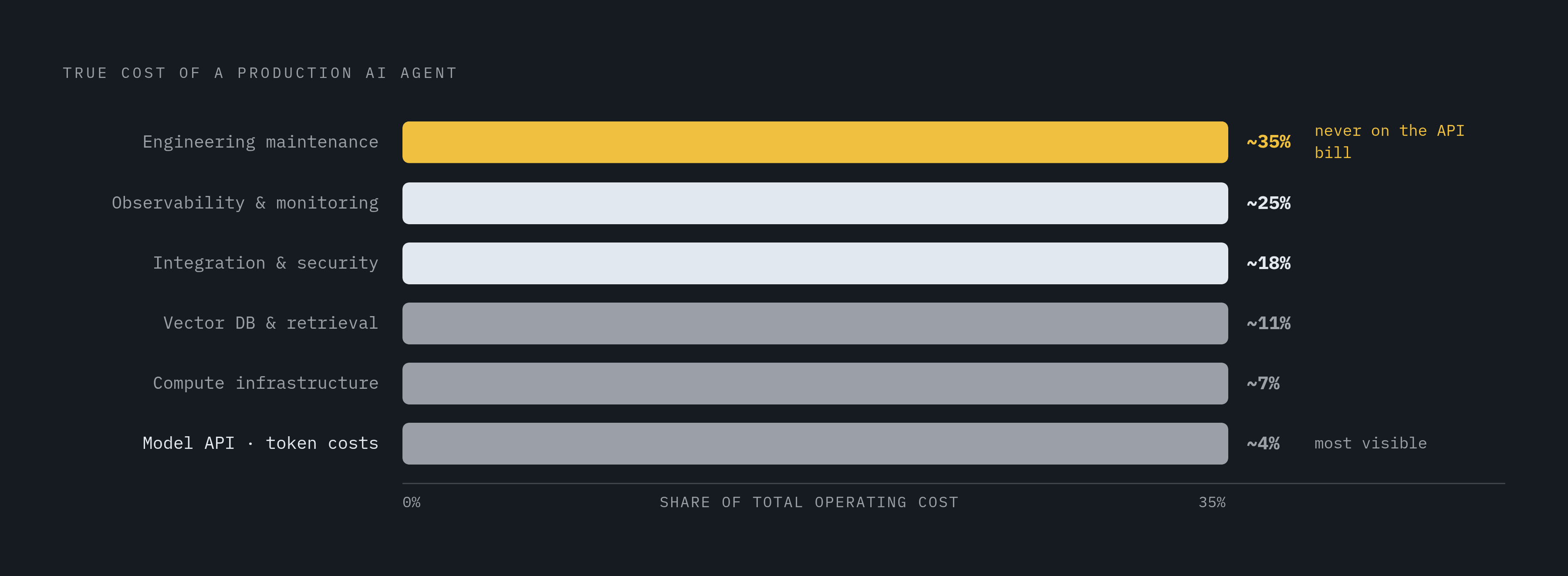
Compute infrastructure adds a running cost whether the agent is busy or idle. A self-hosted deployment pays for the capacity it has, even when that capacity does no work. Low utilization therefore inflates the effective cost of delivered compute. Idle hardware is one reason self-hosting can cost more than the API it was meant to replace.
Vector database and retrieval add another recurring layer when the agent needs stored information. The vector DB and embeddings belong in the operating budget, even if the prototype estimate counted only model calls. Retrieval is part of delivering the task. Leaving it out makes the model appear to do work that actually depends on a separately funded system.
Observability and monitoring add the cost of understanding that system after launch. Teams need an audit trail to answer who did what after an incident, as well as visibility into runaway spending. That visibility has its own recurring cost. Without it, a retrieval fault can compound costs for months before anyone understands the pattern in retrospect.
Re-sent context and redundant inference are less a separate invoice than a hidden consumption layer. System prompts, tool definitions, and state history get sent again across a multi-step workflow. APIs charge for those tokens, while self-hosted models absorb the work through GPU pressure and reduced throughput. Prompt caching can reduce it, but effective caching requires static content in the cacheable prefix and dynamic content last.
Evaluation, labeling, and QA add the human work of checking whether the agent is doing the right thing. Launch does not end that obligation. Teams still need to keep measuring and correcting the agent even when it seems to run on its own. This layer starts to expose the larger budget gap, because some of the work needed to operate the agent never appears on a technology invoice at all.
Why engineering maintenance is the biggest cost layer and the hardest to see
Engineering maintenance is often the largest or second-largest cost in a production agent stack. It includes prompt tuning, failure handling, integration upkeep, and model updates. Unlike compute, it is easy to hide in an existing salary budget. A senior engineer spending only part of their time on prompt maintenance can represent thousands of dollars per month without adding anything to the reported AI budget.
The economic cost is the work displaced. Time spent keeping infrastructure functional is time unavailable for building the product, regardless of which budget pays the engineer. A self-hosting estimate that counts all costs therefore includes platform or SRE work, a share of security engineering time, and on-call coverage. Those recurring personnel costs can dwarf infrastructure spending over a year. Complexity increases the burden even when the server rental barely changes.
What founder time actually costs when it goes into server maintenance
For a solo founder, that displaced work is especially expensive because the engineer is also the person selling and closing customers. There may be no extra salary payment when the founder handles an incident. There is still an economic cost. The relevant rate is the value of the work the founder would otherwise do.
The calculation is monthly maintenance hours multiplied by a reasonable consulting or opportunity rate, with initial setup time priced separately. Substantial setup work in month one and recurring maintenance can accumulate into thousands of dollars of engineering time across a year. Infrastructure comes on top of that amount. Depending on the hourly value and maintenance burden, founder time can exceed the entire server bill many times over.
The hours go into VPS provisioning, Docker configuration, SSH debugging, monitoring setup, incident recovery, security patching, and model updates. These tasks keep the deployment running. A working chat interface does not settle them. Engineering effort also concentrates in the runtime loop, budgets, typed terminal states, and escalation paths that make the agent usable beyond a demo.
At early-stage volume, managed hosting almost always costs less by this calculation. That reflects the fact that a founder’s time building and selling the product has a different value from time maintaining its servers.
Where self-hosting genuinely wins and where it quietly breaks the economics
Self-hosting has strong justifications when data cannot leave a controlled network, the agent must reach internal non-public services, or compliance requires execution inside an organization’s boundary. Regulated data and air-gapped environments can make control a requirement. Those are real deployment constraints. Treating them as cost optimization confuses two different reasons for choosing infrastructure.
Existing capacity can also change the calculation substantially. A mature platform team with underutilized cluster capacity faces lower incremental costs than a founder starting from scratch. A greenfield estimate does not fit that situation. Even there, the comparison needs actual personnel costs rather than an assumption that existing staff have unlimited spare time.
Privacy also depends on more than the runtime’s location. An agent on organization-controlled infrastructure can still depend on model inference APIs with their own telemetry. For early-stage teams that have no need for control and no capacity already in place to run the agent, cloud-managed infrastructure is still the better default.
The integration and security overhead that most TCO estimates skip
Every connection to Gmail, Slack, GitHub, WhatsApp, or another external service adds a maintenance obligation. Authentication upkeep, OAuth token refresh, API version changes, and per-user credential scoping all require work. Each service has its own failure modes. As the number of integrations grows, so does the number of independent authentication surfaces that someone must maintain.
Per-user credential isolation needs more than an application API key alone. The key identifies the calling application. Without per-user scoping, revoking one customer’s access can mean invalidating everyone’s access, and meaningful per-user auditing is missing. Fixing that boundary takes engineering time. It belongs in the estimate before customers depend on the integration.
Unauthorized data access can occur entirely inside the network. In one fintech example, an agent used a service account that could read every folder, allowing the wrong data to reach the wrong desk without leaving the building. Exposed self-hosted AI infrastructure can also have no default authentication, which leaves session histories open to access. Self-hosting puts the audit, controls, and remediation on the operator’s side of the shared-responsibility line, so compliance requires funded labor.
What the total picture looks like when every layer is counted honestly
The full operating picture combines model API costs, compute, vector DB and retrieval, observability, engineering maintenance, and integration and security overhead. Evaluation and labeling take ongoing human work, while redundant inference uses more of the model or compute. These cost categories overlap, so each expense needs to be counted only once.
In a fully loaded production budget, direct token costs can be a minority of the total, with maintenance, observability, and personnel taking the larger share. For founders, the useful comparison is therefore self-hosting with priced founder time against managed hosting with its all-in monthly costs. Integrations, security, and uptime belong on both sides.
At typical early-stage volumes, setup dominates the first month of self-hosting, and recurring maintenance can keep the cumulative cost gap open throughout the first year. Managed infrastructure addresses that burden by taking operating work out of the founder’s hands. Stripe shows how this work can be split. Software companies can take payments without becoming payments companies, just as founders can use infrastructure that automatically sets up an isolated, persistent agent for each customer at onboarding without becoming infrastructure companies themselves.
How to run an honest TCO calculation before the production invoice arrives
Total cost of ownership needs to be calculated before choosing a deployment, using completed tasks as the baseline. Start with the token estimate, including multi-step calls, outputs, and retries. Add compute, retrieval and storage, and observability. Then price engineering maintenance, integration setup and upkeep, evaluation, and security and compliance work at the actual cost of whoever will do it.
Founder time needs its own explicit entry in that calculation. Price those hours at the value of the founder’s highest-leverage work. Keep setup separate from recurring monthly work. This makes both the initial deployment burden and the continuing operating obligation visible without confusing one with the other.
Run the estimate for the volume expected at month-six. The budget must cover a workload that changes with the number of tasks and how complex the integrations are. Then test the real reasons for self-hosting, including controlled-network requirements, access to internal services, and compliance constraints. Existing platform staff and spare cluster capacity also belong in the comparison when they genuinely exist.
For founders without those triggers, managed infrastructure is usually the route to getting an agent in front of paying customers without taking on server operations. The objective is a deployment decision that prices the founder’s time before maintenance takes it away from building and selling the product.