OAuth Credential Management for Hundreds of Agent Users
Shared OAuth credentials break at scale through confused deputies, token drift, and audit gaps.
Advertisement
A single OAuth connection works fine when one user is running an agent. Scale that same setup to hundreds of users, and the credential model doesn't bend, it breaks, in three predictable ways at once: confused deputy risk, token drift, and audit gaps that leave no way to trace who did what.
Here's why this happens on a schedule, not by accident, and what a credential architecture that actually holds looks like once the user count climbs past a demo.
Where the shared-credential model falls apart
Most agent platforms start life with one OAuth connection or a single service account. That's the right call early on: fewer moving parts, faster to ship, and fine for a handful of internal testers. The trouble starts when that same credential gets asked to serve hundreds of people at once, because nothing in that setup was built to draw a line between them.
Confused deputy risk appears first in agent authorization. An agent authorized under User A's session can end up acting on User B's behalf, simply because nothing checks identity at the moment of execution. That's not a hypothetical edge case, either: indirect prompt injection can trigger this directly, feeding an agent instructions that exploit the missing boundary.
Token drift follows close behind. Refresh tokens rotate, scopes get changed upstream, and stored credentials go stale without anyone noticing, because nothing is watching for it. The agent just keeps running until a 401 error finally surfaces, and by then, retries are already cascading and destabilizing whatever background tasks were mid-flight.
Then there's the audit gap. When every action an agent takes traces back to one shared identity, there's no per-user chain of custody. Nobody can reconstruct, after the fact, what the agent actually did and for whom. For any team that has to answer to a security review or a customer asking "what did your agent touch in my account," that gap isn't a minor inconvenience, it's a wall.
Obsidian Security found that 90% of agents carry more privilege than their actual workflow needs. Shared credentials make that number worse, not better, because the scope gets set for the broadest possible use case across every user, not the narrowest task any one of them actually needs done.
OAuth for agents functions as long-lived delegated authority rather than a login flow. It's long-lived delegated authority. Access tokens expire and refresh tokens rotate, but the agent keeps acting well after the person who kicked off the session has logged off, closed the laptop, and moved on with their day. That distinction is the right frame for everything that follows: this is a persistent grant of authority, not a momentary handshake.
None of this is prescriptive yet. It's just naming the failure modes precisely enough that the rest of this piece reads as their fix.
The three OAuth flows agents use in production and when each applies
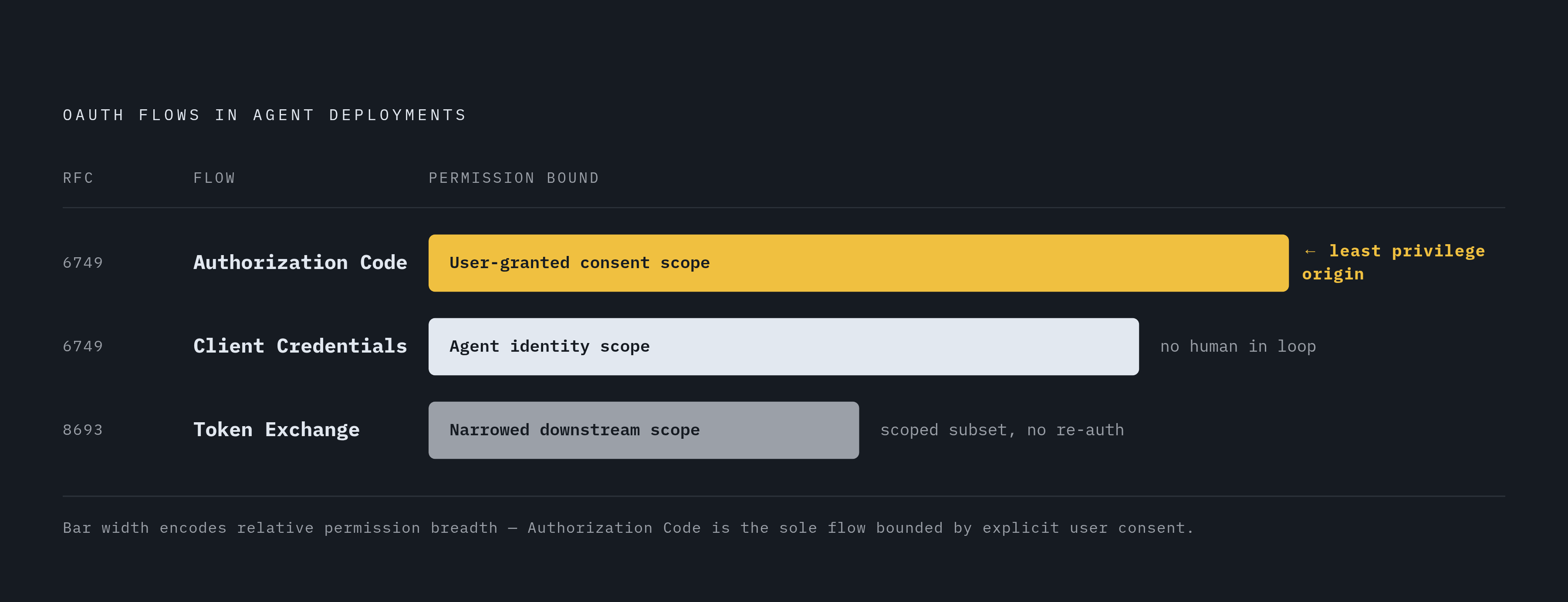
Production agent platforms lean on three OAuth flows, and picking the wrong one for the job isn't a minor implementation detail, it determines whether permissions stay properly bounded or quietly balloon. Scalekit's production architecture guide identifies those three as Authorization Code, Client Credentials (both RFC 6749), and Token Exchange (RFC 8693).
Authorization Code flow is the user-delegated case. The agent acts on behalf of a real, authenticated person who explicitly consents on a provider's screen, and both the access and refresh tokens tie back to that specific user, not to whoever operates the agent platform. This is the flow behind reading a Slack channel's history, posting a message as a user, pulling files from Google Drive, or reviewing a GitHub pull request. The defining property here matters: the agent's permissions are bounded by exactly what the user granted at consent. This is where least privilege actually starts, at the moment someone clicks "allow."
Client Credentials flow covers agent-to-server calls with no human in the loop at all. The agent authenticates using its own registered identity and gets back a scoped access token. Standard implementations skip the refresh token entirely, so the agent just re-authenticates once the token expires. This matters beyond convenience: the Model Context Protocol specification (version 2025-11-25) mandates OAuth 2.1 for remote MCP server authentication, and this is the flow it uses. SecureW2's June 2026 guidance states that OAuth 2.1 tightens things up by dropping the implicit grant and resource owner password credentials entirely, and it makes PKCE and HTTPS mandatory across every flow.
Token Exchange, defined in RFC 8693, handles the case where a workflow orchestrator needs to call downstream APIs without re-authorizing the original user each time. It preserves least privilege as authority moves across service boundaries, letting a scoped, narrower token get issued for the downstream call instead of just forwarding the original one.
For most production agent deployments in 2026, OAuth 2.1 is the sensible default. It folds in the security lessons of 2.0 and happens to be a hard requirement for MCP compliance anyway, so there's little reason to build against anything older.
How token storage and refresh architecture determine real security posture
Picking the right flow only gets an operator halfway there. The core rule in any multi-tenant system: tokens have to be encrypted at rest, isolated per tenant, and never written to a log file. Skip any one of those three, and the flow choice above stops mattering.
Refresh timing deserves its own scrutiny. Waiting for a 401 to trigger a token refresh sounds simple, but in practice it creates race conditions, and once a few requests start retrying at the same moment, background execution destabilizes fast. Agents running unattended across hundreds of users will hit token expiry in clusters, not one at a time, so a reactive refresh strategy produces exactly what infrastructure engineers call a thundering herd: everyone hammering the token endpoint at once. Proactive, coordinated refresh is a baseline design requirement here. It's a baseline design requirement.
Isolation has to go deeper than "separate database rows," too. Each user's or tenant's token store needs to be logically isolated, and ideally physically isolated as well. Tokens should never appear inside an LLM's context window, inside agent prompts, inside task files, inside a committed manifest, or inside anything the agent generates as output. The right mental model: treat credentials as runtime configuration that gets injected at the moment of execution, never as content the agent is capable of reading or repeating back.
Storage controls alone don't close every gap, though. Standard bearer tokens can be stolen and replayed by anyone who gets a copy, no matter how well they're encrypted at rest. Token binding closes that hole. Under RFC 8705, an authorization server binds an access token to the TLS client certificate presented at issuance, and the resource server checks that certificate's fingerprint on every request. DPoP offers a similar guarantee in setups where mutual TLS isn't practical to run. SecureW2's June 2026 analysis states that mTLS is the right call for infrastructure-layer mutual authentication in controlled environments, and static API keys have no business running in production agent deployments at all.
Boiled down, the non-negotiables look like this: a per-user token vault, automatic refresh handled proactively, encryption backed by a KMS or HSM, hard isolation from anything the LLM can see, and audit trails built on a standard observability framework that can actually answer "what happened" after the fact.
Four design principles that enforce least privilege at the scope and action level
These four hold regardless of which platform or framework ends up in the stack. They're architecture decisions, not features a vendor bolts on later.
Scope minimization comes first. Every token should carry exactly the scopes the task at hand requires, nothing broader. An agent that only needs to read files has no business holding an admin:* scope just because it was convenient to grant at setup. This is precisely how that 90% over-privilege figure from Obsidian Security becomes the default state rather than the exception: shared credentials get provisioned for the widest need across every user, and scope creep just accumulates from there.
Just-in-time privilege elevation is the second piece. Permissions should elevate only when a task genuinely needs them, and the token granting that elevated access should expire the moment the work finishes. Anything sensitive, anything with real consequence, should trigger a step-up authorization check rather than running on whatever ambient privilege the agent happens to be carrying.
Human-in-the-loop approval for irreversible actions is the third, and it's the one that costs money to skip. Moving funds, deleting data, sending an email to someone outside the organization: these are actions where a mistake can't be undone by rerunning the task. Production agents need runtime policy hooks that pause execution and surface a real consent prompt before anything irreversible fires. This isn't optional hardening, it's the floor.
Two-identity modeling with delegated context rounds things out. Arcade's 2026 analysis lays out the durable pattern well: agent identity, user identity, and task-specific authorization context, all evaluated together at the moment the action runs. Where authorization actually gets enforced is the real question about any agent platform. Gateways and wrappers connect agents to tools, sure, but the runtime is the actual control point, the place where credentials get resolved, permissions get checked, and the tool call either executes or doesn't.
A fifth principle underlies all four: audit trail as a baseline expectation, not an add-on, because every action needs a per-action record complete enough to feed a SIEM, support an incident response, or survive a SOC 2 review without gaps. Every action needs a per-action record complete enough to feed a SIEM, support an incident response, or survive a SOC 2 review without gaps.
How sandbox isolation extends credential security to the execution environment
OAuth architecture alone can't close every door. An attacker can publish a malicious MCP tool that looks entirely legitimate on the surface but carries hidden instructions that fire the moment an agent invokes it. Without a sandbox around that execution, the malicious tool inherits whatever the agent's process can already touch: broad filesystem access, environment variables holding live API keys, and network reach into internal services that were never meant to be exposed.
Per-user sandbox isolation is the natural complement to per-user credential isolation, and the two need to be designed together, not bolted on separately. Each sandbox has to be scoped to a single agent or a single user, with state that persists across turns so the agent keeps its working context without ever needing credentials reloaded into the prompt to "remember" where it was.
A production-grade sandbox setup needs a specific list of capabilities:
- Multi-tenant isolation, enforced per-agent or per-user, not shared
- A pre-warmed pool of sandboxes so allocation doesn't add latency to every task
- Support for pausing, resuming, and snapshotting a running sandbox
- Scale-to-zero behavior once a sandbox sits idle or times out
- An immutable audit log covering every network request, every shell command, every file write
- Outbound network filtering that restricts by default, opening only an explicit allowlist for the specific APIs the agent needs
An agent writing a Python script has no legitimate reason to reach out to an unknown IP over port 443, and a sandbox that allows it anyway is a sandbox that isn't doing its job. An agent writing a Python script has no legitimate reason to reach out to an unknown IP over port 443, and a sandbox that allows it anyway is a sandbox that isn't doing its job.
Credentials inside the sandbox follow the same rule laid out earlier: runtime configuration, never prompt content. They shouldn't appear in user prompts, agent instructions, task files, committed manifests, or anything the agent generates. For teams building this themselves rather than buying it, Agent-Sandbox is a self-hosted, open-source reference worth knowing: it wraps a Kubernetes foundation behind a RESTful API and an MCP server, borrowing lifecycle and API patterns from other sandbox projects in the space.
The agent identity infrastructure that makes per-user isolation manageable at scale
2026 brought two infrastructure moves that turn agent identity from a problem every operator solves alone into something with real platform support.
Microsoft's Entra Agent ID reached General Availability in April 2026, built specifically for non-human identities rather than adapted from human login systems. It extends the same Zero Trust pillars, authentication, authorization, governance, lifecycle, through standard OAuth 2.0, MCP, and A2A protocols. Agents authenticate through Federated Identity Credentials, or through certificates and client secrets, issued by what Microsoft calls an "agent identity blueprint." Agents don't log in the way people do, and Entra Agent ID is built around that reality rather than adapted from human login systems.
MCP itself moved in June 2026, too. Enterprise-Managed Authorization went from an experimental feature to production-grade, stable as of June 18, 2026, and a subsequent spec update on July 28, 2026 formalized it further alongside other protocol changes. Taken together, these updates push MCP away from being just a tool-calling API and toward something closer to a full agent operating system.
AWS has its own answer in Amazon Bedrock AgentCore Identity, available as a standalone service. It implements the Authorization Code Grant, the three-legged OAuth flow, with secure session binding and scoped tokens, and it's built to work whether the agent runs on ECS, EKS, Lambda, or on-premises infrastructure.
What all three platforms share: a central place to watch agent behavior, revoke credentials without touching a line of agent code, and enforce governance policy across every non-human identity in the system. What none of them hand over by default is the execution runtime itself, or the per-user credential vault that any multi-tenant agent product actually needs day to day. That piece stays the operator's job, unless a dedicated agent authentication platform is brought in to own it.
Comparing the dedicated agent authentication platforms operators choose
Arcade's July 2026 analysis lays out the right criteria for judging these platforms: where authorization actually gets enforced, how credentials get managed, how consent and approvals work, how tools execute, what the deployment model looks like, and how strong the auditability is for compliance purposes.
The question that separates these platforms from each other is simple to state and hard to answer from a spec sheet: does the platform enforce authorization at execution time, using the full picture of user, agent, tenant, resource, scope, and task together? Or does it hand an operator identity, policy, SDKs, and gateways, and leave the wiring-together as homework?
Arcade supports managed cloud, hybrid or private MCP servers, VPC deployment, air-gapped environments, and enterprise self-hosting on Kubernetes. Credentials run through a per-user OAuth token vault with automatic refresh, plus secrets management for custom tools built on API keys. Authorization gets enforced at runtime, checking the intersection of user, agent, and delegated context before any tool call executes. Tool execution is hosted, with agent-optimized tools and governed MCP gateways. Arcade's own July 2026 analysis rates itself best overall for production multi-user autonomous agents in 2026, and this is notable since Arcade is also the source of this comparison framework.
Composio runs on managed cloud with SDKs, a CLI, MCP clients, and both remote and local sandbox options. Credentials work on a two-piece model: an auth config as a reusable template, and a connected account as the specific user's actual credential. Authorization enforcement happens at the session and tool level. The integration catalogue is large by any measure: 1,089 toolkits as of August 11, 2026, exposing more than 20,000 individual tools, all reachable through a single MCP endpoint. The recommended path for 2026 is hosted authentication through Connect Link: generate a link, the user signs into the service directly, and Composio takes over storing the connected account plus handling refresh and lifecycle from there. WhatsApp integration runs through a managed OAuth app tied to WhatsApp Business accounts specifically (personal accounts aren't supported), covering sending, fetching, automated replies, and contact management. Framework support is broad: OpenAI, the OpenAI Agents SDK, Anthropic, the Claude Agent SDK, LangChain, LangGraph, LlamaIndex, CrewAI, Google ADK, Mastra, and the Vercel AI SDK. A 2026 expansion added custom-actions support, letting teams wrap internal APIs in the same managed auth and execution layer used for the built-in integrations. Arcade's analysis places Composio's best fit at individual use cases and rapid prototyping across many apps; Composio's own materials frame it around agent-native tool calling with production reliability, managed auth, permission scoping, and wide framework compatibility.
AWS AgentCore is fully managed and AWS-native from top to bottom. Credentials flow through IAM, OAuth, on-behalf-of flows, secure credential exchange, and AWS's own credential services. Authorization enforcement leans on AWS-native identity and gateway security policies across the AgentCore service family, and tool execution runs through a managed gateway that turns APIs, Lambda functions, and other AWS services into MCP-compatible tools. The clear best fit: teams already standardized on AWS infrastructure who'd rather stay inside that ecosystem than integrate a separate vendor.
Nango offers both cloud and source-available self-hosted deployment. Credentials are managed per-connection, covering OAuth and API-key-based credentials with managed refresh handling built in. The operator still owns the intersection of agent and user permissions rather than getting that resolved automatically at runtime, since authorization enforcement sits at the integration level. That makes Nango a fit for teams that want strong integration-layer credential handling but are prepared to build the authorization logic connecting agent, user, and task themselves.
Sources
- 7 Best AI Agent Authentication Platforms (2026) | Arcade
- OAuth for AI Agents: Production Architecture and Practical Implementation Guide
- OAuth for AI Agents: A Practical Implementation Guide
- MCP Authorization: OAuth 2.1, PKCE, and Agent Identity | Aembit
- AI Agent Credential Management | Obsidian
- Secure AI agents with Amazon Bedrock AgentCore Identity on Amazon ECS | Amazon Web Services
- Multi-User AI Agent Auth: OAuth & MCP Guide | Arcade.dev