Billing Controls and Spend Alerts for Agent Workloads
Runaway agent costs require enforcement during execution, not alerts after the fact.

Advertisement
Visibility is not control. That distinction is at the center of nearly every runaway cost incident involving AI agents, and it explains why teams with dashboards, Slack alerts, and provider spend caps still wake up to bills they never authorized. A billing alert is a record of money already spent. A dashboard is a record of money already spent. A provider-level cap, even a well-configured one, only matters once accumulated spend reaches a threshold someone set in advance. None of these mechanisms can reach into a running process and refuse the next API call before it fires.
A documented incident involving a LangChain research pipeline shows how this plays out. The team had a live Helicone dashboard tracking spend in real time, Slack alerts wired at multiple thresholds, and a provider-level spending cap on the OpenAI account set at $50,000 for the entire account. Every piece looked like a safety net. The cap never fired, because accumulated spend reached $47,283, just under the $50,000 ceiling, so by the letter of the configuration, nothing had gone wrong yet. The loop kept running anyway. Engineers eventually stopped it by force-terminating the LangChain worker pods directly, because nothing in the monitoring stack was built to do that for them.
The dashboard told part of the story, but not the part that mattered most. It showed total spend climbing, and roughly 70% of that spend turned out to be retries of the same failed tool call. The aggregate number looked like usage. It was actually a loop failing to resolve itself, over and over, at full price each time. That is the gap this piece is about: attribution inside a dashboard is not enforcement, a correctly configured cap is not the same as a system that can say no mid-run, and the entire category of tools most teams reach for first, alerts, dashboards, monthly limits, is built to describe the past, not to govern the present.
How agent workloads turn small inefficiencies into large bills
Agent workloads break the cost intuition most teams carry over from traditional software. A single customer-facing task doesn't trigger one inference call and stop. It reasons, calls tools, re-reads context, waits on results, and often retries several times before finishing, or failing. That structure means a small inefficiency at any one step doesn't just repeat, it compounds across every step downstream of it, and it compounds again across however many tasks are running in parallel. A cost spike in an agent system is usually the expected output of a loop that isn't resolving the way it was designed to.
The clearest version of this is the retry amplifier. A tool call fails. A retry policy kicks in. The retry fails too, so the agent routes the problem back upstream and asks for "a clearer version" of the input, which triggers another full pass through planning and tool use. Each step in that chain is priced in cents. The aggregate, run across a queue or a fleet, is priced in thousands. A handful of model calls, a few web searches, and several failed retries at the same model rate can push a single task to a meaningful cost on their own, something barely noticeable in isolation but dangerous once multiplied across many runs, many queues, or many tenants sharing the same budget.
Prompt bloat makes the retry amplifier worse without adding a single extra retry. A large context window means every retry carries more accumulated tokens than the one before it, since the agent typically re-reads prior context before trying again. Spend accelerates even when the retry count stays flat, purely because each attempt is more expensive than the last.
These same structural weaknesses don't stop at cost. A lead follow-up agent that receives the same webhook three times, with no deduplication check in place, will write three CRM notes, send three texts, and create three tasks for a single lead. The API charge for that mistake might be pennies. The hours spent by a human cleaning up duplicate records, and the trust cost of a customer getting the same text three times, are harder to put a number on, but they're real costs all the same. Retry storms, prompt injection that forces unnecessary tool calls, and poorly scoped permissions all share a root cause: nothing in the system draws a line between what the agent is allowed to attempt and what it has already attempted. Cost control and security posture turn out to be the same problem, approached from different directions. Both get solved, or fail to get solved, at the same layer: before and during execution, not after.
What provider-level controls give you
Credit where it's due: provider-level cost controls got meaningfully better in 2026. The gap that remains is a structural limit on what a monthly boundary can ever do for a system that spends money step by step, in real time, across tools the provider doesn't see, not a failure of effort from OpenAI, Anthropic, or Google.
OpenAI shipped hard monthly spend limits for organizations and projects on July 22, 2026, and followed with API-key filtering and grouping in the Usage and Costs dashboards and APIs on August 4, 2026. The two features work together in a useful way: a key attributes cost to a specific workload, while the project and organization levels enforce the actual stop. A project breach returns the error code project_spend_limit_exceeded; an organization breach returns organization_spend_limit_exceeded. Both arrive as an HTTP 429, which looks identical at first glance to a rate-limit 429, so an application has to distinguish between the two to respond correctly. For a team running a single agent, the clean setup is one dedicated project paired with one dedicated key. That makes cost visible without guesswork, and it caps the blast radius of a runaway loop at the project's budget. OpenAI is explicit that even this enforcement isn't instantaneous. The API can process a small amount of extra usage while the limit state propagates, so recorded spend can slightly exceed the configured amount.
Anthropic's contribution came through the Enterprise Analytics API, launched in February 2026, which added per-user attribution: named user consumption, individual token and cost data, and engagement patterns including Claude Code sessions. The limitations matter as much as the feature. There's no per-request granularity, engagement data carries a three-day delay, and access is restricted to enterprise-tier accounts. That combination makes it a finance reporting tool built for retrospective review, not something a running agent can check against before its next step.
Google Cloud's Gemini platform added consolidated spend guardrails: hard monthly caps on AI spend and projects, cost estimation for agent runtime, and detection of sudden budget spikes before they hit an invoice. A deferred execution pricing option for eligible agent workloads during off-peak windows was listed as coming soon at launch and has since entered Preview, as of September 2, 2026.
Each of these is a genuine improvement over what existed before. None of them solves the problem that actually matters for a multi-model agent stack: a project cap on OpenAI has no visibility into spend happening on Anthropic, on Google, on a paid search API, or on any other tool the agent calls mid-run. Cross-provider budget enforcement remains unsolved for any team running more than one model provider, which describes most production agent stacks today. A monthly ceiling at the organization level is a useful backstop against catastrophic loss. It is not, and cannot be, the same thing as a system that refuses a single step inside a loop that's already running.
The enforcement layer that provider controls and dashboards cannot replace
Spend has to be stopped while a run is still active, and that requires a layer that sits between the agent and the provider endpoint, checking every request against a set of rules before it goes out, and refusing to forward the ones that break those rules. That layer is what provider dashboards, monthly caps, and after-the-fact alerts cannot provide, because all three only describe what already happened.
A single master dollar cap, even a well-chosen one, fails late by design. By the time total spend crosses an alerting threshold, the agent may have already burned through a dozen retries, filled its context window with junk state from a half-finished task, or escalated to a more expensive model without anyone deciding that was appropriate. A production agent needs several controls working together, not one number watched from a distance: token ceilings on both a per-call and a cumulative basis, limits on how many model calls a single task can make, limits on how many tool calls it can issue, retry budgets tied to the specific class of failure it just hit, and a monetary cap sitting as the outermost boundary behind all of it. No single one of those controls catches everything. Together, they catch the failure early enough that it never reaches the dollar amount that would otherwise trigger an alert.
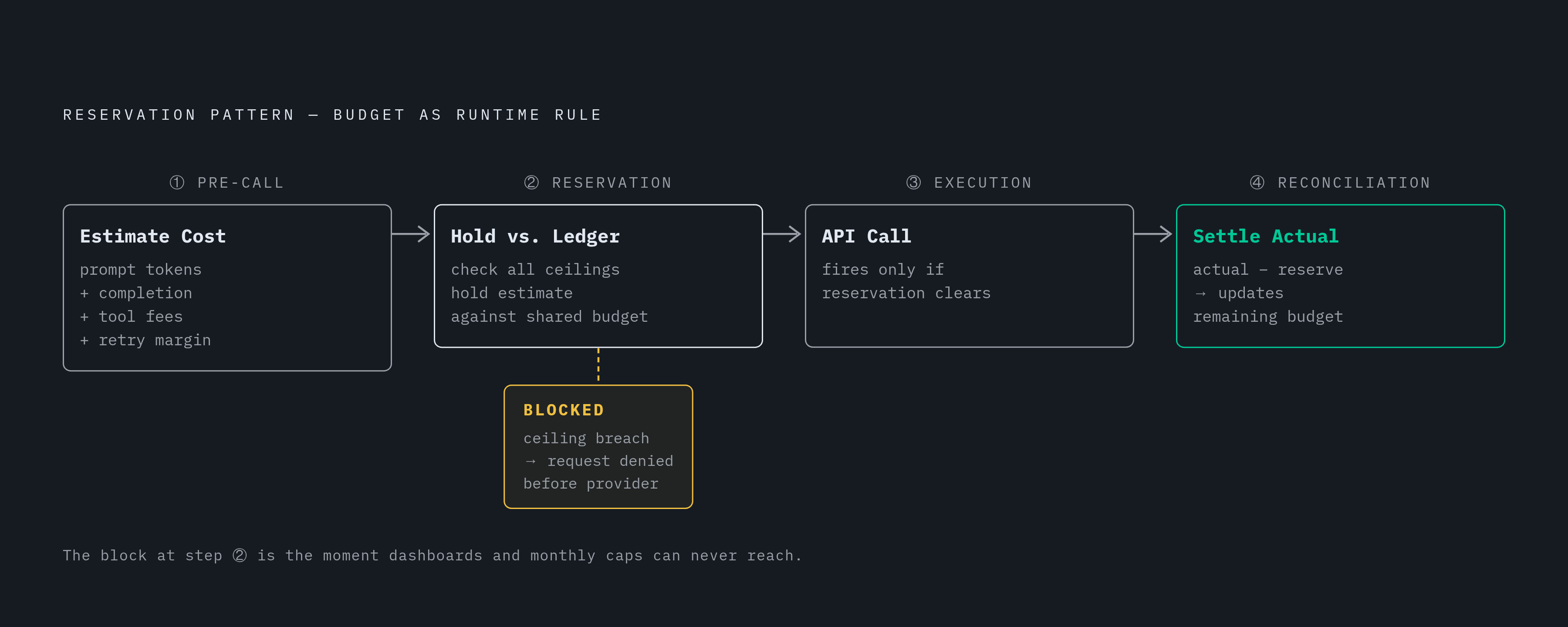
The mechanism that makes this practical is a reservation pattern. Before any step runs, a central budget manager estimates what that step is actually going to cost: prompt tokens, expected completion tokens, any tool fees involved, and a margin for likely retry exposure. It creates a reservation against a shared cost ledger for that estimate, and if the projected call would breach any of the ceilings in place, the request gets blocked before it's ever sent to the provider. Once the call completes, actual usage gets reconciled against that reservation, and the difference updates the budget that remains. Reserve before the call, reconcile after it. That two-step discipline is what turns a budget from a number on a dashboard into a rule the system actually obeys in the moment it matters.
Money alone isn't the only thing worth capping. Every deployed agent needs two budgets running in parallel, not one. A money budget limits what the agent can spend with providers. An action budget limits what the agent can do to customers and business records before a person has a chance to review it. A spending cap with no operating boundary next to it only limits how expensive the confusion gets, it doesn't stop the agent from sending the same customer three duplicate texts for free. Action budgets look like concrete, countable limits: a maximum number of follow-up attempts per customer, a maximum number of CRM records a single run is allowed to create, a maximum number of retry attempts before the job lands in a human-review queue instead of continuing on its own. The single most important primitive inside an action budget is a deduplication check: before repeating an external action, the agent has to prove that action hasn't already succeeded. A retry should resume a job that's already in flight, not spin up a new one next to it.
Five further controls round out a production architecture built this way. Bounded plans give a run a defined step structure before it starts, rather than letting the agent improvise its own path indefinitely. Scoped retrieval limits context to what the current step actually needs, instead of pulling in every related document on the chance it might help. Model routing sends each step to the cheapest execution path that can reliably handle it, reserving expensive models for the steps that actually require their judgment. Deterministic checks run rules and formulas as ordinary code instead of paying a language model to evaluate a date range or a required field, which is usually both more expensive and less reliable than a function call. Outlier alerts fire on variance from a workflow's expected cost, not only when total spend crosses some monthly ceiling.
When none of those controls can get the next step done safely within what's left of the budget, the correct response is to stop cleanly. End the run, return whatever partial work exists, state what remains undone, and surface the reason for the stop to whoever owns that workflow. Partial work with a clear stop reason attached is worth more than an expensive run that stalls out halfway through with no explanation. A run that ends this way leaves behind a signal someone can actually use. A run that just stops leaves behind nothing but a confusing bill.
Useful cost observability once enforcement is in place
Once runtime enforcement is handling the actual stopping, the job of a dashboard changes completely. It's no longer the last line of defense against a runaway loop; the reservation checks and action budgets running underneath it handle that job now. The dashboard becomes a tool for finding which steps in a workflow waste money, which categories of documents drive expensive retrieval, and which retry patterns point to a design flaw worth fixing. That's a product feedback loop, not a monthly financial review.
Useful cost observability goes well beyond a single token count. A reviewer should be able to open any individual run and see cost broken down by step, classification, extraction, retrieval, validation, calculation, synthesis, see which model handled each one, how much context got pulled in, which tools got called, and which deterministic checks ran in place of a paid model call. Attribution tied to business objects is what turns that into a decision tool rather than a report: cost per completed task, per customer, per document type, per workflow, not simply cost per month. If one document type is driving expensive retrieval, the fix is to scope retrieval tighter for that type. If one rule keeps creating ambiguity the model has to reason through, the fix is a deterministic check that removes the ambiguity. If one step keeps routing to an expensive model for work that doesn't need that much judgment, the fix is to route it down. None of those fixes are visible in a monthly aggregate number. They only show up once cost is broken apart by step and by business object.
A useful alert looks different from the generic "usage exceeded" notification most teams start with. A useful cost alert names the workflow involved, states the last step that completed successfully, identifies the step that's repeating or failing, and says whether the agent already paused itself. That gives the person receiving it an actual choice: resume the run, leave it paused, or hand the rest of the queue to a human. Magnitude alone isn't the signal to watch. Variance is. An outlier alert that fires when a run exceeds the expected cost for its workflow type catches something a simple dollar threshold misses: the expensive run is usually a run where the agent wandered off course, retried something it shouldn't have, or reached for the wrong tool before eventually finding its way back.
How these controls change for per-customer agent instances
Everything above holds for a single agent running inside one team's infrastructure. The requirements shift again once that agent becomes a product delivered to many customers at once, each one expecting their own instance to behave independently of everyone else's.
At single-agent scale, a monthly project cap paired with a hand-wired retry limit can be enough to keep spend under control. At multi-tenant scale, that same setup creates a shared failure point: one runaway tenant can exhaust a budget meant to cover everyone, degrading the experience for every other customer on the platform at the same time. Per-user quota enforcement stops being optional at that point. It becomes the minimum viable architecture for running the product.
The right unit of isolation is one dedicated, persistent agent instance per customer, provisioned automatically the moment that customer onboards. That containment keeps each customer's spend, action budget, and failure state inside its own boundary, so a problem in one customer's session never reaches into another's. An AI agency managing multiple client accounts is a clear example of why this matters commercially, not just technically. Giving every client a dedicated project and key, each carrying that client's approved monthly project limit, lets the agency see exactly which credential generated a given bill and stops one client's campaign from quietly eating into the margin reserved for every other account. A contract that promises a fixed AI allowance means something when a technical boundary enforces that allowance in real time.
One decision has to be made before any of this goes live, not after an incident forces the question: when a limit is reached, does the system pause the work, request approval before continuing, or quietly degrade the service instead? Each of those is a defensible choice depending on the product and the customer relationship. What isn't defensible is leaving that decision unanswered until a customer, or a client, is the one who discovers the answer by accident.