From Working Agent to Paying Customer Without Touching a Server
Solo founders can ship agents to paying customers without ops work.

A solo founder can deploy AI agents without DevOps or infrastructure knowledge by using a managed delivery platform that handles persistent execution, customer isolation, credentials, recovery, and automatic onboarding. The gap between a working agent and a paying customer is operational.
Why "it works on my laptop" is not the same problem as "every customer has their own instance"
Building an agent prototype has become cheap and fast, but running a service for customers still takes work. A terminal session proves that an agent can perform a task under the conditions of that session. It does not prove that the agent can run unattended overnight, survive a restart, or recover from a half-finished job. Those are different tests of the product. They become unavoidable when dozens or hundreds of customers need separate instances running at once.
The change is bigger than the number of users. Agents now do more than answer questions: they write to databases, send emails, move money, and file tickets. They also run on schedules, with no one watching each step. Failure now reaches beyond an unfinished conversation. Platforms that handle prompting, orchestration, and tool-calling solve agent creation, but those capabilities alone do not provide durable execution or a record that security teams and auditors can follow.
What the gap actually contains — the five operational jobs between working and shipped
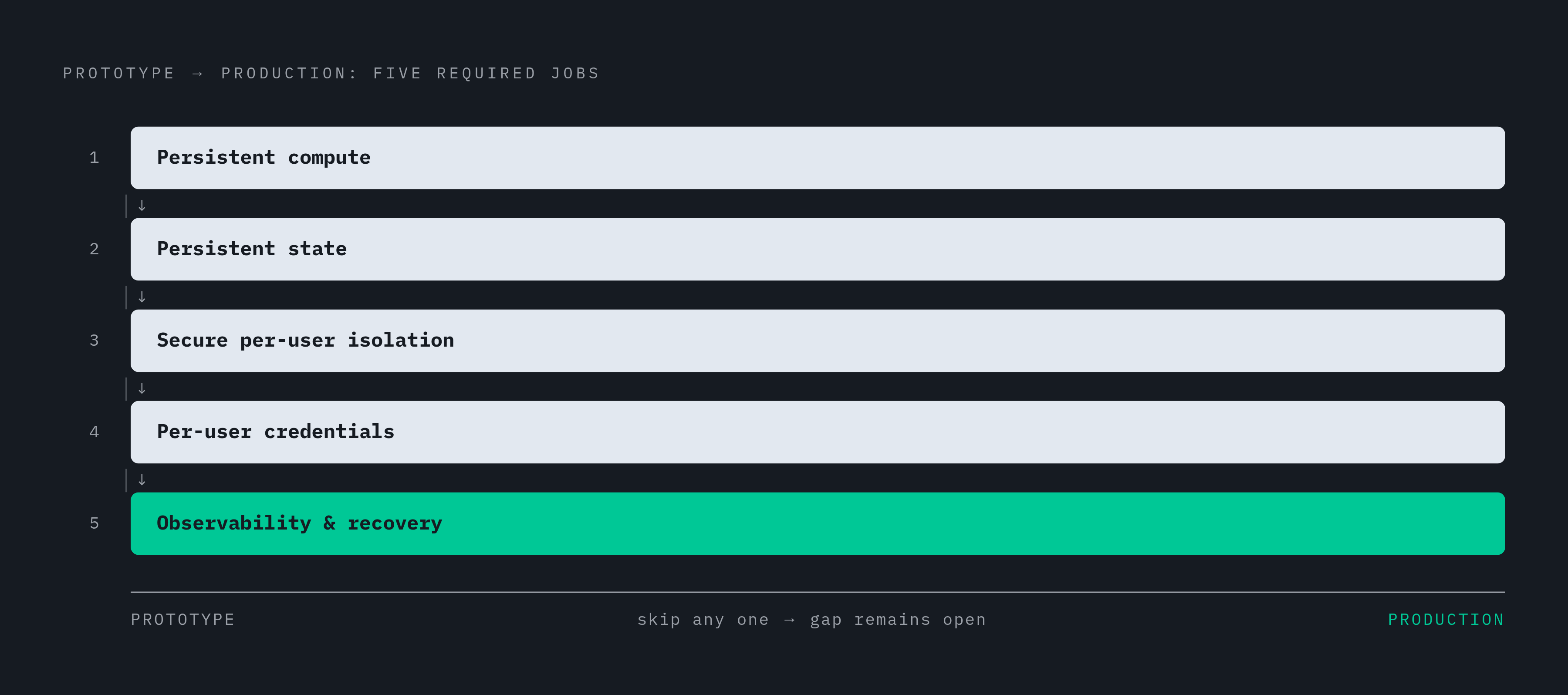
The first job is compute that stays alive. A production agent cannot depend on an open terminal or a virtual machine that sleeps when it becomes idle. Work that runs for a long time, scheduled tasks, and recovery from a task that stops halfway through need a runtime that keeps the agent running as a persistent service. Starting a process is only the beginning. Keeping it available when things fail is part of running it.
The second job is persistent state, including conversation history, reports, contracts, and code artifacts that survive redeployment. The third is secure per-user isolation, which keeps one customer's data and execution context out of another's session. Storage and isolation solve different problems. Saving every file does not help if the wrong customer can reach it, and an isolated environment is incomplete if it loses the work it was supposed to protect.
The fourth job is integration credentials tied to each user in place of a master secret shared by the whole product. Each customer needs scoped, revocable access to their own accounts. The fifth job, observability and recovery, involves knowing where a task failed and whether it can resume from that point. A running process is not enough evidence. When an agent fails silently at 3am, the builder needs more than a machine-level status saying that the server is available.
Why the agents builders are deploying today make each of these jobs harder
Claude Code runs its loop inside an engineer's shell, supports sub-agents working in parallel, and provides a GitHub Action that turns that loop into a hosted CI worker. Running work in these ways takes persistent state, enough capacity for parallel execution, and credentials for the tools being used. More capability means more operational surface to manage. The infrastructure has to support the work the agent can initiate.
OpenAI Codex cloud runs tasks in isolated containers, so work can run in parallel and people can review it before merging the pull requests it produces. Code execution raises the isolation requirement. Firecracker microVMs and gVisor provide sandbox boundaries, while deploying an ordinary container alone does not settle that question.
An agent connected to Gmail, Slack, GitHub, and a CRM holds credentials attackers want, and every connection needs its own scope and audit controls. Parallel execution makes the combination of credentials, state, and independent work harder to manage by hand.
What the integration layer demands before an agent can act on a customer's behalf
Tool access creates two separate scaling problems. The agent needs to find the actions it can take without loading every tool definition into its context, and it needs permission to act for the right customer. Loading GitHub and Notion as regular MCP tools already consumes tokens before the user says anything. That approach becomes unwieldy across hundreds of applications. Composio addresses discovery through a meta-tool architecture and a single MCP endpoint, so the agent can find what it needs without loading everything upfront.
Composio also manages authentication through per-user “connected accounts” that store OAuth credentials. The builder does not have to handle each token directly. Each customer grants scoped access that can be revoked independently of everyone else's access. This is not just a convenience during setup. It sets whose account the agent is allowed to use.
The agent checks Gmail each morning for emails matching specific keywords, then creates a Notion task containing the subject, sender, summary, and thread link. Those actions must use the right customer's connected accounts. Similarly, a GitHub-to-Linear workflow can turn a pull request with a specific label into an issue containing its title, description, and link. Even with authentication managed, the runtime still has to provision a separate connected-account context for each customer.
How can a solo founder deploy an AI agent without managing servers?
A purpose-built managed delivery platform takes responsibility for the operational jobs rather than giving the founder more parts to assemble. Its role is different from a VPS, which provides a place to run software. General compute and task platforms, including Modal, Railway, Fly.io, and Trigger.dev, address useful parts of the stack. That does not make them interchangeable with customer delivery. The amount of integration and ongoing operation left to the builder matters.
Trigger.dev has durable background tasks, retries, scheduling, and a production runtime for AI agents and services. It also provides an official MCP server. Those are meaningful capabilities for teams assembling an execution layer, but they are not the same as automatically creating a private, persistent agent for every new customer. The distinction is the unit being managed. A task platform can manage the work while the product team still has to handle customer provisioning and isolation.
A founder without an operations background thus needs to weigh more than how fast deployment is. A suitable delivery platform must handle uptime, billing controls, encryption in transit and at rest, integrations, and automatic provisioning at onboarding. Security certification, including SOC 2 Type I, is another explicit criterion. Comparing managed compute with self-hosted compute requires considering whether the founder must assemble and maintain the customer-delivery system.
Per-user sandboxing — why one isolated agent per customer is the right unit of scale
One isolated, persistent agent per customer is the right default for a multi-customer agent product. That choice establishes the boundary around each customer's work before the product ships. It is not an enterprise upgrade to add later. Automatic provisioning then makes that architecture repeatable, without a founder configuring another instance at every signup.
The execution environment needs a compute sandbox such as a Firecracker microVM or gVisor, default-deny outbound network access, a per-tenant namespace or VPC, and credentials scoped to a single run. A sandbox does not replace network restrictions, and a separate namespace does not replace properly scoped credentials.
Persistence needs just as much care because providers differ in what they keep when an environment goes idle. Some reset everything, some keep files, and some keep the full running state. Files alone are not always sufficient continuity. Agents need full-state persistence when they have persistent customer context, open sessions, or task state that carries on. White-label delivery pairs that continuity with a private, branded agent that starts at onboarding, so provisioning happens when the customer arrives and no one has to do another infrastructure job by hand.
Security, data privacy, and compliance as infrastructure requirements, not afterthoughts
An agent with access to inboxes, payment systems, CRMs, and source repositories is already handling sensitive authority. The first customer's credentials need protection too. That makes encryption, access controls, audit trails, and ownership of the patching loop requirements of the initial infrastructure.
Self-hosting changes only part of the privacy picture. Unless the model also runs on the same system, the agent sends prompts to an external LLM API. Owning the runtime does not make that flow private. Regulated deployments also more often call for governance outside the agent's own trust boundary, so they do not have to rely on the agent to control itself. The location of the server is therefore only one part of the security decision.
Compliance adds work that grows with the system's complexity. Frameworks including SOC 2, HIPAA, ISO 27001, and FedRAMP demand audit trails, access reviews, and incident response. Managed providers can include or sell coverage for these requirements, while teams that self-host must build and maintain it themselves. Coverage still needs an explicit scope. An acceptable platform must also state that conversations, files, and sessions will not train AI models, and let users export their files and cancel on their own terms.
When self-hosting makes sense and when it stops making sense
Self-hosting offers legitimate control over the execution environment, model selection, and data residency. Those advantages can be decisive for teams with strict regulatory requirements or proprietary model weights. Self-hosting can also cost less for hosting alone when the volume is low. At very high execution volumes, open-weight models on owned hardware can be meaningfully cheaper than managed platforms, provided a dedicated DevOps allocation supports the system. Control has value when a team can operate it.
For most working agents, however, inference costs outweigh compute costs. A minimal VPS bill is therefore a poor basis for the whole build-versus-buy decision. Running instances for more than one customer takes provisioning, monitoring, security patches, and recovery work, even when the server is cheap.
The initial build estimate also misses much of the work after launch. Model drift, prompt regressions, evaluation tooling, and recovering customer satisfaction all consume engineering time. Managed delivery removes infrastructure work that would otherwise compete with improving the agent. Self-hosting stops being a saving when the founder repeatedly postpones product improvements to provision another customer or repair the runtime.
What clearing the deployment gap actually looks like — from working agent to paying customer
For a founder choosing managed delivery, the path begins by moving the agent from a manually started process into a persistent, recoverable service. The platform must support continuous execution, crash recovery, and replay from the last known good state. Deployment is not complete at the first successful response. The service has to keep working when the founder is no longer watching it.
The next transition is a separate sandbox, credential namespace, and state store for each customer. A suitable managed platform with a Cloud API can make provisioning a single API call, rather than a collection of infrastructure tasks the founder maintains. Customer connections then become part of that isolated context. Each agent acts through its customer's Gmail, Slack, or GitHub access, with permissions that can be revoked independently. A shared service account is not a substitute.
The final transition connects provisioning to onboarding. A customer signs up, grants the required access, and gets a running agent without waiting for someone to configure a server. This is where delivery becomes repeatable without founder labor. The founder can spend that time selling the product and improving what the agent does for the next paying customer, instead of opening a terminal to make another instance exist.