Customer Success Triggers in Agent-Powered SaaS
Track agent failures between human sessions to spot churn risks early.
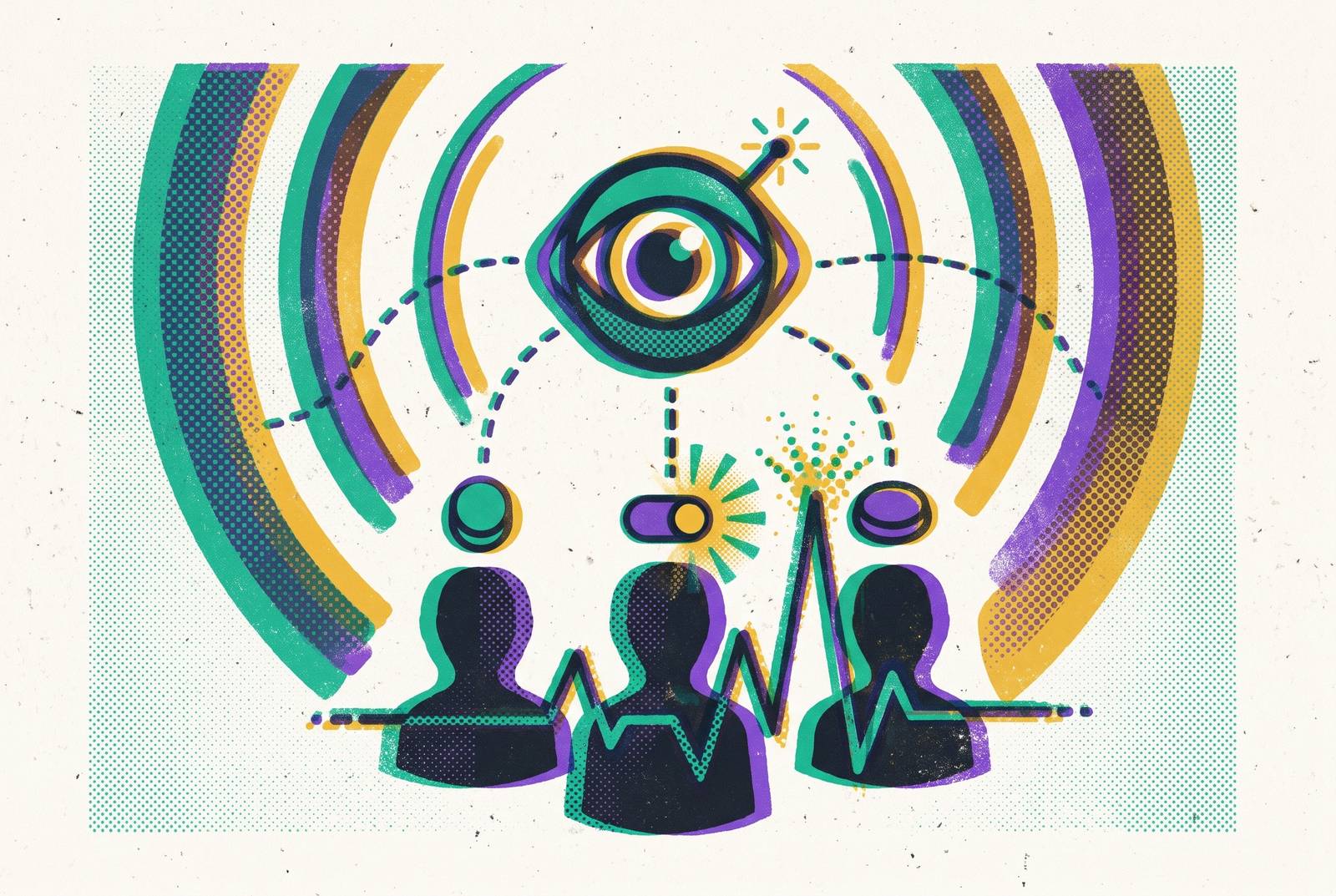
Customer success in agent-powered SaaS has to follow the agent. For a solo founder who wants to deploy AI agents without software operations or infrastructure knowledge, managed agent hosting should provide isolated customer instances, persistent state, automated provisioning, and customer-level logs. Those capabilities make session failures, tool errors, context drift, and silent degradation usable as customer success triggers.
Why the traditional CS playbook assumes human pacing that agents don't follow
Traditional customer success responds to things people do. A user logs in, takes an action, submits a ticket, or answers an NPS survey. Those events tell CS when to look closer because the model assumes that product use and human attention move together. That assumption breaks down with agents, which call tools, process context, and run multi-step workflows while the customer is doing something else.
A recent login, an active seat, and no support ticket say little about whether the agent completed its work. A customer can be heading toward churn because the agent is failing between those recorded human events. Better dashboards do not fix this mismatch if they still observe the human session while failure happens in the agent session. The triggers therefore have to come from the agent.
What agents do between human touchpoints and why it produces invisible failure
Production agents do more than return individual answers. They maintain persistent sessions, call external tools, manage context windows, and fan work out to sub-agents without a human watching every step. Each activity introduces a different way to fail. A tool can return an error that the agent retries without escalating, while accumulating conversation history can cause earlier instructions to lose weight. A sub-agent can also complete its part incorrectly even though the orchestrating agent reports success.
A running agent is not necessarily a useful agent. Silent degradation happens when it keeps returning output, but the quality falls below the standard the customer paid for. There may be no crash, timeout, or explicit error to draw attention to that decline. The agent can keep using up the customer’s budget while doing less useful work, even as the usual availability signals look normal.
These failures are technically observable but can remain organizationally invisible. An engineering alert may reveal a failed call without prompting anyone to assess the customer relationship. Even a session that succeeds may have output that no longer meets the customer’s needs. The missing link is a rule that connects an observable agent behavior to a specific CS response, including cases where no technical error occurs.
A taxonomy of agent failure signals, organized by when CS needs to know
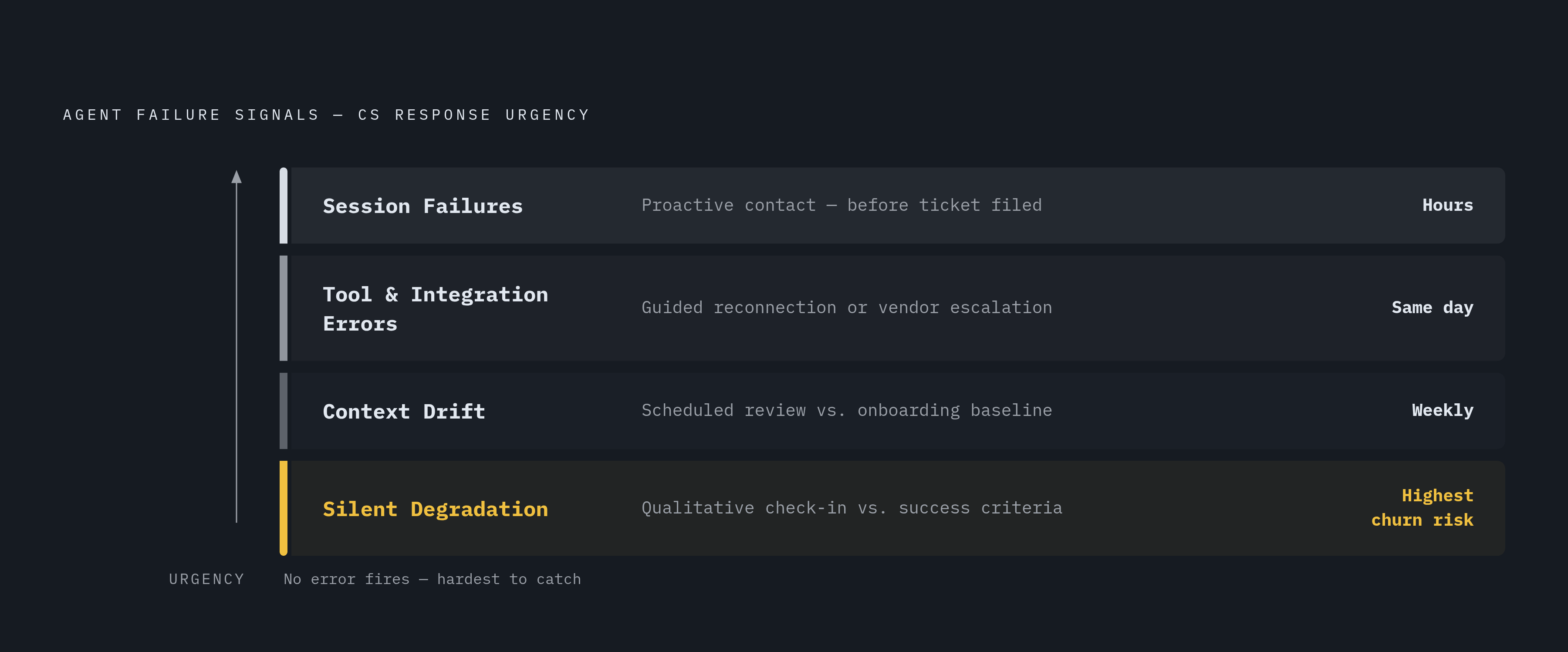
CS urgency follows customer risk. The four useful categories are session failures, tool and integration errors, context drift, and silent degradation. Their order reflects how quickly CS needs to respond.
Session failures demand attention in hours. The observable signal is a crash, timeout, or task that ends with an error. The customer knows something went wrong and is waiting for work that did not arrive. CS should make proactive contact before the customer files a ticket, naming the failed task.
An expired API key, broken OAuth connection, or webhook that stops firing can prevent completion without indicating a defect in the agent itself. A failed tool call requiring human intervention is the signal. The CS response is credential refresh, guided reconnection, or vendor escalation, depending on the cause.
Context drift needs a review. A change in tool-call patterns or output behavior compared with onboarding is observable even when no error appears. CS should use that divergence to check whether the agent still follows the customer’s original intent. Technical completion alone cannot settle that question.
Silent degradation has the highest risk of surprise churn. Decreasing engagement with output, shorter subsequent sessions, and declining tool-call diversity can indicate diminishing value. The customer may not complain because they assume their own use is the problem. CS should respond with a qualitative check-in anchored to the customer’s stated success criteria.
Why per-user agent isolation changes what CS can observe and act on
A trigger is useful only if CS can identify whose agent produced it. That requires customer-level attribution. In a shared runtime, a session failure might stem from the platform, one customer’s configuration, or another customer’s workload. CS needs per-instance telemetry to tell those causes apart reliably and choose the right response.
One isolated, persistent agent instance per customer has its own session logs, tool-call history, and error trail. A failure within one instance does not contaminate another customer’s data. Persistent context, connected tools, and memory also give CS a continuous record against which behavioral changes can be judged.
Shared dependencies can still fail even with Isolation. One broken OAuth token should be attributable to one customer, while an outage in the integration layer can affect everyone using it. That difference tells CS whether to guide one customer through reconnection or handle an incident that affects more customers. Security is supporting context here, but attribution is the practical benefit for CS. The team needs to know whether it is looking at an account problem or a common cause.
Building the trigger system without leaving actions and thresholds vague
To put this framework into practice, operators should give every trigger a signal source, a threshold, and a response protocol. The signals for session failures come from runtime error logs, task completion rates for each instance, and timeout events. The signals for tool failures come from success rates for each instance, OAuth expiry dates, and integration health. These signals need a CS-facing view. CS must be able to connect the event to a customer and an action.
A workable session rule is two or more failures in a rolling 48-hour window. A single failure remains an engineering event under that rule. Once the threshold is crossed, CS should reach out within the same business day and say what failed and how it will be fixed. Integration outages belong in that immediate response tier too, rather than waiting for customers to discover the problem themselves.
Tool errors need a filter before they reach CS. A failed call that succeeds on retry is noise for this purpose, while a broken connection requiring customer action warrants a guided self-service workflow. CS should follow up if it remains unresolved within a defined window. This keeps routine recovery from competing with failures that need a person.
Drift and degradation require a known reference point. CS should compare current tool-call patterns and output structure with the onboarding baseline, then schedule a review when behavior diverges beyond the agreed threshold. Silent degradation also calls for output engagement, session depth, and re-run trends connected to the specific agent. Acceptable output differs between a research workflow and a customer-facing booking agent, so those thresholds must be customer-specific. The response should allow CS to recommend reconfiguration.
What the onboarding session needs to capture for a trigger system to work downstream
A broad aim such as saving time is not enough to judge performance six weeks later. The useful record names the type of task, the expected output, and how often that output should arrive. Those details give later outreach a concrete subject and give degradation thresholds a basis beyond intuition.
The launch configuration needs its own point-in-time record. It should show which tools were active, which OAuth connections were authorized, and which workflows were enabled. A later disconnection can then be compared with a known-good state. The first week of live operation supplies a different baseline, including actual tool-call patterns, session lengths, and output types. That baseline should represent the period when the customer considered the agent to be working correctly.
The customer’s technical context belongs in the record too. A technical operator may understand error signals as they are, while a non-technical user needs CS to explain them in plain language. That difference should shape the response protocol. Onboarding therefore produces both a behavioral reference and the context needed to act on it. Automated provisioning makes this starting state more consistent than manual configuration after signup.
How the CS trigger system changes as agents scale from one instance to many
A system built for tens of instances can overwhelm its operators at hundreds or thousands. The signals have not changed, but human response capacity has not grown at the same rate. An alert for every failure across a thousand instances makes the queue too noisy to use. For an operator reaching that stage, the next step is automated triage with more selective human escalation.
Pattern detection should group failures from instances that are related to each other. An unusual failure rate among customers who use the same integration points to a shared cause. The same kind of pattern among instances onboarded in a given week gives the team another cohort to look into. CS still needs Per-instance attribution, but cohort-level observability lets the team look into the same problem once for all the affected accounts.
Declining tool-call diversity across customers whose agents have been running for an extended period is a product signal. Routing that pattern to product lets CS address a common weakness while preserving human outreach for customer-specific needs that require human intervention.
The founding team’s time is the binding constraint. Founders manually sorting agent failures are not selling or improving the product. The trigger system should automate work below the point where a human relationship is at risk, while preserving enough customer context for the cases that reach a person.
How can a founder deploy agents without DevOps and still support CS triggers?
Managed agent infrastructure needs to expose more than uptime. For a founder without an operations background, the useful comparison is between hosting that supplies customer-level visibility and an arrangement that leaves the founder building it. A shared runtime leaves attribution harder unless per-instance telemetry is available. A self-managed VPS also leaves the operator responsible for the infrastructure beneath the CS system.
Customer-queryable session logs are a basic selection criterion. CS should be able to retrieve a customer’s agent history without navigating engineering tooling organized only by timestamp or error type. Per-instance tool-call success and failure rates matter just as much because the health of the platform as a whole cannot show whether one customer’s Gmail connection is failing. Persistent context, memory, and connected tools keep enough history to compare how the agent behaves from one session to the next.
Automated provisioning should set up instances so their starting state is known. That makes onboarding baselines reproducible rather than dependent on a founder’s manual setup steps. Documented uptime and recovery SLAs are another requirement, together with automated recovery. CS also needs to distinguish planned maintenance from unexpected failure so downtime can support a meaningful trigger.
Managed hosting services can combine isolated, persistent instances with uptime SLAs, encrypted-at-rest storage, and integrations through Composio for tools including Gmail, Slack, WhatsApp, and GitHub. The deployment workflow should begin with that infrastructure, capture the customer’s intended outcomes and initial behavior, then connect per-instance signals to the response rules. Getting an agent online is only the start. Supporting paying customers requires knowing when their particular agent stops delivering what they bought.