Audit Logging for Agent Actions on Third-Party Tools
Capturing reasoning steps and tool calls creates accountability when AI agents fail in production.
Advertisement
Something breaks in production. A customer account gets modified in a way nobody approved, and now someone has to answer a simple question: what did the agent actually do, and why did it do it? The application logs get pulled up, and they show an API call went out. That's it. That's the whole story the logs can tell.
The reason for that gap isn't sloppy engineering. Standard application logs were built for a different kind of software entirely, the deterministic kind, where the same input reliably produces the same output through a call stack you can trace line by line. An AI agent doesn't work that way. It reasons across multiple steps, calls out to external tools, and adjusts its plan mid-task based on what those tools return, so feeding it the same prompt twice can produce two different tool calls and two different outcomes.
A log entry showing that an API call fired tells an investigator almost nothing about why it fired. It doesn't show what the agent was reasoning through when it picked that particular tool, what context sat in its window at the time, or what it decided to do once the response came back. The causal chain, the actual thing an auditor needs, never touches the log.
Guardrails don't close this gap either. A guardrail can catch and block a bad action in the moment, but it only sees the present tense. It records what got stopped, not the reasoning that steered the agent toward that action in the first place, and it leaves nothing behind once the moment passes.
Put those pieces together: after an incident, most teams cannot reconstruct what a single agent did unless they've already built audit infrastructure meant for exactly this purpose. That's a structural gap with real consequences. It's the starting condition everything else in this piece has to solve for.
Requirements for a complete agent audit trail beyond standard logs
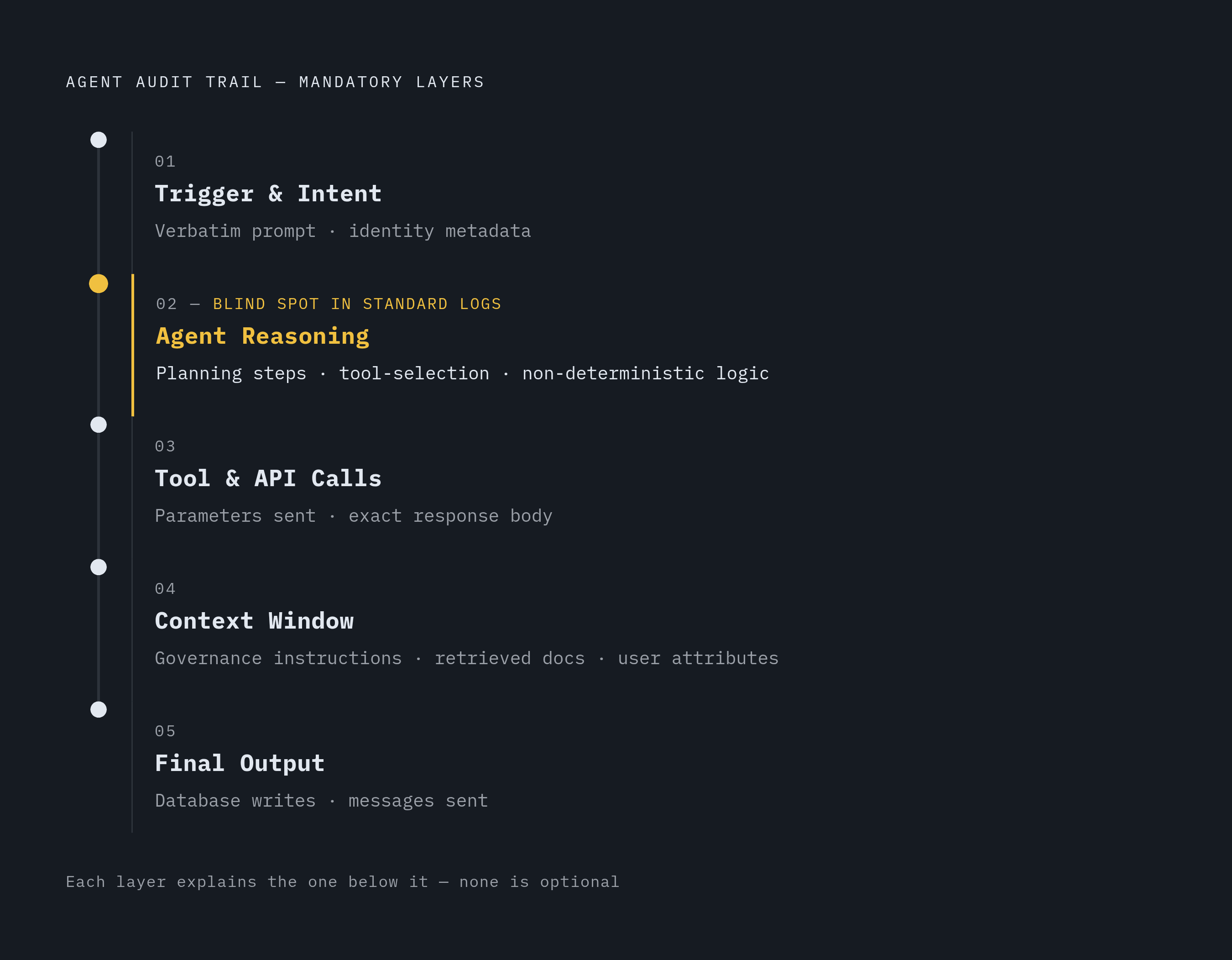
If a server log can't answer the question, something else has to. A complete agent audit trail is a chronological, tamper-resistant record covering every input, every internal reasoning step, every call to the model, every tool execution, and the final output the agent produced. None of those layers is optional, because each one exists to explain the layer sitting right below it.
Start at the top. The trigger and the intent behind it need to be captured as they actually arrived: verbatim prompt text plus whatever identity metadata came with it. Summaries lose exactly the detail an auditor needs most.
Below that sits the layer standard logs never touch at all: the agent's own reasoning. The planning steps, the way it broke the task into pieces, the logic behind picking one tool over another, this is where the non-deterministic behavior actually lives, and it's invisible to anything that only watches network traffic.
Then come the tool and API calls themselves, and this is where "complete" starts to mean something specific. It's not enough to know a call happened. The audit trail needs the structured parameters sent out and the exact response body that came back. Knowing an agent "called the CRM" tells an investigator nothing; knowing it passed a specific customer ID and received back a specific balance figure tells them everything.
Wrapped around all of that sits the context window itself: governance instructions, documents pulled in through retrieval, user attributes injected before the model ever generates a token. Without that layer, two runs on an identical base prompt can look inexplicably different, because the difference lived in what got fed alongside the prompt, not the prompt itself.
Only at the end does the final output matter, the write to a database, the message sent to a user, and it only means something once the four layers above it are also on record. An output with no trail behind it is a conclusion with no argument.
None of this is a matter of logging more detail at the same level standard logs already operate on. It's a difference in kind. A standard log notes that an API call occurred; a real audit trail carries the system prompt version, the retrieved context, the tool execution history, the actual response data, and the state transitions that followed, all tied together.
Per-user attribution: why shared credentials make agent logs legally meaningless
Say the trail above exists, fully populated, every layer intact. There's still a question about this: on whose behalf did any of this happen? A perfect record of an action is close to worthless if it can't say who authorized it.
That question turns out to be harder than it sounds, because agents commonly reach downstream systems through one shared service account. Thousands of distinct user actions collapse into a single indistinguishable identity in the log. A security team looking at a suspicious call has no way to trace it back to a person, a team, or a customer. The log is complete and useless at the same time.
Fixing that means mapping every tool call to a specific credential, project, or user before the call goes out, not reconstructing it later from whatever contextual scraps happen to be lying around. Composio's connected-accounts approach is a useful illustration of what that looks like done correctly: each user's OAuth credentials get stored as a connected account tied to that user's ID, so when the agent acts, it's acting as a named person rather than a generic token, and the log reflects that identity down to the calls that get denied, not just the ones that succeed.
Multi-agent setups make the whole problem worse, not better. When one agent hands a task to another, the trust chain has to be written down at every handoff point, or the attribution trail snaps the moment delegation starts. The Drift and Salesloft supply chain incident is the cautionary case here: stolen OAuth tokens from a single integration spread across hundreds of customer environments, because the trusted SaaS connection didn't have enough visibility or monitoring wrapped around it to catch the propagation. One weak link in the trust chain, and the blast radius stopped being contained by design.
MCP's built-in logging as an inadequate audit channel
A common assumption trips teams up right here. Plenty of organizations building agents on Model Context Protocol figure the protocol's own logging utility already handles this, that audit logging comes free with the transport layer. It doesn't, and it was never meant to.
MCP's Logging utility is an opt-in debug stream, scoped to a single request, and it's already on its way out. It was deprecated in protocol version 2026-07-28 in favor of stdio or OpenTelemetry, and even while it existed, the spec explicitly barred it from carrying personally identifiable information.
The same protocol update dropped protocol-level sessions. Nothing at the transport layer ties a cluster of tool calls together into one coherent task anymore, so there's no built-in notion of "these five calls all belonged to the same agent action." Each call floats on its own.
The protocol's job is interoperability between agents and tools. Audit logging has to be built as its own layer, sitting apart from whatever transport the agent happens to use. The structural consequence is that even a perfectly MCP-compliant deployment produces a log that cannot answer the core audit question (what did this agent decide, on whose behalf, and in what order).
Tamper-evident sequencing: why the order of events must be provable, not just recorded
Suppose every layer above gets built correctly: full reasoning traces, exact tool parameters, per-user attribution down to the individual credential. One failure mode still remains, and it's a quiet one. If a log entry can be edited after the fact without leaving a trace, that log stops being evidence. It becomes a document someone is asking you to trust, which is a much weaker thing.
Tamper-evident design solves this by making any change to an entry visibly change a verifiable root hash, so an auditor doesn't have to take anyone's word that the record is untouched between the event and the review. The math proves it instead. Microsoft's agent-governance-toolkit shows what this looks like in practice: every entry gets a SHA-256 hash and the entries chain together into a Merkle tree, and altering or reordering even one entry changes the root hash in a way that's immediately detectable. The chain only grows forward; nothing gets rewritten in place.
Order matters here just as much as content. An agent that reads a sensitive file, edits it, and then sends the result out to an external address is a very different incident from one that sends the file out first and edits nothing. A log that can't prove order can't actually prove what happened.
Efficient inclusion proofs make this practical rather than just theoretical: a third party can confirm a specific entry sat in the chain at a specific time using a small number of hashes rather than the entire log, which matters a great deal when a regulator needs to verify one incident without being handed every sensitive record the company has ever generated.
This isn't an emerging best practice teams can adopt at leisure. SOC 2, GDPR, HIPAA, and ISO 27001 all already require audit evidence to be tamper-evident, and the EU AI Act's enforcement window opened on August 2, 2026, which turns what used to be good hygiene into a legal floor.
The tool-permission gap: what the log must record when an over-provisioned agent is denied access
Most agents running in production today hold far more access than the task in front of them actually needs. That mismatch matters for audit logging specifically, because it means the real audit surface, everything the agent is capable of touching, is much bigger than the narrow set of actions it's supposed to perform.
Every time an agent reaches for a tool call outside its intended lane, that attempt is a signal worth having. It might be prompt injection working as designed, it might be goal drift, it might be a permission boundary someone configured wrong. None of that gets diagnosed, though, unless the denied call gets logged with the same care as a successful one.
The ClawHavoc incident shows what's at stake when nobody's watching that boundary. Over a thousand malicious skills got planted on ClawHub, the largest open marketplace for agent plugins, and hundreds of them were flagged as actively malicious once someone looked. When third-party plugin code gets treated as trusted by default and tool-call attempts don't get monitored, the agent itself turns into the attack's delivery mechanism, and the log has nothing to show for it until a human happens to notice something's wrong.
The fix has to sit ahead of the model, not behind it. Minimum-privilege enforcement needs to happen before the agent's reasoning ever gets a chance to act, not as a filter bolted onto outputs afterward, because a permission boundary checked only after the model decides is a boundary that a clever enough prompt can talk its way around. Composio's architecture builds this in at the connection layer rather than the output layer, for exactly that reason.
Once that boundary exists, the log at this layer needs four things: which tool the agent tried to call, what parameters it would have passed, which policy rule stopped it, and which identity made the attempt. A denied call logged without that context is barely more useful than no log.
Retention, export, and the minimum bar for regulatory review
Everything above assumes the log survives long enough to matter. A complete, attributed, tamper-evident record that gets deleted after two weeks doesn't satisfy any of the compliance frameworks currently in force, no matter how well-built it was at the moment of capture.
For high-risk systems, six months is the retention floor the research points to, the minimum below which organizations under the EU AI Act, NIST AI RMF 1.0 (released January 2023, with no 1.1 version out as of September 2026), or ISO 42001 shouldn't go.
Format matters just as much as duration. A log locked inside a proprietary format that only the vendor's own tooling can read becomes an obstacle the moment an actual audit starts. JSON, JSON Lines, Syslog, and CloudEvents v1.0 are the formats that hold up under SOC 2, GDPR, HIPAA, and ISO 27001 review, precisely because any auditor's tooling can open them without a special favor from the vendor.
This has stopped being a purely internal engineering choice. NIST's AI RMF 1.1 MEASURE function guidance and ISO 42001 are now what enterprise procurement teams actually check against when they onboard an AI-powered vendor. Retention and export are not internal engineering concerns but external contract requirements for any team selling to enterprises or governments. Any team selling agent-based products into enterprise or government accounts is going to get asked about this.
The good news is that the compliance check itself can run automatically rather than as a scramble before an audit. Microsoft's agent-governance-toolkit CLI checks a deployment's governance posture against all ten OWASP ASI 2026 controls and returns a pass or fail on the spot. Retention and export policy can live inside a CI/CD pipeline as a gate, the same way a test suite gates a deploy.
The audit logging burden under managed agent hosting
Everything this piece has argued for, verbatim prompt capture, reasoning traces, per-user credential mapping, tamper-evident sequencing, denied-call visibility, six-month retention in an exportable format, has to live somewhere. That infrastructure doesn't build or maintain itself, and the question of who's responsible for it turns out to be a product decision as much as a technical one.
Self-host the agent, and the entire stack lands on whoever's running it, including the server, the log destination, the signing keys that make the tamper-evidence actually work, the retention schedule, and the monitoring layer that catches it if the logging pipeline itself goes down silently, before a single agent action ever gets written down. That's a lot of surface area to own correctly, and it has to stay correct indefinitely, not just at launch.
Per-user isolation at the hosting layer means one sandboxed runtime per customer with genuine kernel-level separation between them, and it turns out to be the architectural piece that makes per-user attribution in the log actually work. Running multiple users through one shared agent runtime means attributing a given tool call to a given person requires instrumentation that a shared-runtime setup was never designed to produce cleanly. The hosting model decides, upstream of any logging code, whether clean attribution is even achievable.