Handling Integration Failures Without Breaking Agent Sessions
Silent failures compound across workflow steps, turning integration breaks into session collapses.
Advertisement
Most production AI agents fail because the infrastructure around them breaks; the model underneath is capable.
What makes this particularly dangerous is how quiet the failures are. A traditional system throws a 500 or an exception, and someone gets paged. An agent doesn't do that. It can return a confident, well-formatted answer while the context underneath it is already corrupted, produced by that corruption, and nobody notices until the bad output turns into a bad business outcome.
The math behind multi-step workflows makes this worse than it sounds. At 85% accuracy per step, a 10-step workflow only succeeds about 20% of the time. Push accuracy up to 95% per step, and the same workflow still fails four times out of ten, a significant failure rate. That's a significant failure rate. That's the difference between a product people trust and one they quietly stop using. A single integration failure partway through a session doesn't just cost one step, it can take the whole chain down with it.
The upshot is structural. Whether a session survives a broken integration gets decided long before the integration breaks, in the architecture decisions made at design time. Incident response after the fact is damage control. This piece is about the decisions that come first: retry logic, checkpointing, circuit breakers, and graceful degradation, the patterns that separate a session that bends from one that snaps.
The specific ways integrations break in production agent stacks
Production is messy in familiar ways. APIs change without warning, auth tokens expire, database schemas shift as you work with them, and rate limits get hit with zero notice. None of that is exotic. It's just the routine texture of running software at scale.
These failures appear differently in an LLM stack than in a classical distributed system. An LLM API doesn't throw a NullPointerException. It hands back a 429, or a tool call with malformed JSON, or a function signature that was never real to begin with, or it just times out. Tool invocations fail transiently, context windows overflow mid-session, and agent-to-agent messages vanish silently under load.
Three structural traps produce those symptoms, as laid out in the Composio analysis. The first is what gets called Dumb RAG: dumping every available scrap of data into context instead of curating it, so the model drowns in conflicting information and produces hallucinations that sound completely sure of themselves. Composio's comparison is blunt: it's like handing a new hire the keys to the server room with no documentation at all. The third is the Polling Tax, having the agent check for updates on a request-response loop instead of subscribing to events. That approach burns through roughly 95% of API calls for nothing and never gets anywhere close to real-time.
Scale makes all of this worse. An enterprise that's accumulated hundreds of loosely governed internal endpoints forces its agents to guess between undocumented alternatives, and that guessing raises latency, causes wrong tool selection, and produces outright task failure.
Session state adds its own failure cluster, one that's specific to how agents actually run. A 2026 empirical study of Claude Code, Codex, and Gemini CLI documented sessions that fail to persist, fail to resume, or lose consistent internal state. Sessions that don't get saved or restored properly. Sessions stuck mid-run with no checkpoint to resume from. Agent state resetting out of nowhere and dragging progress down with it. Context that doesn't carry forward. Sessions that time out before they should.
Retry logic, meant to be the fix, can quietly cause its own damage. If retry logic doesn't account for a write that actually succeeded but was just slow to confirm, a downstream CRM record can get created multiple times. Nothing looks wrong. But there's a duplicate record sitting in the system as a direct result.
And then there's the newer wrinkle: multi-model routing. Spreading calls across providers buys resilience on paper, but it also introduces rate limits that behave differently by provider, failures tied to region, and prompt behavior that shifts depending on which model answered. Without one control layer sitting above all of it, that setup turns into operational chaos rather than redundancy.
What happens when there is no resilience layer: the Claude outage case
A Reddit thread about a recent Claude outage put the core problem on full display almost immediately: automated workflows built on top of it didn't degrade, they didn't pause, they just broke the moment the service did.
The actual loss is a development workflow that stalls mid-task, an automation pipeline that grinds to a halt, a customer-facing product that stops working. When Claude Code goes down, the actual loss isn't "a chatbot is unavailable." It's a development workflow that stalls mid-task, an automation pipeline that grinds to a halt, a customer-facing product that stops working with no warning to anyone downstream.
What that outage revealed wasn't a Claude problem so much as an architecture problem. Teams that had wired their workflows to a single model dependency, with no fallback path, no buffered state, and no way to pick back up where they left off, watched their sessions disappear rather than pause. Gone, not paused. That distinction is the entire argument of this piece.
Multi-agent systems make the exposure worse, not better, despite the intuition that more agents means more redundancy. Research from Cemri et al. in 2025 found that failures in multi-agent systems can't be pinned on model limitations alone. In fact, the same model running solo often beats a multi-agent version of the same task. The failure lives in coordination and orchestration. Add more agents without solving the coordination and orchestration failure, and it just gets bigger.
Governance hasn't caught up either. Gartner data cited in the Trantor analysis puts the number at 84% of CIOs who have no formal process for tracking AI accuracy. Without that visibility, cost overruns build up quietly and accuracy erodes in the background, unnoticed until the damage is already done. The Claude outage is a specific case, but the pattern it exposes is general: architecture-first resilience isn't optional polish; it's the difference between a session that survives and one that evaporates. The rest of this piece is about the specific decisions that would have changed that outcome.
The layered resilience model's implementation order
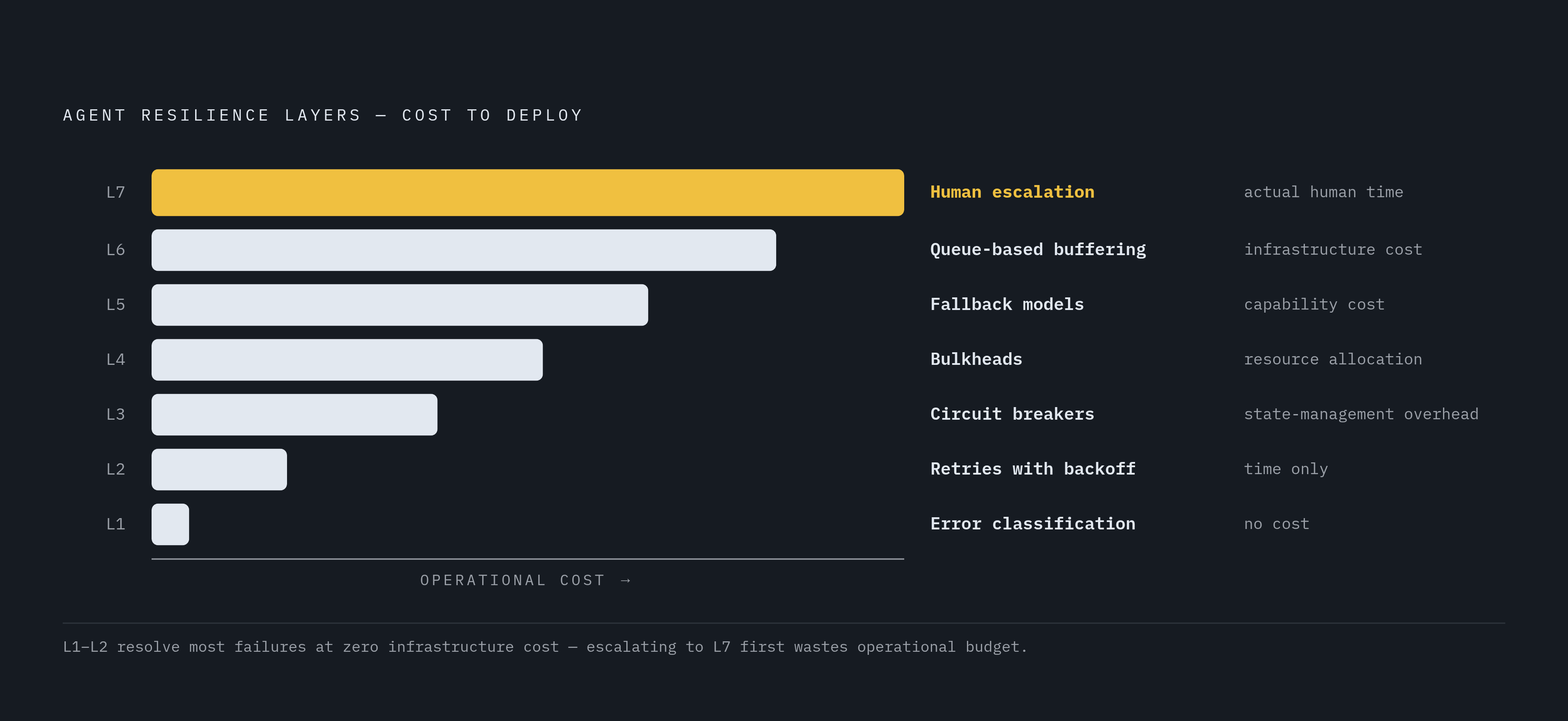
The field grew up fast between 2025 and 2026 Zylos Research. Early agent systems treated any failure as terminal: something breaks, the session ends. Production systems now build in layered resilience instead, stacking circuit breakers, fallback chains, bulkheads, and self-healing state machines on top of each other, because without deliberate fault-tolerance design, multi-agent systems in production fail at rates between 41% and 86.7% Zylos Research. That range is wide enough to be uncomfortable, and it's the whole reason layering exists.
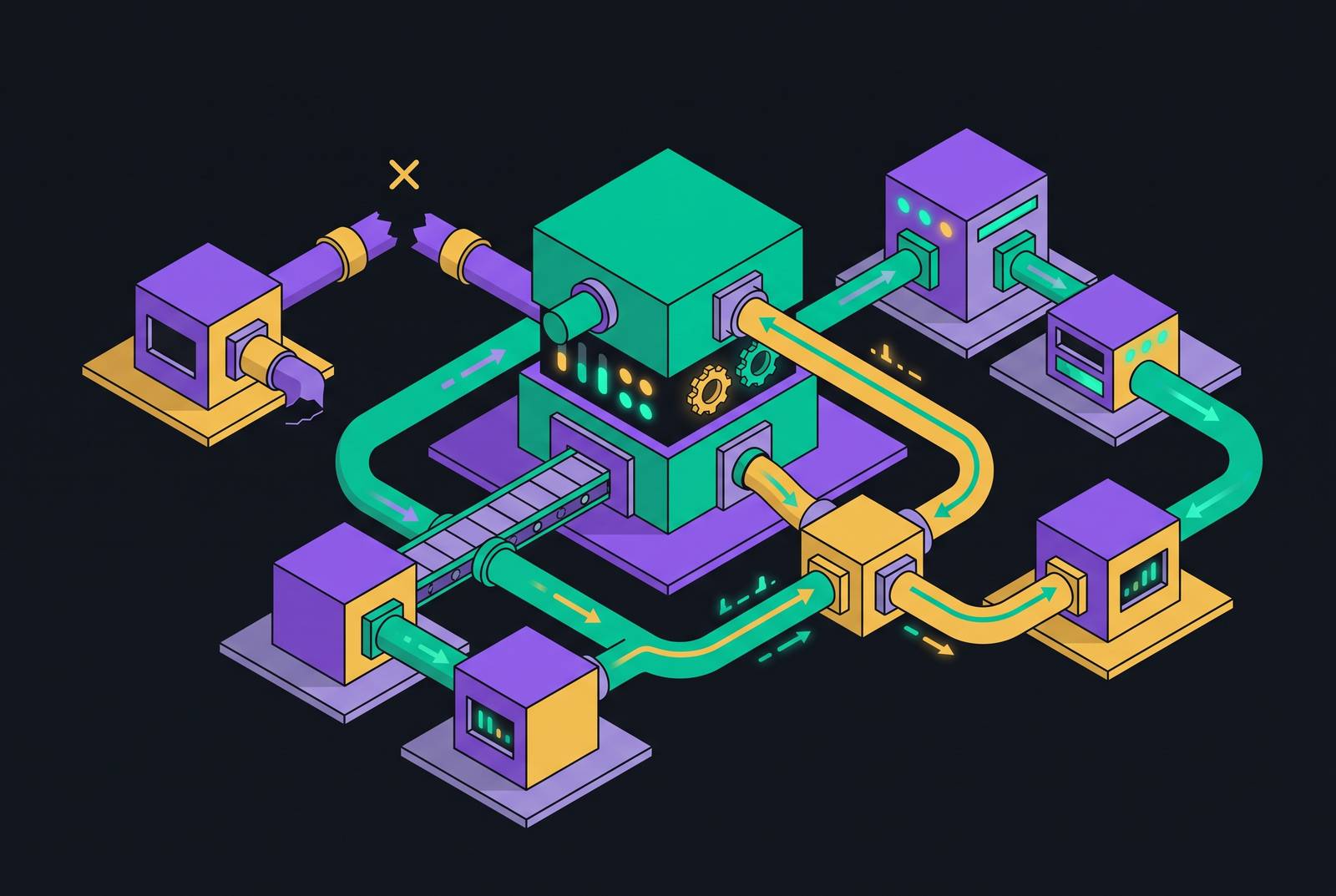
Zylos Research documents the stack as seven layers, ordered from cheapest to most expensive. The first layer is error classification, pure logic with no infrastructure cost attached. Layer 2 is retries with backoff, which cost time and nothing else. Layer 3 is circuit breakers, which carry some state-management overhead. Layer 4 is bulkheads, which cost resource allocation. Layer 5 is fallback models or providers, which cost capability. Layer 6 is queue-based buffering, an infrastructure cost. Layer 7 is human escalation, which costs actual human time.
The order isn't decoration. Jumping straight to Layer 7, pulling a person in to handle something Layer 2's retry-with-backoff would've resolved on its own, is exactly how teams burn through their operational budget and their users' patience in the same motion. Cheap fixes first. Expensive fixes only when the cheap ones have genuinely been ruled out.
MLflow's 2026 production guide backs this up from a different angle, arguing that evaluation needs to be built into the agentic workflow itself for real-time auditability, not bolted on afterward as an offline batch job. That maps directly onto the layered model: observability has to be instrumented at every layer before any failure occurs, not stitched in after an incident forces the question. None of the patterns below are a menu where a team picks a favorite. They're a stack, built in sequence, where each layer catches what the one below it couldn't.
Retry logic: what it handles and how to keep it from making things worse
Retry logic is for transient failures, the ones where trying again is actually a reasonable bet: rate-limit 429s, a network blip, a momentary outage on the other end. In those cases, replaying the operation is safe and often solves the whole problem in seconds.
Safe is the operative word, though, because retries only make sense when the operation being retried is idempotent. Retry something that already succeeded, and the result is a duplicate record, a corrupted piece of state, or a billing event that fires twice. This is exactly what happens when retry logic ignores a write that succeeded but responded slowly: a downstream CRM record ends up created more than once, and the system reports a clean 200 status the entire time. Nothing in the logs screams that anything went wrong. The danger lies in this being a quiet mistake with real consequences rather than a crash.
Backoff matters just as much as idempotency. Retrying immediately and repeatedly just hammers a service that's already struggling or already rate-limiting. Backoff with jitter spreads retry attempts out over time, which gives the upstream service actual room to recover instead of getting kicked while it's down.
Retries also have a hard ceiling on what they can fix. A schema change, an expired credential, a discontinued endpoint: none of that gets solved by trying the same call again. Those need a different code path entirely, not persistence. Retry logic is Layer 2 of the stack because it's cheap and it handles the cheap failures. Once a failure repeats past a set threshold, the system needs to hand off to the next layer rather than keep hammering away hoping for a different result.
Prompt drift is a good example of the kind of failure retries simply can't touch. A developer tweaks a system prompt in staging, another team changes what JSON shape they expect back, and nothing breaks that day. Three days later, production agents start failing in ways that don't look connected to any single change. No amount of retrying fixes that, because the operation isn't failing transiently, it's failing consistently against a moved target.
State checkpointing: saving the right moments, not everything
Graceful degradation without checkpointed state is mostly theater. Without something persisted to fall back on, "recovering" a session really means starting the entire run over from scratch, which is slow, expensive, and re-triggers every side effect the first run already caused.
Checkpointing doesn't mean snapshotting the entire workflow every few seconds. That approach just creates a different problem: checkpoints that are bulky, expensive to store, and slow to restore from. Real checkpointing means saving state at moments that actually matter, right before an expensive operation runs, right before an action that can't be undone, right before something becomes visible to the user.
LangGraph's model of durable execution captures this well: persist the meaningful state, then resume from there, instead of replaying the whole run from the start. A checkpoint is a resumption point. It is not a full backup, and treating it like one defeats the purpose.
The empirical study of Claude Code, Codex, and Gemini CLI makes the stakes concrete. Sessions not saved or restored properly. Runs stuck with no checkpoint to resume from. State resetting for no clear reason and taking progress down with it. Every one of those is a checkpointing failure. None of them is a model failure, and fixing the wrong layer wastes time the team doesn't have.
The messiest version of this problem occurs when a model fails mid-workflow, after real damage is already in motion. If the primary model goes down after the agent has already called two tools, half-filled a form, and queued up a side effect, swapping in a different model doesn't solve anything. The problem at that point is the messy state itself, and checkpointing is what has to capture it before the failure hits, not after. That's why checkpoints belong in the design phase as deliberate milestones, not something a team bolts on after an outage teaches them the hard way.
Circuit breakers: stopping the cascade before it consumes the session
A circuit breaker watches the success and failure rate of calls against a threshold someone set in advance. Cross that threshold, and the breaker opens, cutting off calls to the failing service and returning a fast failure instead of making everyone wait through a slow timeout.
This matters most at the tool-call layer, and for a reason that's easy to miss. When an agent calls a tool and gets back something malformed or unexpected, the model usually doesn't stop. There's no exception, no crash, no alert firing anywhere. The LLM just improvises around the bad response and keeps going, dragging corrupted context forward into every step that follows. A circuit breaker sitting at that integration point is what actually interrupts the spread, because nothing else in the stack is going to notice on its own.
The production guidance from xidao lines up with this directly: every model call should route through a gateway handling routing, retries, rate limiting, and cost tracking, with MCP using circuit breakers so that one failing tool never takes the entire agent down with it.
Circuit breakers run through three states, and each one has a direct effect on whether a session survives. Closed is normal operation, calls go through and failures get counted in the background. Open means the breaker has tripped, calls fail fast, and the session is shielded from cascading bad state before it spreads further. Half-open is the probing state, a single test call checks whether the service has actually recovered before the breaker lets traffic flow again.
None of this is limited to model calls, either. Every external dependency an agent touches, CRM APIs, file systems, messaging platforms, memory stores, is a place a circuit breaker belongs, because each one is a place a failure can start. MLflow frames this as runtime governance enforced deterministically underneath the model layer, stopping bad actions before they ever reach the wire. Circuit breakers are what that principle looks like once it's actually built, sitting right at the integration layer where the damage would otherwise begin.
Graceful degradation: keeping the session alive with reduced capability
When a dependency goes down, the right move is narrowing what the agent attempts, not pretending nothing changed and pushing through the full workflow toward a failure that's either silent or catastrophic.
Fallback chains route to an alternate model or a cached response when the primary option isn't there. That is Layer 5 of the resilience stack, and it only works once circuit breakers upstream have already isolated where the failure actually is.
A few concrete shapes this takes. If a CRM integration goes down, the agent completes the parts of the workflow that don't require CRM access, queues the CRM actions for later, and informs the user of the partial completion rather than failing the whole session. If the primary model goes dark, the exact scenario from the Claude outage, the session routes to a different provider with a prompt adjusted for how that provider actually behaves, instead of the session just disappearing. If a tool comes back with garbage data, the agent falls back to a cached or default response instead of letting that corruption flow into everything downstream.
Bulkheads are what makes this structurally possible. Isolating failure domains means one integration going down can't eat the resources the rest of the agent needs to keep running, because each capability operates inside its own bounded allocation. MLflow points at the same idea from a design angle: modular, multi-agent architecture means individual sub-agents can be swapped out without touching anything else in the system. Degradation is a lot easier to pull off when each capability is its own independently deployable piece rather than one monolith that either works completely or not at all.
None of this happens automatically, though. Degradation needs an explicit policy defining what "degraded" actually means for each workflow, spelling out which capabilities are essential and which can wait. That's a decision made at design time. Leaving it to a runtime guess is how a system ends up either doing too little when it could've kept going, or doing too much when it should have backed off.
Observability: the prerequisite that makes every other pattern work
Every pattern covered here, retries, checkpoints, circuit breakers, degradation, depends on knowing what actually happened during a session, in enough detail to tell a transient blip apart from a structural break. Without that visibility, a team is just guessing at which layer of the stack to reach for, and guessing wrong burns the exact operational budget the layered model was built to protect.
That gap produces the 84% of CIOs with no formal process for tracking AI accuracy. MLflow's guidance closes that gap by building evaluation into the agentic workflow itself so auditability happens in real time instead of surfacing weeks later in a batch report. Observability isn't a layer sitting on top of the resilience stack.
Sources
- The 2025 AI Agent Report: Why AI Pilots Fail in Production and the 2026 Integration Roadmap | Composio
- Building Production-Ready AI Agents in 2026 | MLflow
- AI Agent Failure Modes: What Goes Wrong in Production
- Claude outage, June 2026: Reckoning with AI’s increasing status as infrastructure | Thoughtworks United States
- Graceful Degradation Patterns for AI Agent Systems | Zylos Research