Why Startup Founders Should Never Hand-Configure Agents After Signup
Automatic provisioning at signup scales faster than manual setup ever can.
With automatic agent provisioning at customer onboarding, a signup triggers an API call that creates a running, isolated, persistent agent without the founder having to step in. For a startup selling agents per customer, that is the delivery model to build. Hand-configuration makes the founder’s available time the limit on growth, and working faster does not remove that limit.
Why hand-configuring agent instances after customer signup is a structural limit, not a setup inconvenience
The founder is still setting up agent number six while customer seven waits. Every signup goes through the founder’s hands, so getting an agent to a customer still depends on the person who sets it up. A faster founder can shorten the wait, but the mechanism remains one-to-one inside a business that needs one-to-many delivery.
An agent can work perfectly in a demo while the business remains unable to give every paying customer a working instance. Better reasoning from the model will not create the missing customer environment, connect its tools, or establish its permissions. Those are duties of the deployment architecture. Until that architecture can turn a signup into a running agent on its own, the product depends on a personal service hidden behind the signup page.
That distinction separates a pilot from a repeatable product. In a pilot, getting an agent running for a customer can be part of the work being sold. In a per-customer product, the same work must happen whenever onboarding needs it, without waiting for the founder to have time.
What founders are actually doing when they hand-configure — and what each step costs them
Hand-configuration starts with VPS setup and getting the agent into a container, but it does not end when the process starts. The founder wires credentials, defines permission boundaries, authorizes integrations, adds monitoring hooks, and plans recovery. SSH access and a container restart become part of delivery. Each step takes attention away from the product because each customer needs a correctly configured environment.
Tool access adds another chain of work. An agent connected to email, code repositories, and messaging needs authorization for those systems. To build those connections by hand, the founder must write and maintain OAuth flows, store per-user tokens, handle token refresh, and keep up with upstream API changes. Credential rotation means there is still work to do after the first setup. Each new integration gives the founder more to keep working for each customer.
The runtime also has costs separate from the model. There must be a budget for the infrastructure that context, tool invocations, and integrations need, and a separate budget for model usage. Neither budget accounts for the founder’s installation work, access controls, updates, monitoring, or recovery tests. Initial provisioning is only the first obligation. Permission boundaries, integration authentication, uptime monitoring, failure recovery, and version updates remain part of the job, while customer churn and replacement bring another round of setup.
Why the delivery problem gets worse as customer count grows, not better
At one or two customers, the work feels like setup. By the fourth, eighth, or fifteenth customer, it starts to look like a job function. The provisioning effort grows with customer count. Being more organized may reduce mistakes, but it cannot remove the need for a person to execute the sequence again.
The timing makes that cost especially damaging. A new customer creates delivery work just when the founder needs to build the relationship and pursue the next sale. At the same time, the customers who have already signed up still need updates, monitoring, and recovery. The founder who sells fastest has the longest queue.
Failures make the queue harder to manage. One misconfigured instance can produce incorrect agent behavior while other customers’ instances remain unaffected, leaving the founder to isolate, diagnose, and correct that customer’s setup through the same manual access used to create it. A tidy checklist records the work that the founder must still perform.
White-label and per-customer products expose the conflict most sharply. Their promise is a private, persistent agent for every client, which requires a provisioning event for every signup. The way the product delivers agents must keep that promise without giving the founder more work to do by hand with every new sale.
How do you give each new customer their own AI agent automatically at signup?
The target architecture makes provisioning a side effect of onboarding. A signup triggers a call that receives a customer identifier and returns a running, configured agent endpoint. No founder task sits between those events. Stripe let software companies take payments without becoming payments companies. The same kind of interface for agents lets the product ask for a customer environment without someone having to manage each setup by hand.
That environment needs isolation, persistence, and an automatic trigger. With isolation, each customer’s agent has its own data, configuration, and conversation history. Persistence keeps state across interactions. The trigger connects these properties to the business event. If someone still has to create an isolated agent by hand, delivery still depends on that person.
Isolation cannot stop at per-user filtering in a shared instance. A failure in that arrangement can expose one customer’s data to another customer’s agent. Microsoft Foundry’s hosted agent documentation describes per-session VM-isolated sandboxes with a persistent filesystem and automatic state restoration when an idle session resumes. That is a concrete pattern for runtime separation, though the product must still connect its customer model to the platform’s session model.
Identity belongs inside this boundary too. Each deployed agent needs a workload identity of its own in place of shared API keys. Otherwise, the credentials undermine the separation the architecture is supposed to provide.
How the major managed runtimes divide the provisioning work between the platform and the founder
Managed hosting does not automatically mean automated customer delivery. The useful comparison is how much of the provisioning sequence the platform absorbs and what the founder still has to connect to onboarding. A runtime may handle scaling and state while leaving packaging, permissions, and the signup trigger to the product team.
Microsoft Foundry Agent Service hosted agents became generally available on July 9, 2026. Foundry accepts containerized agents built with Microsoft Agent Framework, LangGraph, or custom code and manages web server setup, scaling, instrumentation, session state, and platform security. Rollback uses a version selector that can direct traffic back to the previous version. The founder still has to supply the container image, set tool permissions, and check compliance for third-party systems.
Amazon Bedrock AgentCore Runtime reached general availability in October 2025. AgentCore offers serverless hosting with session isolation for agents built with any framework or model, and gives each deployed agent a workload identity. Named endpoints such as “PROD” stay pinned until explicitly moved, so rollback means pointing the endpoint at an earlier version. These mechanisms remove runtime and release work, but the application still needs to translate customer onboarding into the required provisioning calls.
LangSmith Deployment, rebranded from LangGraph Platform in October 2025, provides a managed agent server with a self-hosting option. It is the managed deployment counterpart to LangGraph’s framework for stateful agent workflows. Self-hosted and Bring Your Own Cloud options allow agents to run within the operator’s infrastructure and keep data in its VPC. The choice depends on the existing stack, team size, and compliance needs.
Security as a second reason hand-configuration does not scale — not just slow, but increasingly risky
Every customer instance managed by hand is one more security surface to keep safe. The founder must keep its access boundaries, credentials, and platform updates in order. Even a founder willing to absorb the setup time still has to account for the exposure created by managing instances individually.
Coding agents make the boundary especially concrete. Their sandboxes must enforce filesystem, network, credential, and git constraints at the platform level. Permission rules in CLAUDE.md or AGENTS.md can shape what an agent attempts, but they do not change what the runtime permits. Writing “never touch production” is not a security control. The restriction must hold even when the agent does not follow instructions.
Foundry’s architecture assigns the founder responsibility for code inside the sandbox while the platform owns the endpoint, identity, scaling, and session state around it. Platform-layer security patches therefore spare the founder visits to every customer instance while leaving responsibility for agent code or tool permissions with the founder. It removes a class of repeated maintenance that otherwise competes with onboarding and support.
What productizing an agent for per-customer delivery actually requires at the infrastructure layer
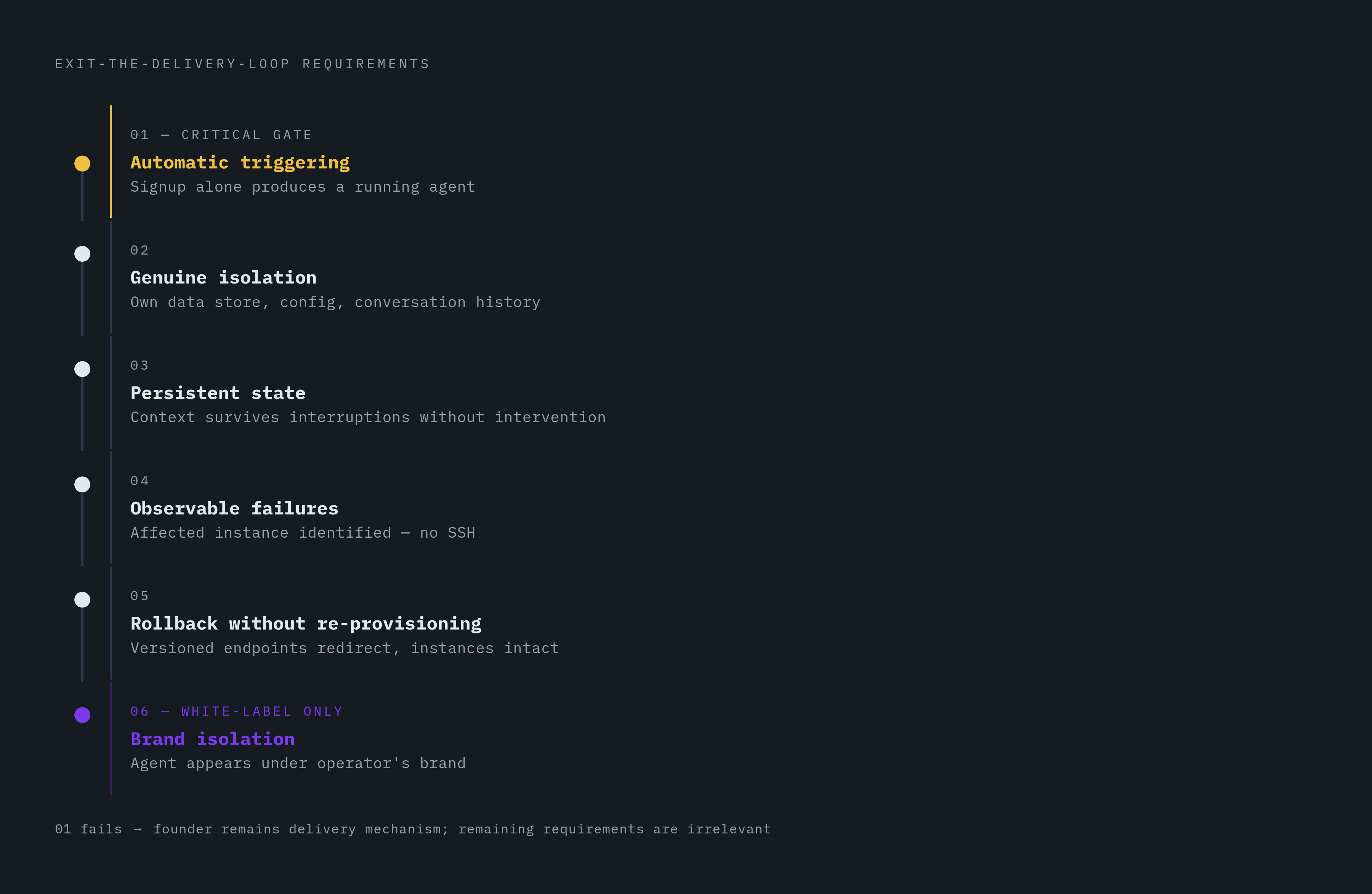
Automatic triggering is the first requirement: the signup event must be enough to produce a running agent for that customer through the provisioning flow. Genuine isolation is the second. Each customer needs their own data store, configuration, and conversation history, with boundaries that keep a failure or misconfiguration for one customer from affecting another.
Persistent state is the third requirement. Context, credentials, and session state must survive interactions without the founder restoring them after an interruption. Foundry’s scale-to-zero model with stateful resume illustrates the target. The agent can go idle while its state returns automatically on the next request. Keeping a process running is not the same as preserving a customer’s working environment.
Observable failures are the fourth requirement. Support must be able to identify the affected instance, what failed, and why without SSH access to a server. Platform-managed logging and observability make that possible. Rollback without re-provisioning is the fifth requirement, because a bug fix or capability update must not force the founder to rebuild every customer instance. Versioned endpoints that can be redirected provide that release mechanism.
White-label delivery adds a sixth requirement to these five. The agent must appear under the operator’s brand so the customer experiences the operator’s product. A setup that fails any one of them will eventually force the founder back into manual intervention at scale.
The strongest objection to automated provisioning — and where it actually applies
The strongest objection is control over data and compliance. A founder handling regulated information may have a real reason to keep execution or infrastructure inside a controlled environment. Claude Managed Agents is not eligible for Zero Data Retention or a HIPAA business associate agreement. For products involving healthcare data, financial records, or high-risk AI Act classifications, that can create a constraint that managed orchestration alone does not resolve.
But infrastructure control does not require hand-configuration after signup. Nor does the choice have to be entirely managed or entirely self-hosted. Foundry describes an architecture with a managed control plane and a private data plane. Anthropic’s self-hosted sandboxes, released in public beta on May 19, 2026, move tool execution into the customer’s environment while keeping orchestration on Anthropic infrastructure. These arrangements separate who coordinates the agent from where its tools execute.
The compliance cases are narrow and identifiable. A founder with a specific data-handling requirement needs an architecture that meets it, which may include hybrid deployment. A lead-qualification agent, coding assistant, or customer-support agent without regulated data does not have to meet the same requirement just because it uses an agent.
What a founder should do differently starting from the next customer signup
The next step is to move provisioning from the founder’s task list to the onboarding trigger. A new customer signup, without founder action, must produce a running, isolated, persistent agent for that customer. If it does not, the founder remains the delivery mechanism, regardless of how much automation exists elsewhere in the stack.
Use the five infrastructure requirements as the audit. The provisioning call must connect onboarding to genuine isolation and persistent state, while support and releases must work through observable failures and rollback without re-provisioning. For a white-label product, delivery must also preserve the operator’s brand. A managed runtime is useful only insofar as it helps the whole flow meet those requirements.
The reason to change now is the existing customer base. Every customer onboarded by hand adds one more setup that the founder will later have to migrate, update, or recover by hand. Delay expands that obligation before the replacement mechanism is ready. Make the next signup the point where delivery becomes a property of the product.