Programmatic Agent Teardown and Cleanup Flows
A six-step sequence for safely shutting down autonomous AI agents.
Advertisement
Deployment guides for AI agents are everywhere. Retirement guides are nearly nonexistent, and that gap is not an accident of publishing priorities. It reflects a real asymmetry in how organizations behave once an agent is live.
Proper agent teardown follows a fixed six-step sequence: inventory, redirect, revoke, retain, tombstone, verify. First, locate every credential, token, service-account, and data store the agent touches. Second, move dependent traffic to a successor before touching the old agent's access, because revoking before redirecting breaks production immediately. Third, cancel all credentials at every layer they exist, including any OAuth tokens or API keys held through a separate integration system, and confirm revocation actually happened rather than assuming a deleted config file is enough. Fourth, preserve logs and audit trails that carry regulatory obligations rather than deleting them in the name of a clean teardown. Fifth, mark the agent's identity as retired in the registry so it cannot be quietly reactivated. Sixth, verify that no credential still works, no traffic still routes to the old agent, and no audit obligation was dropped.
Deployment has momentum behind it. A team wants the agent, a budget exists to build it, and launch checklists get followed because the launch itself depends on them. Retirement has none of that momentum. By the time an agent needs to be shut down, the team that sponsored it has usually moved on to something else, and no one's quarterly goals include a line item for turning things off. Leaving the agent running costs nothing you can see on a dashboard today. Shutting it down risks breaking some dependency nobody remembers writing down. Given that choice, the rational move for any individual engineer or team is to leave it alone, and that local logic repeats across every team in the organization until it becomes the default.
A growing population of credentials and active identities has outlived whatever purpose they were built for. None of these are inert. Each one is live autonomy, acting under a purpose nobody owns now.
The scale of this problem is not a guess. Gartner predicts that by 2027, 40% of enterprises will demote or decommission autonomous AI agents because of governance gaps that only get discovered after something has already gone wrong in production. That figure is a lifecycle failure, and the enterprise AI literature has barely begun to address it. The deployment half of the agent lifecycle has been documented, debated, and productized. The retirement half has been left to whoever happens to notice the zombie agent first.
How agent autonomy level determines what teardown must cover
Retirement is not one action; it is a process that has to match how much independent authority the agent actually held while it was running, and most organizations get this match wrong. The common failure is this: a teardown process built for a simple, low-autonomy agent gets applied to one that has spent months acting independently, accumulating audit trails, and touching production data.
Gartner's taxonomy of agent autonomy makes the mismatch concrete. Retiring either one is close to trivial: stop the process, and there's nothing left running that could cause harm. Level 4 is a different animal entirely. A Level 4 agent executes actions independently within defined guardrails, and humans only review exceptions, audit logs, and aggregated outcomes rather than approving each individual decision. Stopping the process for a Level 4 agent does nothing about the guardrails it was operating under, the audit logs it generated, or the aggregated outcomes tied to its decisions. So all three need to be addressed directly during teardown, not left behind as an afterthought.
Gartner names the underlying mistake directly: enterprises tend to treat AI agent governance as binary, either locked down completely or fully trusted, with nothing in between. It carries real history, real access, and real consequences, and a Level 1 teardown checklist was never built for that.
This gets worse because of who's actually accountable for any of it. Gravitee's survey of executives and practitioners found that most organizations have no formal accountability structure for AI agent behavior at all, and only a small fraction of respondents could name a specific individual responsible when an agent takes an action. An agent that misbehaves after nobody remembers building it cannot be contained quickly, because nobody can find who owns the problem.
The infrastructure underneath these agents compounds the difficulty: orchestrators manage lifecycle and routing but rarely treat teardown as a first-class feature. Agent orchestrators handle a lot: they manage agent lifecycle, scale instances horizontally through Kubernetes, route multi-agent workflows, and handle failover when something breaks. Teardown logic is rarely built as a first-class feature inside these systems. Google Cloud now ships Agent Identity, built on the SPIFFE standard, plus an Agent Registry and Agent Gateway. So agent lifecycle management no longer has to be a manual, easily forgotten chore, because now it can be governed. Tools built to track individuated agents can't retroactively account for agents that were never individuated.
What steps do I follow to shut down an agent, revoke its credentials, and purge its state?
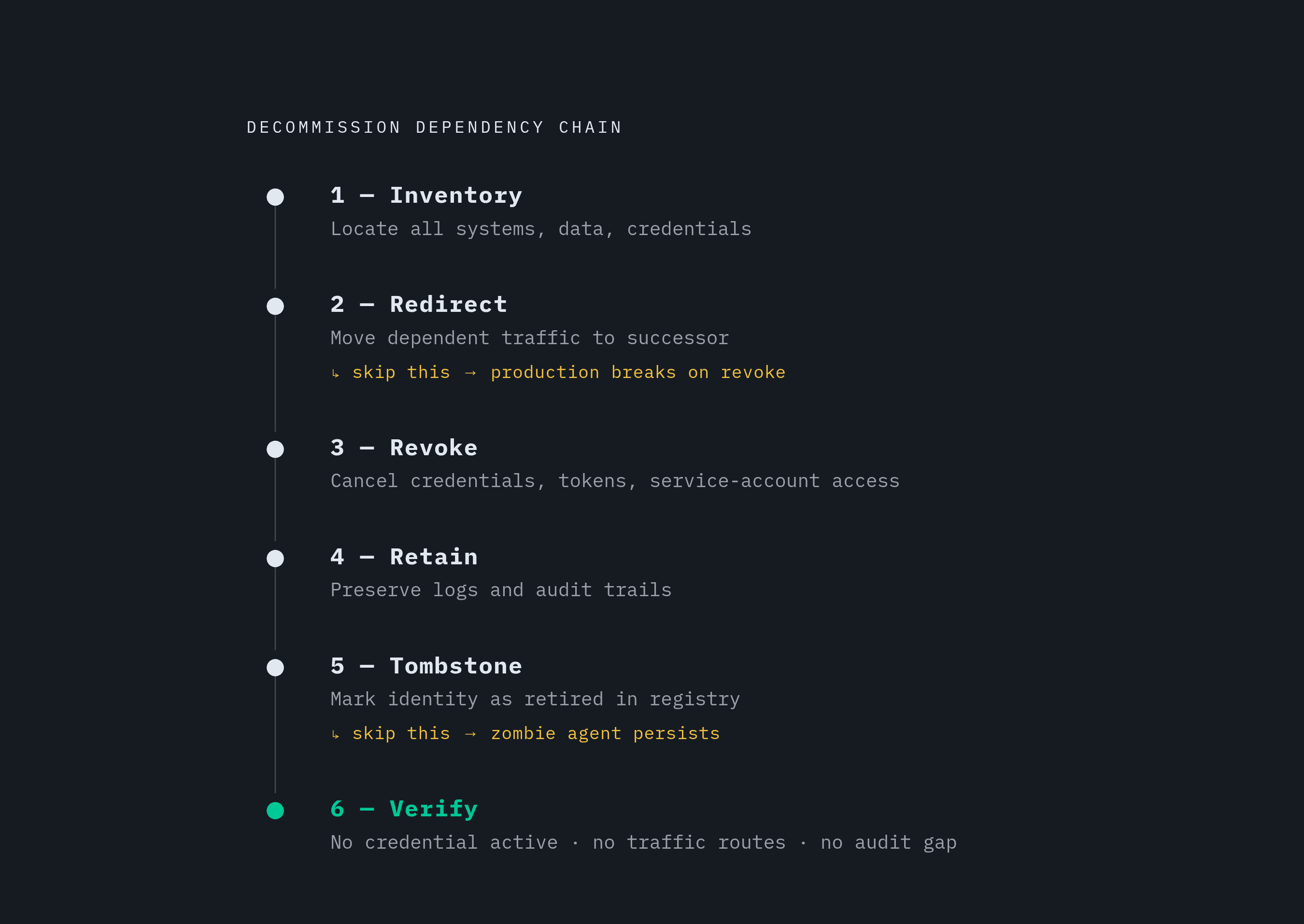
Step one is inventory: establishing what the agent is, what systems and data it touches, and where its identity and credentials actually live. Nothing else in the sequence can be done safely until this step is complete, because you cannot revoke, redirect, or retain what you haven't located.
Step two is redirect: moving any dependent traffic or workflow over to a successor before touching the old agent's access. If you skip this step, you get the most common teardown failure in practice: access gets revoked before anything downstream has been redirected, and production breaks the moment the old credentials stop working.
Step three is revoke: canceling the credentials, tokens, and service-account access the agent was using. Revocation without the inventory and redirect steps before it, and the retain and verify steps after it, is incomplete by design.
Step four is retain: preserving the logs, audit trails, and decision records tied to regulatory or compliance obligations. Deleting these in the name of a clean teardown is itself a failure mode, erasing exactly the record an auditor or incident investigator would need later.
Step five is tombstone: marking the agent's identity as retired inside the registry so it cannot be quietly reactivated, and so any future audit can account for what happened to it.
Step six is verify: confirming that no credential from the old agent still works, no traffic is still routed to it, and no audit obligation got dropped along the way.
The playbook only works smoothly if the agent was individuated, scoped, and traced from the start. So teardown discipline and deployment discipline are the same discipline, just applied at opposite ends of the same lifecycle.
A real example shows what this looks like at scale rather than in theory. The VMS-LITE project's pull request removing its deprecated GSD framework, submitted October 2, 2026, tore out legacy agent infrastructure in one coordinated move. The PR removed more than thirty agent definitions, including gsd-planner, gsd-executor, gsd-verifier, and gsd-debugger, along with every workflow definition, every orchestration file, a large set of CommonJS modules handling state management, configuration, command routing and artifact handling, and all template and configuration files, somewhere north of two hundred files of legacy infrastructure in total. The reasoning behind it was straightforward: the GSD framework had been superseded by a newer SDK-based architecture, and removing it cut maintenance burden while clarifying what API surface was still supported. The pull request itself is the audit record: it documents what was removed and why, and the new SDK had already provided the redirect path before a single file was deleted. That's the tombstone and retain steps, executed at scale, in public, with a paper trail built into the process rather than bolted on afterward.
Credential revocation, the highest-stakes step in the sequence
Revocation carries the most risk in both directions: sequence it wrong, and the fix itself takes production down.
So this is exactly the step where the zombie agent mechanism described earlier turns dangerous. If an agent has stopped being used but still holds live credentials and access, it is running autonomy under a purpose nobody currently holds, and it stays invisible because it was produced by broken lifecycle governance rather than by any attacker's effort. The 2026 incident record shows what that invisibility costs once someone else finds it first. Each of these cases shares a root cause: an integration or identity that had never been cleanly governed left an opening that didn't need to exist.
Revoke credentials before traffic has been redirected, and production breaks immediately, so the order of these steps must be followed exactly. But if you redirect before you revoke, there's a window where both the old and new agents hold valid credentials at once. An overlap window with no defined end is just a zombie agent with extra paperwork.
Verifying that revocation actually happened, rather than assuming it did, is where current tooling helps most directly. Microsoft Entra Agent ID and Google Cloud Agent Identity both maintain a registry against which revocation can be checked, so a team can confirm a credential was actually revoked rather than simply confirming that a configuration file was deleted somewhere. For OpenClaw environments specifically, defenseclaw, built by Cisco AI Defense, integrates with SIEM systems to capture tool call history and surface whether a supposedly revoked credential got used again after the fact. For CLI coding agents such as Claude Code and Codex, Bernstein, an open-source tool under the Apache-2.0 license, runs each task inside an isolated git worktree with credential scoping applied per agent. That design choice turns credential scope into something built in from the start rather than something a teardown team has to reconstruct after the fact.
One part of revocation gets missed constantly: the integration layer. When an agent holds OAuth tokens or API keys through a separate integration system, those credentials have to be revoked at that integration layer directly, not just inside the agent's own configuration. The scale of this problem is easy to underestimate. Composio's catalogue listed 1,089 toolkits as of August 11, 2026, with each toolkit corresponding to a separate application. Teams operating under data-residency requirements who use Nango, open source under the Elastic License 2.0, for self-hosted credential management face a simpler version of this problem: because credentials live on infrastructure the operator directly controls, they can be hard-deleted without routing the revocation through a vendor intermediary.
State flushing and memory cleanup for agents with persistent context
Stopping an agent's process is not the same as retiring it. If an agent's process has been killed but its memory stores are still populated, it has only been paused, not retired. It's been paused, with whatever sensitive context it accumulated sitting in storage that's still fully accessible to anyone who finds it.
Production agent architecture typically runs on a dual memory system. Long-term memory, usually a distributed vector store, holds persistent knowledge built up over time: past interactions, user preferences, institutional data the agent learned along the way. So teardown has to address both layers on their own terms, because stopping the agent's process clears neither one automatically.
Short-term context deserves the first and most urgent attention. Active session state, in-flight task queues, and conversation history sitting in Redis or an equivalent store hold the most sensitive recent data an agent produced, so that data becomes the first target if anyone reaches the storage layer after the agent process has ended. Tool call logs and decision traces that carry audit obligations get retained rather than flushed. That decision about what to delete and what to archive has to be settled before teardown starts, not worked out in the middle of it.
How cleanly any of this can be done depends heavily on what kind of sandbox the agent ran in. When each user or task runs inside a bounded environment, a microVM or an isolated container, teardown can be as simple as destroying that environment. Shared-kernel container isolation, the Docker and runc model, is no longer considered sufficient for running untrusted AI agent code under the 2026 consensus, and shared environments make state flushing harder precisely because memory boundaries between tasks aren't hard boundaries at all. If an agent is built on a weak isolation boundary, teardown teams are left guessing at what memory belongs to the retired agent and what belongs to something else running alongside it.
Session termination patterns for multi-agent and per-user architectures
The isolation boundary that determines how cleanly memory can be flushed also determines how a session gets terminated. So when architectures are built around per-user or per-task sandboxes, a single session maps to a single bounded environment, and ending that session means you tear down one clearly defined unit of infrastructure. There's no ambiguity about what belongs to the session being closed, because the sandbox boundary already drew that line at creation time.
Multi-agent architectures complicate this picture because a single workflow often spans several agents working together, and each one can hold its own credentials, its own slice of short-term memory, and its own position in an orchestration graph. Closing out that kind of session means tracing every agent that participated in the workflow, not just the one that initiated it, and applying the same inventory, redirect, revoke, retain, tombstone, and verify sequence to each one individually. So if a teardown only accounts for the lead agent in a multi-agent workflow, every supporting agent keeps running the zombie existence this entire lifecycle problem is built around.
The throughline across every pattern is the same one that runs through the rest of agent teardown: the cleanliness of the ending depends entirely on the clarity of the beginning. An agent given a distinct identity, scoped credentials, a defined sandbox boundary, and a clear data-retention policy at the moment of its creation can be torn down in a bounded, verifiable sequence. So an agent that was never individuated this clearly ends up as the kind of credential and memory remnant that enterprise governance surveys repeatedly find: unaccounted for, unattributed, and running under a purpose nobody currently holds.