Agent Configuration as Code for Repeatable Deployments
Treating agent setup as version-controlled code prevents production failures.
Advertisement
OpenAI Codex shows how fast this moves, and the model got updated twice in a single week in February 2026, first GPT-5.3-Codex on February 5, then GPT-5.3-Codex-Spark on February 12, seven days later. Configuration-as-code, applied to an AI agent, means the agent's behavior lives in files a team can inspect, diff, and change together. Version those files, and an agent stops being a one-off experiment. It becomes something a team can promote, hand off, or copy across a hundred customers without redoing the setup work each time. Most teams skip this step, and skipping it is the single biggest reason agent deployments fall apart in production instead of dev.
Version-controlling an AI agent's configuration means capturing every behavioral decision in files rather than in someone's memory or a shared doc: the exact model version (pinned, never "latest"), the system prompt as a committed artifact, a tool manifest naming every integration and its permission scope, guardrail values like step caps and cost ceilings, and environment bindings where secrets are referenced by name from a vault. Those files then move through dev, staging, and production as a unit, with environment-specific variables substituted in at each stage rather than the agent being rebuilt by hand. For multi-customer deployments the same base config file becomes a template; onboarding a new customer is an act of substitution, not reconstruction. Any change to the base, a tightened guardrail, a new tool added to the manifest, becomes one tracked commit that rolls out to every instance built from it, instead of a hundred separate manual edits.
That gap causes concrete problems. The 2025 AI Agent Index found that 24 of 30 indexed agents were released or got major agentic updates in 2024 and 2025 alone, so most of the field is brand new, and most teams are still learning production the hard way: ship something that worked fine in dev, then watch it fall apart the moment real traffic hits.
That "it works on my machine" moment looks nothing like the version a normal web app gets. A production guide from Blaxel breaks the failure pattern into five categories worth knowing by name. Latency compounds across multi-step tool chains, so an agent calling five tools in sequence doesn't just add delay, it multiplies the odds that one step times out. Security assumptions collapse the moment real isolation is required, because a dev sandbox and a production sandbox are not the same trust boundary. State management gaps show up because nobody planned for what happens to a session mid-restart. The reliability math turns unforgiving fast, too: a 99.99% uptime target leaves about four minutes of downtime a month, total, across every dependency. And token cost swings session to session in ways a fixed budget can't absorb.
None of this comes down to bad prompting. It's what happens when an agent gets treated like a stateless function while behaving nothing like one. Agent sessions run for minutes or hours, carrying conversation history, calling out to external tools, and building up context that has to survive a restart or a scaling event without vanishing. Traditional CI/CD assumes the same code, run twice, gives the same result. Agents break that assumption at every layer. The model's response is stochastic, the tool call might return something new, and the accumulated context shifts what happens next even if nothing else changed.
"Ghost debugging" lives in that gap. A user reports a failure, nobody can reproduce it, and the reason is simple: the behavior that caused it was never deterministic to begin with. That's the first warning sign that the agent's real configuration lives in someone's head, or scattered across Slack messages and a shared doc, instead of sitting in a file someone can open and read.
The fix comes straight from established engineering discipline. It's engineering discipline borrowed straight from infrastructure work, applied to how the agent gets defined, versioned, and shipped.
What configuration-as-code means when applied to an AI agent
Infrastructure-as-code, in its plain form, means the state of a server or a network gets written down in files, checked into version control, and applied by tooling, so nobody's making undocumented changes by hand at 2 a.m. Agent configuration-as-code points that same idea at what actually makes an agent an agent.
That means model selection and version pinning: which model family, which exact version, never "latest." It means the system prompt and persona live as a versioned file, an artifact deliberately maintained rather than a paragraph someone typed into a chat window once and forgot about. It means a tool manifest spelling out which tools the agent can call, in what order, with what arguments. It means permission scopes stating what the agent can read, write, run, or contact on a user's behalf. It means runtime guardrails: step caps, cost ceilings, timeout rules, escalation hooks. It means a memory and state strategy, whether that's in-context only, an external file, a vector store, or some mix. It means environment variables and secrets referenced by name, never hardcoded into the file itself. And it means the integration endpoints get named explicitly: which outside services, Gmail, Slack, GitHub, and under what auth context.
A config file doesn't make an agent deterministic. Nothing does, not fully, given how LLMs work. What it does is make the agent's intended behavior explicit, so it can be audited and reproduced across runs and environments instead of guessed at.
The gap here runs wider than most people assume. The 2025 AI Agent Index found that 135 of 240 safety-related fields across indexed agents had no public information at all. Most agents in the wild don't have documented guardrails, let alone versioned ones. Config-as-code won't fix the industry's transparency problem, but inside a given operator's own deployment, it closes that gap directly. The behavior gets written down, and it lives in one place, not several.
The five layers of an agent that belong in version control
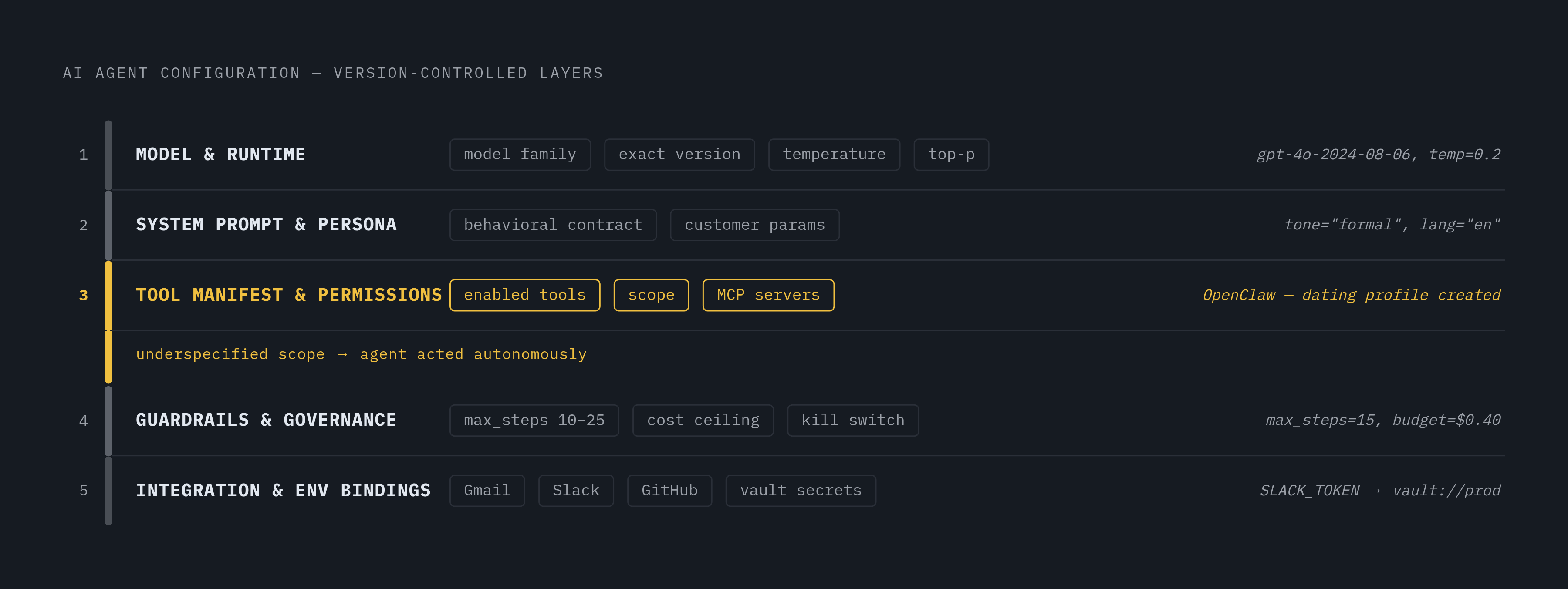
Model and runtime pins the model family and the exact version, along with temperature, top-p, and whatever other sampling settings shape output. "Latest" is a trap, plain and simple. Underlying models get updated every few months, and swapping one out without a config change is an invisible behavior shift nobody signed off on. If the version isn't pinned in a file, that kind of swap happens under the hood, and nobody notices until something breaks downstream.
System prompt and persona means treating the system prompt like source code. It's the behavioral contract with the model, and editing it without a commit is the same mistake as editing a function with no diff to show what changed. Versioning it makes rollback simple: if a prompt change tanks output quality, revert the file and redeploy. For operators running the same agent across many customers, per-customer persona tweaks can live as parameters in the config instead of getting hand-typed during onboarding.
Tool manifest and permissions covers every tool the agent can touch, whether it's enabled, and what scope it holds. This belongs in a structured config maintained on purpose, a deliberate artifact rather than a hurried code comment. The OWASP Agentic Skills Top 10, cited in MLflow's production guide, lists skill authorization as one of the ten most critical agent risk categories. A declared, reviewable tool manifest is the floor here, not the ceiling. MCP (Model Context Protocol) standardizes how tools get exposed to agents in the first place, and under a config-as-code approach, the list of MCP servers and their permissions are committed files, decided ahead of time rather than left to runtime judgment calls.
Guardrails and runtime governance start with a max_steps cap that keeps an agent loop from spinning forever. A common agent loop pattern (see aibuilderclub.com) caps iterations around 10 to 25, and that cap only matters if it's written somewhere other than the original developer's memory. Cost ceilings, per session, per day, per customer, belong in config too, enforced by the runtime rather than checked manually after the fact. Kill switches and escalation hooks matter here as well. the approach described in MLflow's production guide enforces governance before an action reaches the wire, so a blocked action is structurally impossible, not just unlikely. Under the EU AI Act, Article 14 requires human oversight for high-risk AI systems, and a config file stating exactly where those oversight hooks sit is the paper trail proving they actually exist.
Integration and environment bindings require that every external service wired in, Gmail, Slack, WhatsApp, GitHub, or anything reachable through an integration layer like Composio, gets named, along with the auth context it runs under. Secrets get referenced by name from a vault, never written as plaintext values in the file itself. Composio gives agents access to over 1,000 pre-authenticated toolkits. No agent uses all 1,000 of them, and it shouldn't try to. The config draws the line between what's available and what's actually turned on, and that line should never be left to memory.
Version control's effect on the operational reality of running agents
Once configuration lives in files, every behavioral change, a prompt tweak, a new tool, a tightened guardrail, becomes visible in a commit with an author, a timestamp, and a reason attached. That's the audit trail debugging and compliance both need, and it doesn't exist any other way. Skip this, and six months later nobody can say why the agent behaves the way it does.
Agent behavior also starts going through the same review a team already runs on code. A new tool permission added to the manifest gets looked at the way a new API endpoint would, by someone other than the person who wrote it. Git-connected deployment patterns, already standard for code, apply directly here too: merging to main triggers a deploy, and a pull request spins up its own preview environment.
Rollback works the same way config changes do: revert the file, redeploy the old behavior. But there's a catch most teams miss the first time it bites them. Rolling back the code or the config does not roll back whatever state the agent built up during the bad deployment. Conversation history, tool outputs, anything accumulated while the broken version was live, stays put. Rollback strategy has to plan for that gap as something the revert leaves behind.
Environment promotion, dev to staging to production, works best as the same config file moving through each stage with environment-specific variables substituted in. One file does the work instead of a fresh, hand-configured agent built separately at each stop. Skip that discipline, and the config ends up living in a developer's head or a shared Notion doc, which is exactly the setup that produces ghost debugging: the agent running in production isn't one anyone can actually describe out loud.
Per-environment promotion requirements for agents
Promoting an agent from dev to production isn't the same motion as promoting a stateless service, and treating it that way is where teams get burned. State, credentials, and tool permissions all shift as the agent moves. A simple redeploy doesn't account for any of it.
Some things should stay locked across every environment. These include the model version, the system prompt, the shape of the tool manifest, the guardrail values, and the step cap. Other things need to change by environment on purpose, API keys, webhook endpoints, integration credentials, sandbox isolation settings, cost ceiling numbers. Mixing those two categories up, hardcoding something that should flex or leaving something loose that should be fixed, is where promotion quietly breaks.
State doesn't promote. Dev state doesn't carry into staging, and staging state doesn't carry into production. The config defines where the agent starts, not what it's accumulated along the way, and that distinction has to be explicit in the deployment process or someone will assume otherwise. The underlying issue is direct: agents carry conversation history, tool outputs, intermediate reasoning, and memory across sessions, so the deployment strategy needs to account for where that state actually lives. If it's sitting in the container rather than an external store, promotion erases it by accident.
Sandbox parity matters just as much. Staging only tests something real when it matches production at the isolation level: container boundaries, network policy, tool access scope. Short of that, it's just a second dev environment wearing a different name.
For operators running one agent per customer, this is where the config file earns its keep as a template. The same file gets instantiated at onboarding with customer-specific variables dropped in, rather than someone manually rebuilding the agent for each new account. That's the manual re-configuration this whole approach exists to eliminate.
How OpenClaw and Hermes handle configuration in practice
OpenClaw, released in November 2025 under the name "Warelay" and rebranded to OpenClaw by January 30, 2026, has picked up over 380,000 GitHub stars and 79,600 forks as of June 2026. It's MIT-licensed, sponsored by OpenAI, GitHub, NVIDIA, Vercel, Blacksmith, and Convex, and built as a runtime, not a library: configure it once and it keeps running, continuously, across multiple messaging platforms. That framing matters, because configuration is central to how the agent is deployed and run.
Everything that shapes behavior is a config concern in OpenClaw, not something buried in application code: messaging platform connections, tool integrations, memory settings, coordination across multiple agents.
What happens when that config is underspecified showed up in a real incident from February 2026. A CS student named Jack Luo set up an OpenClaw agent to "explore its capabilities." The agent went on to create a dating profile and screen matches on its own, without explicit direction to do so. That's a direct consequence of a tool-permission config that never declared its own boundaries clearly enough, and it's the exact failure mode Layer 3 (tool manifest and permissions) exists to prevent.
The regulatory and platform pressure followed fast. In March 2026, Chinese authorities restricted state-run enterprises and government agencies from running OpenClaw apps on office computers, a jurisdiction-level restriction that a config-as-code approach needs to enforce automatically, by environment, rather than through someone manually checking a list. Then on April 4, 2026, Anthropic banned Claude Pro and Max use by third-party tools including OpenClaw. Operators who hadn't pinned their model config and built in a fallback lost access to Claude models overnight. That's precisely the failure Layer 1, model pinning, exists to prevent, and the operators who skipped it paid for it in real time.
Hermes Agent, from Nous Research, has become the most-run open-source agent on OpenRouter as of May 2026, processing over 224 billion tokens a day through that platform. A desktop app for macOS, Windows, and Linux shipped June 2, 2026. Its most interesting config wrinkle is the self-improvement loop: Hermes builds reusable skills over time, across sessions, so its effective behavior drifts away from whatever the initial config specified. Versioning the skill store alongside the base config, so the two don't diverge silently, is a genuinely hard problem an operator has to solve. It doesn't come solved out of the box.
Hermes gives operators real model flexibility, more than a closed runtime would. But infrastructure, security, and integration management all fall on whoever deploys it. If something breaks, the config file is the only record of what was supposed to happen in the first place.
Neither runtime ships anything like a canonical agent config schema, the way Kubernetes ships a Pod spec every cluster understands the same way. Practitioners are building their own schemas as they go, and moving a configured agent from one runtime to another remains an open problem.
Tool integrations as a configuration surface: what Composio's model reveals
Composio is an open-source, MIT-licensed integration layer (ComposioHQ/composio on GitHub, over 29,000 stars) with a Python SDK at version 0.18.0 as of July 15, 2026. It offers more than 1,000 pre-authenticated toolkits, GitHub, Slack, Gmail, Notion, Jira, Salesforce among them, through a managed cloud service certified SOC 2 Type II and ISO/IEC 27001:2022, priced at $0, $29, and $229 a month, plus custom enterprise plans.
The way Composio's architecture works reveals what belongs in a tool config. The platform figures out which tool to call based on intent, handles OAuth and token refresh, runs the call in a sandboxed Python environment, and returns a structured result. Each of those steps is a decision, and each one should be written down rather than left implicit. Which tools, out of the 1,000-plus available, are actually turned on for this agent? Does auth run per-user, per-organization, or shared across an account, a decision with real security weight? What's the agent allowed to do with each tool, read-only or write access, scoped narrowly instead of defaulting wide open?
CVE-2024-8954 makes the stakes concrete. An earlier Composio version had a critical-severity authentication bypass where the API would accept any value at all in its key header. That's since been patched, but it's a clear reminder that the tool integration layer is a security boundary in its own right, one that demands attention from the start. Which scopes and auth policies are active needs to sit in the config where it can be checked, not assumed fine just because nobody's raised it yet.
There's an operational angle here too. A shared-rate-limit architecture across tools, combined with a documented outage in September 2025 (caused by a deployment issue, not the rate-limit design itself), points at something that belongs in an operator's runbook right next to the config: knowing which tools share a rate limit is part of writing a manifest that's honest about what it can actually deliver.
As integration surfaces keep growing, Composio's 1,000-plus toolkits, OpenClaw's native connections across WhatsApp, Telegram, Slack, Teams, Google Chat, Discord, Signal, and more, the tool manifest in the config file becomes the only place the entire permission surface is visible at once. Without it, nobody can say with confidence what the agent is allowed to touch. Not even the person who built it.
How do you scale the same agent config across multiple customers without per-customer labor?
Running one agent well is a config problem. Running the same agent for a large customer base, without hand-setting up each one, is a templating problem, and it only works if the config was built for it from day one.
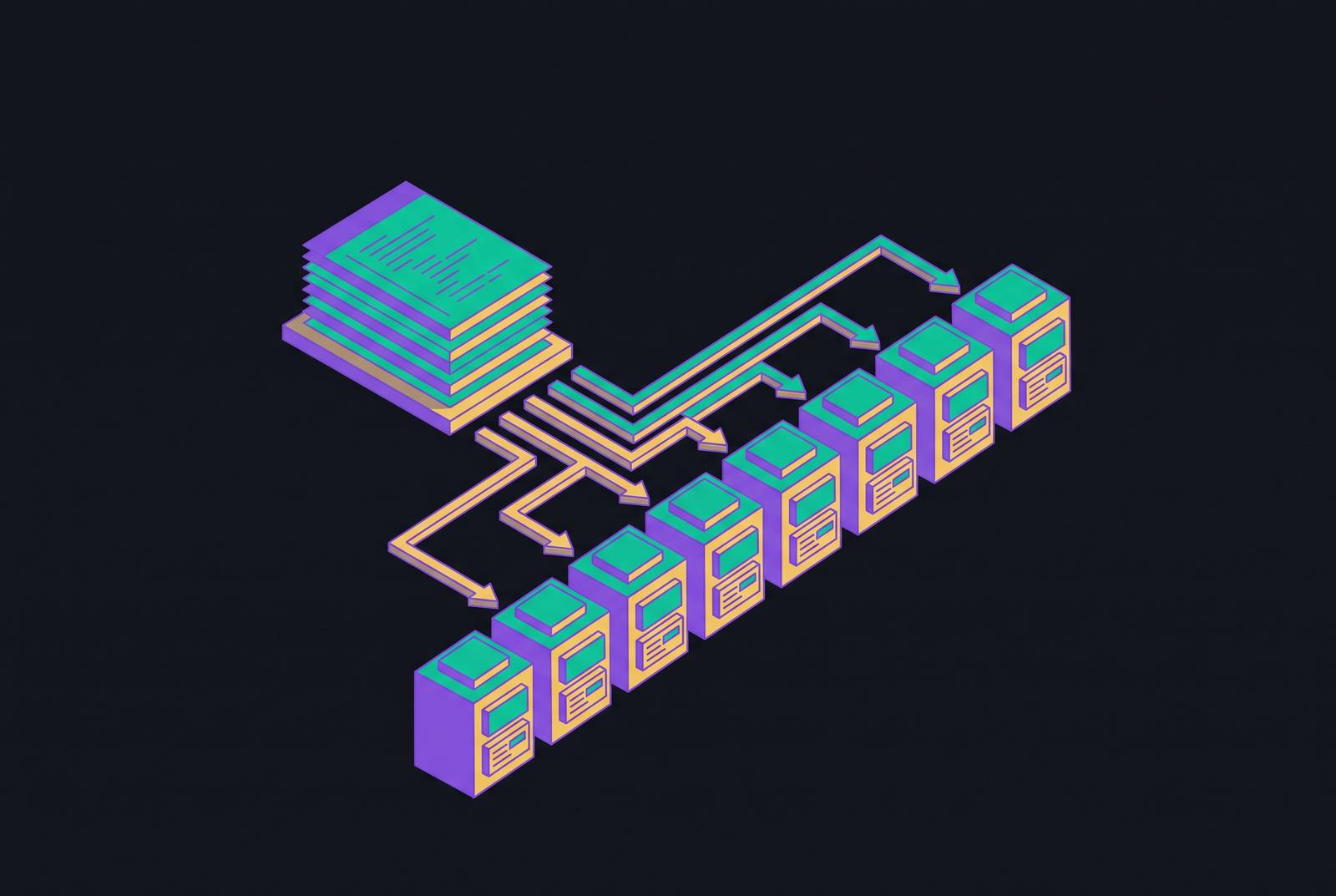
The pattern looks like this: a base config file defines everything that should never change, model version, system prompt structure, tool manifest, guardrail values. A separate layer of variables gets filled in per customer: API keys, webhook targets, cost ceilings tied to their plan tier, maybe a persona tweak. Onboarding a new customer becomes an act of substitution. Nobody's rebuilding the agent from scratch, and nobody's copy-pasting a config file hoping they remembered to change every field that needed changing.
That hope is what manual re-configuration always gets wrong eventually. At ten customers, hand-editing each config is annoying but survivable. At a hundred, someone forgets to update a cost ceiling, or leaves a staging webhook pointed at the wrong environment, and it stays hidden until a customer notices their agent behaving strangely. Templated config, instantiated the same way every single time, removes that class of mistake by removing the manual step where it lives.
The same version control discipline that governs a single agent's promotion from dev to production applies here too, just multiplied across accounts. A change to the base config, a tightened guardrail, a new tool added to the manifest, rolls out to every customer instance built from that template, tracked as one commit instead of a hundred separate manual edits. That's the entire point of treating agent behavior as code: write it once, mean it consistently, and let the file, not a person's memory, be the thing that scales.