Versioning Agent Configurations Across a Growing User Base
Treating prompts and models like versioned code prevents silent agent failures at scale.
Advertisement
What needs versioning in a production agent
Most agent products die in the gap between a demo that works and a production system that survives contact with thousands of real sessions. McKinsey's State of AI report found that 62% of organizations are experimenting with AI agents, but only 11% have anything running in production. Gartner projects that by the end of 2026, 40% of enterprise applications will embed AI agents, up from under 5% in 2025. A lot of agents are about to hit production, and most teams building them are about to learn the same lesson the hard way.
The failure pattern is drawn from an account documented by buildmvpfast.com. A team changes one word in a system prompt, from "summarize the issue" to "summarize the issue concisely." Within an hour, customer responses start getting truncated mid-sentence. Ticket backlog triples. The team can't roll it back without redeploying the entire service, because nobody versioned the prompt separately from the code. Most teams still treat agents like scripts instead of versioned software with a real lifecycle, and that gap is exactly where things break. At ten users, someone would catch that broken response by reading it. At ten thousand, the bad prompt spreads through every session before anyone notices a thing.
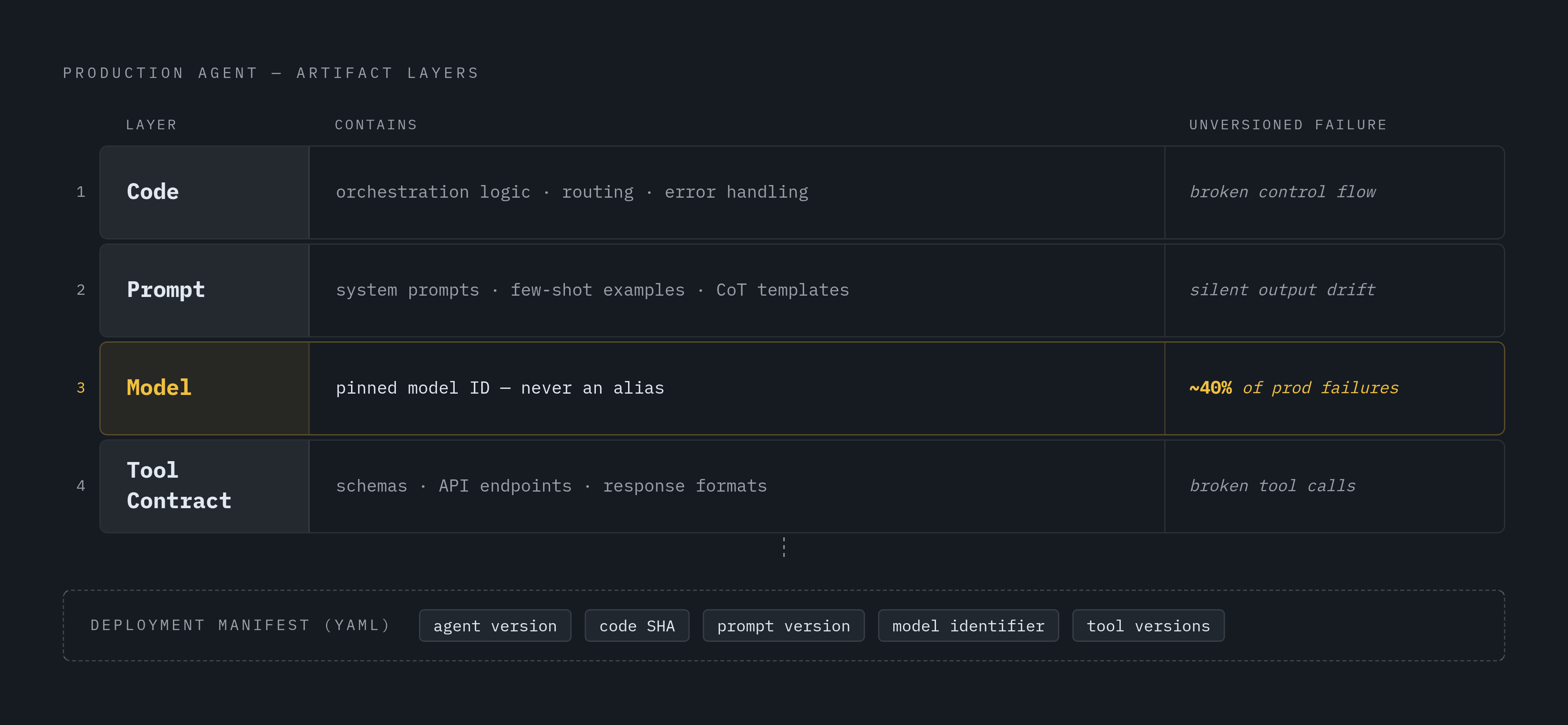
An agent is at least four artifacts stacked on top of each other, and changing any one layer shifts behavior in ways the other layers won't warn you about.
Layer 1 is code: orchestration logic, routing, error handling. Most teams already track this in Git, so everyone tends to get this right.
Layer 2 is the prompt: every system prompt, every few-shot example, every chain-of-thought template the agent runs on. This is where silent failures usually start, because prompts don't feel like code to most teams, so nobody treats them like code.
Layer 3 is the model, and specifically the pinned model identifier, not an alias. buildmvpfast.com's guidance is blunt about this: pin the identifier.
Layer 4 is the tool contract: schemas, API endpoints, response formats for every tool the agent calls. If Stripe or Salesforce or an internal search index changes its response shape, that's a version change for the agent, even though nobody touched a line of its code.
The fix is a deployment manifest, a YAML file or something like it, that pins all four layers at once: agent version, code SHA, prompt version, model identifier, tool versions. buildmvpfast.com lays out roughly this structure. The test for real versioning is simple: the exact behavior can be recreated from the manifest alone. If not, what's being called a "version" is just a label with no teeth.
Skipping any of these layers produces specific, recognizable failures. A support agent starts hallucinating refund policies because the prompt drifted. A sales agent quietly stops pulling from Salesforce because a tool contract changed underneath it. An underwriting agent produces a different risk score for the identical application because a model alias got swapped behind the scenes without anyone pinning the version. The research informing this piece attributes roughly 40% of production agent failures to model drift alone, which is not a small number to be leaving unmanaged.
Monolithic agent design makes all of this worse. One LLM handling reasoning, routing, and execution together means no layer can ship independently, so a one-line prompt fix forces a full redeploy of everything. MLflow's 2026 guide pushes toward a more modular approach: treat each capability as its own discrete, independently upgradeable unit, closer to how microservices split up a traditional backend. Prompts are code now. They deserve the same discipline: version every change, no exceptions.
Versioning complications from stateful, per-user agents
Traditional software testing assumes the same input produces the same output every time. Agents break that assumption completely. Running the same query through the same version twice can produce two different responses, so a test suite passing at a high rate tells you very little. It can't tell normal model variance apart from an actual regression.
Then there's what happens to sessions. A user halfway through a conversation doesn't know or care that v2.1 just shipped; they expect the conversation to keep making sense. Roll back to v2.0 and the question becomes what happens to the state v2.1 already created, since v2.0 may not even recognize that data structure. This exact scenario is one of the harder unsolved edges in agent deployment, and it's easy to see why: there's no clean answer, only tradeoffs.
Multi-agent systems stack a cascading dependency on top of that. Agent A calls Agent B, which calls a tool. Roll Agent B back a version, and Agent A can break silently, because it was relying on a response format that only existed in Agent B's newer version. In most multi-agent stacks, that contract between agents is implicit. Nobody wrote it down, so nobody notices when it breaks until a user does.
Scale turns this from an annoyance into a structural risk. With a handful of users, a mid-session version conflict gets caught by someone reading logs that afternoon. With thousands of concurrent users sitting in different version states at the same moment, there's no manual way to track any of it.
Load balancers for agent systems need to be version-aware as well as user-aware. Routing a user's next message to a different version than the one their session started on is a silent break: it appears weeks later as vague complaints, not a clean error in a log. State schema compatibility affects rollback safety directly too. If the new version writes state in a different shape than the old version reads, even a clean rollback can corrupt sessions the new code already touched. Versioning strategy has to account for session lifecycle from day one, because retrofitting it after the first incident is expensive, and it's usually too late for the sessions already caught in the middle.
Deployment patterns that keep updates safe across a live user base
Three patterns cover most of what a team needs. They're not competing options so much as tools suited to different risk levels, and picking the wrong one for the situation is a common, avoidable mistake.
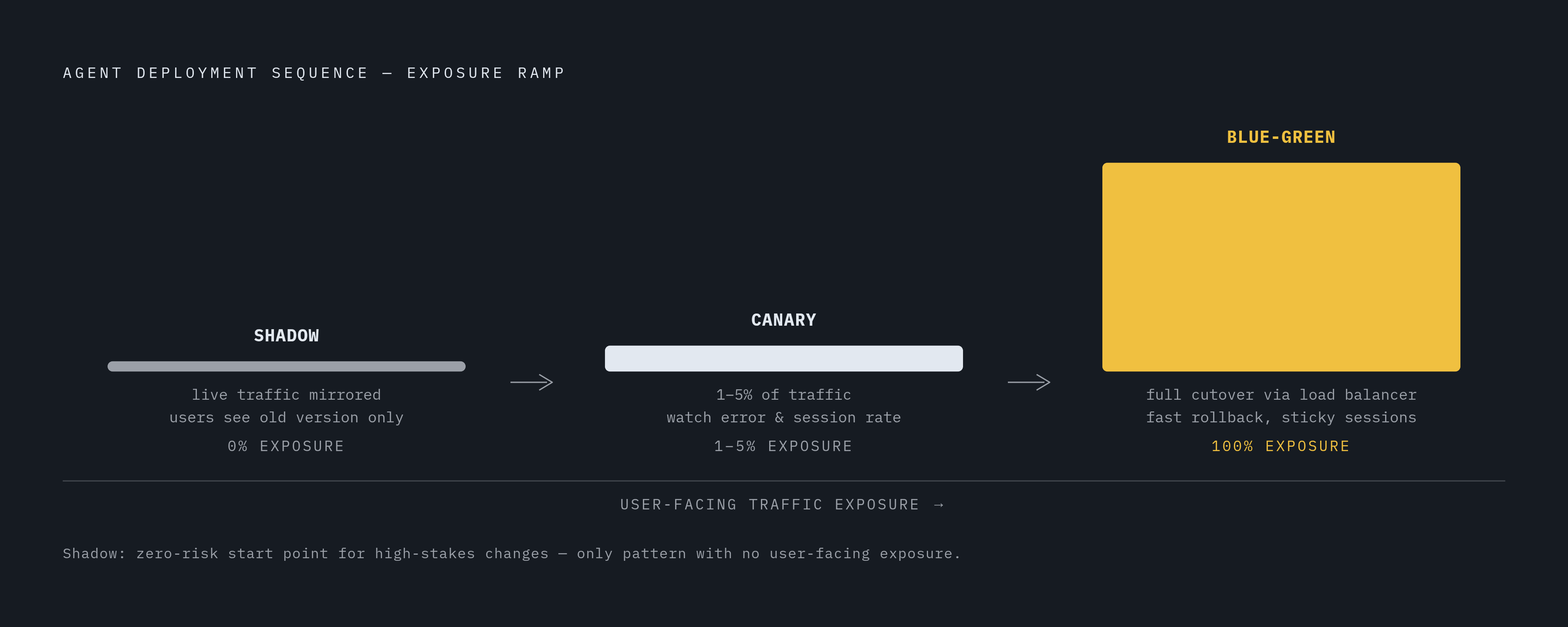
Blue-green deployment runs two identical environments. All traffic sits on "blue." The new version deploys to "green," gets tested there, and traffic switches over once it checks out. Rollback is a single load-balancer flip, about as fast as a rollback gets.
Standard blue-green doesn't account for sessions, though, and that gap means agents lose session continuity on top of the usual deployment risk. Three ways to handle it, each with a real cost:
Draining connections first means waiting for active conversations to finish naturally before switching traffic. It only works if conversations are short, so it's a poor fit for anything long-running.
Sticky sessions with version tagging keep conversations already in progress on blue until they end on their own, while new conversations start on green. buildmvpfast.com identifies this as the approach that works best in practice, and it's the one worth defaulting to unless there's a specific reason not to.
State migration exports state from blue, transforms it to fit green's schema, and imports it into green. That same account calls this the "nuclear option," and for good reason: it's usually more trouble than it's worth.
Smoke tests for agents need rethinking too. A health-check endpoint returning 200 means almost nothing for a non-deterministic system. What matters is sending representative queries and checking that responses fall within expected bounds, not that they match some fixed string exactly.
Canary rollout sends a small slice of traffic, often 1% to 5%, to the new version while everything else stays on the old one. Watch session success rate, escalation rate, error rate. If the numbers hold, expand the slice; if they degrade, roll back automatically. The advantage over blue-green is that canary gives real signal on probabilistic variance before the whole user base sees the new version.
Shadow deployment goes further. Live traffic routes to both the current and new version at once, but only the current version's response ever reaches the user. The new version runs silently in the background, logging its reasoning and results for comparison later. This is the right call for the highest-risk changes, model swaps, major prompt rewrites, situations where even a small canary carries too much exposure. It validates against real traffic with zero user-facing risk, and rollback is automatic in the truest sense, since users were never touching the new version to begin with.
None of these patterns are mutually exclusive, and treating them as one-or-the-other is where teams waste risk budget. A common sequence starts with shadow to validate quietly, graduates to canary once shadow results look clean, and finishes with a blue-green switch for the full cutover. Which sequence to use depends entirely on how risky the change actually is.
Managing rollbacks when state has already diverged
Rolling back an agent is not just flipping a load balancer switch back to the old setting. What happens to the state the new version already created before anyone noticed a problem matters most.
If the new version's state schema is backward-compatible with the old one, rollback is clean. If it isn't, sessions touched by the new version may need manual fixing, or they may not be recoverable in their current form.
Structured audit logging isn't optional here; it's the prerequisite for the whole exercise. Capturing the agent's reasoning, its tool calls, and its decisions at each step gives engineers the evidence trail needed to understand what the new version actually did before anyone pulls the rollback trigger. Both MLflow's 2026 guide and reporting from MachineLearningMastery.com treat this as close to non-negotiable, and for good reason: without that trail, debugging a non-deterministic failure is close to impossible, since the failure often can't be reproduced on demand.
Runtime governance adds a preventive layer on top of logging. Microsoft's Agent Governance Toolkit approach, as described in MLflow's material, enforces governance rules deterministically before an action ever reaches the wire. That makes certain failure classes structurally impossible, rather than something caught after the fact through monitoring alone.
Human-in-the-loop handoffs work as a safety valve at scale. When an agent hits low confidence, fails to retrieve data it needs, or runs into a situation outside its defined routines, handing off to a human agent limits how much damage a bad version can do before someone catches it, a pattern referenced in deployment practices at large scale. For teams operating under the EU AI Act, this isn't a nice-to-have: Article 14 requires human oversight interfaces for high-risk AI systems, so those hooks need to be built before deployment, not bolted on after a regulator comes asking.
Rollback works best treated as a rehearsed procedure, not an emergency improvisation. Whether a rollback is fast or slow depends entirely on whether the manifest-based versioning system got built before the incident happened, not scrambled together during it.
Per-user agent isolation as the architecture that makes safe versioning possible at scale
A shared agent pool creates version conflicts across users by design, simply because every user draws from the same pool of instances running the same version at the same time. That's the wrong architecture for anything beyond a demo. Per-user isolation fixes this structurally: each user's agent gets versioned, updated, and rolled back on its own, without touching anyone else's session.
Isolation, in practice, means each user's agent has its own filesystem, its own persistent state, and its own version manifest. A bad update to one user's agent stays contained to that user. Rollback scopes to a single agent instance, not the whole fleet.
Persistence is what makes any of this meaningful. If an agent's disk state disappears the moment its process ends, there's nothing to roll back to. The "before" state simply doesn't exist anymore, which makes the whole rollback conversation moot.
The provisioning model that makes isolation practical at real scale is one API call per new customer. The right unit of scale for an agent-powered product is one isolated, persistent agent per customer, spun up automatically the moment someone signs up.
Operators who want full control can self-host on their own VPS or Docker stack, keeping the entire versioning pipeline in-house. That control comes at a real cost, though: provisioning, monitoring, and recovery for every single customer instance falls on the operator's own team. Whether that operational load is a good use of a founder's time deserves an honest answer, rather than assuming self-hosting is the more serious or more capable choice by default. Often it isn't.
Versioning the tools and integrations agents depend on, not just the agent itself
Teams most often forget the layer they never control. When a third-party API changes its response schema, that's a version change for every agent calling it, even though nobody touched the agent's own code. Some of the hardest production failures start exactly here, precisely because nothing in the agent's own repo changed.
The integration surface is bigger than most teams assume. Composio's catalogue listed 1,089 toolkits as of August 11, 2026, covering more than 20,000 individual tools spanning Gmail, Slack, GitHub, Notion, and hundreds of others. Loading tools the standard way doesn't scale: loading GitHub and Notion alone as standard MCP tools burns roughly 40,000 tokens before a user has typed a single word. Stretch that pattern across 500 connected apps and the whole approach collapses. Composio's answer is to give the agent five meta-tools instead, fetching the specific schema it needs only at the moment it needs it.
Authentication is a versioning concern too, even though it doesn't look like one at first glance. Composio stores each user's OAuth credentials in what it calls "connected accounts," so an agent always acts as the right person. When an OAuth scope changes or a token rotates, that update happens in one central place instead of getting scattered across a hundred per-user configuration files.
A complete deployment manifest needs a tool contract layer, and at minimum that means a named version or schema hash for every external API the agent touches. If a team skips this, the manifest is only tracking three layers out of four while calling itself complete.
Composio backs its managed cloud service with SOC 2 and ISO 27001 certifications, and the ComposioHQ/composio repository has crossed 29,000 stars. Both are signals teams should weigh when deciding whether to build this integration layer in-house or lean on a managed provider instead.
Choosing which agent to version and host: what OpenClaw, Hermes, Claude Code, and Codex each require
OpenClaw is a mature, open-source platform built on Node.js and released under the MIT license. It's now stewarded by a non-profit foundation, following creator Cole Steinberger's move to OpenAI, a transition that shifted governance away from a single maintainer and toward a structure built to outlast any one person's involvement. For teams weighing where to run their own versioning pipeline, that governance model matters as much as the codebase itself. An open, foundation-backed project gives a team full control over its manifest system, its rollback procedure, and its tool contracts, without depending on a vendor's roadmap to support any of it. That's a real advantage over betting the whole pipeline on a single company's continued interest.
Sources
- Building Production-Ready AI Agents in 2026 | MLflow
- Deploying AI Agents to Production: Architecture, Infrastructure, and Implementation Roadmap - MachineLearningMastery.com
- AI Agent Versioning and Rollback | Zero Downtime
- Versioning, Rollback & Lifecycle Management of AI Agents: Treating Intelligence as Deployable Software | by NJ Raman | Medium
- composio.dev