The One-Week Sprint From Working Agent to Paying Customer
A solo founder can launch by buying infrastructure and clearing five gates.

A solo founder can deploy an AI agent without server or software operations knowledge by using managed hosting, connecting the tools the first customer needs, and setting up pricing and automatic onboarding. Getting from a working agent to a paying customer in one week is an operational sequencing problem. The fastest route is to buy the delivery infrastructure and clear its gates in order.
Why the week's bottleneck is never the agent itself
The sprint starts when the agent works and customer access and payment still need to be set up. The founder has proved that the agent can do a job, but has not built the delivery surface around that job. After a demo works, deployment, authenticated tool connections, onboarding, and payment still need to be in place before a customer can buy.
Another prompt change or another thing the agent can do feels like progress because its effect is immediately visible in the agent's output. Yet an agent that performs better in a private session still cannot serve a customer if it stops when that session ends. Nor can it deliver much value if it cannot reach the customer's tools. The missing work is operational, even when some of it involves technical configuration.
The plan therefore has five gates before outreach. Choose the runtime, deploy it durably, connect the customer's tools, package the service, and clear the buyer's compliance requirements. Each decision supplies something the next one needs, from the runtime's capabilities to the permissions that a security review will examine. The unfinished gate that keeps a stranger from buying today needs the most attention.
Matching the agent runtime to the job before anything else gets built
Hermes Agent, Claude Code, and OpenClaw serve different jobs. Hermes is the fit for ongoing operations where cross-session memory and continuity are central. Claude Code is the fit for coding in a git workspace, including refactors and test loops. OpenClaw is the safe default when neither specialist is a clear fit for the job, especially when the agent needs to connect to a broad range of tools for customers.
The distinction comes from the harness around the model. That harness determines which tools the agent can touch, how memory persists, and how freely the founder can change model providers. Hermes has bring your own key, while Claude Code is built around Anthropic's models and billing. Choosing the wrong runtime can force a rebuild after deployment and integration work has already started.
Some teams need more than one runtime. A small engineering team might use Claude Code on developers' laptops, Hermes as the always-on operator, and OpenClaw as the customer-facing delivery surface. With separate instances, each runtime has a clear job, so one bot does not have to muddle through the work of all three. That workload decision should stay within the first week's scope. For up-to-date pricing, use the pages for each runtime, and keep benchmark scores from driving the runtime choice.
Infrastructure burden is a separate comparison. OpenClawd and OneClaw offer third-party managed deployment for OpenClaw without requiring VPS knowledge, while self-hosting calls for Docker and VPS expertise. A founder can therefore choose OpenClaw for its job fit without also choosing to become its server administrator.
How to deploy an AI agent without DevOps or server knowledge
Managed hosting is the right default for this sprint. The choice is mainly about time and risk. A small VPS with 2 vCPU and 2–4 GB RAM can support a single agent that mostly waits on API calls. The hardware is not the difficult part. Setup, maintenance, backups, and security are the work that competes with finding a customer.
Self-hosting has a legitimate place when control and low running costs take priority. For one or two agents, taking responsibility for a VPS can be a reasonable trade. During a one-week launch, however, that responsibility consumes time the founder needs for integration, packaging, and sales. Managed hosting makes even more sense as the number of customer instances grows. A low server bill is not much of a victory if the product remains unavailable to buyers.
Managed platforms offer one-click deployment for runtimes including OpenClaw, Hermes, Claude Code, Codex, OpenCode, and Grok CLI. The appeal is straightforward. The agent can keep running while the platform takes care of uptime, backups, and security for the founder. To choose a platform for this sprint, look for those operational services as well as support for the runtime the job requires.
Vendor dependency is a real objection, but self-hosting is not the only answer. One-click export, bring your own API key, and freedom from proprietary data lock-in provide a way out without requiring server work on day one. Meanwhile, token usage is likely to dominate the invoice. Prompt design, model choice, and prompt caching deserve more attention than squeezing the monthly hosting fee.
Connecting the agent to the tools that make it useful to a paying customer
A deployed agent needs access to the customer's actual work. Without authenticated connections to an inbox, a workspace, or a repository, it remains separate from the environment where its output is useful. Integration closes that gap. The first choice is not which platform advertises the longest app list, but which connections let the agent complete the first customer's job.
Start with one or two load-bearing integrations. Gmail and Slack may be central to one workflow, while GitHub is central to another. OpenClaw's broader integration surface includes tools such as Google Drive, Google Calendar, Notion, and Outlook, but availability alone does not make a connection ready to use. With self-hosting, the founder still has to do the technical configuration and use their own API keys for AI models. A supported app is not an authenticated customer workflow.
This is where the managed integration layer earns its place. Dashboard-based connections reduce the amount of setup the founder must handle directly, but they do not remove the need to establish access to the right customer tools. Without the authenticated connection itself, the agent cannot act in the customer's environment.
A narrow, complete workflow beats a broad, unfinished promise. Once that workflow delivers value, multi-bot teams offer a way to expand it, with separate bots taking separate jobs and handing work to one another while the customer receives one answer. That architecture can scale the product beyond a single agent.
Packaging the agent as something a stranger will pay for
Before onboarding starts, it must be clear what the customer is buying. Selling access to an agent is different from selling each customer a private, persistent agent instance. Direct subscription is straightforward because the buyer pays a fixed monthly price for access. With per-user agent resale, also called Agents-as-a-Service, each customer buys their own isolated instance. For a one-week B2B sprint, that unit fits the goal of giving every customer their own running agent.
White-label delivery offers another commercial structure. In that model, the founder sells the customer-facing product while buying the underlying infrastructure. The productization work is to define the job, the price, and the delivery path. Each signup needs a repeatable onboarding path. Automatic provisioning sets up a running customer instance after a sale, so the founder does not have to build every account by hand.
Token costs vary with activity, while a fixed subscription does not. A customer who puts a large workload through the agent can therefore make an apparently simple monthly plan expensive to serve. This is the agency pricing trap. Usage-based billing controls or consumption caps need to exist at the platform level.
White-label and per-agent models can have strong gross margins when platform costs stay flat and are easy to plan for, but token consumption still needs a limit. The useful distinction is between a known cost for providing the customer instance and a variable cost for the work it performs. Packaging is complete only when the offer, onboarding, and usage controls fit together.
Clearing the compliance gate that enterprise buyers actually check
Above a certain contract size, security and compliance are preconditions for payment. Building a SOC 2 Type II baseline takes months and a significant budget. A one-week sprint needs a platform with an existing baseline and a buyer whose requirements that baseline can support.
A platform already SOC 2 Type I certified, with encryption in transit and at rest, provides a practical starting point. That buys part of the foundation. It does not settle how the model provider handles data, how transcripts are retained and deleted, or whether agent actions produce an audit trail acceptable to the customer's regulator. The sales path can still stall if the buyer requires more.
Permissions need the same sober treatment. A system prompt that says “never delete” gives an instruction while leaving the agent's access unchanged. An auditor examines what the agent can actually do, so the practical approach is to remove tools and scopes that the workflow does not require. The AIUC-1 standard's April 2026 quarterly update adds MCP-specific controls beyond SOC 2, including approved MCP servers and mandatory monitoring of third-party access. Sandboxing MCP server environments is an optional supplemental control.
Disclosure belongs in this gate too. The EU AI Act Article 50 disclosure obligation needs a close look, and the sprint plan calls for adding the disclosure when serving customers in the EU/UK. It should not be left until after onboarding. Buying compliance infrastructure can shorten the route to review, but the product's permissions, data handling, and disclosure still need to match the buyer's requirements.
Running the week as a sequenced sprint, not a simultaneous build
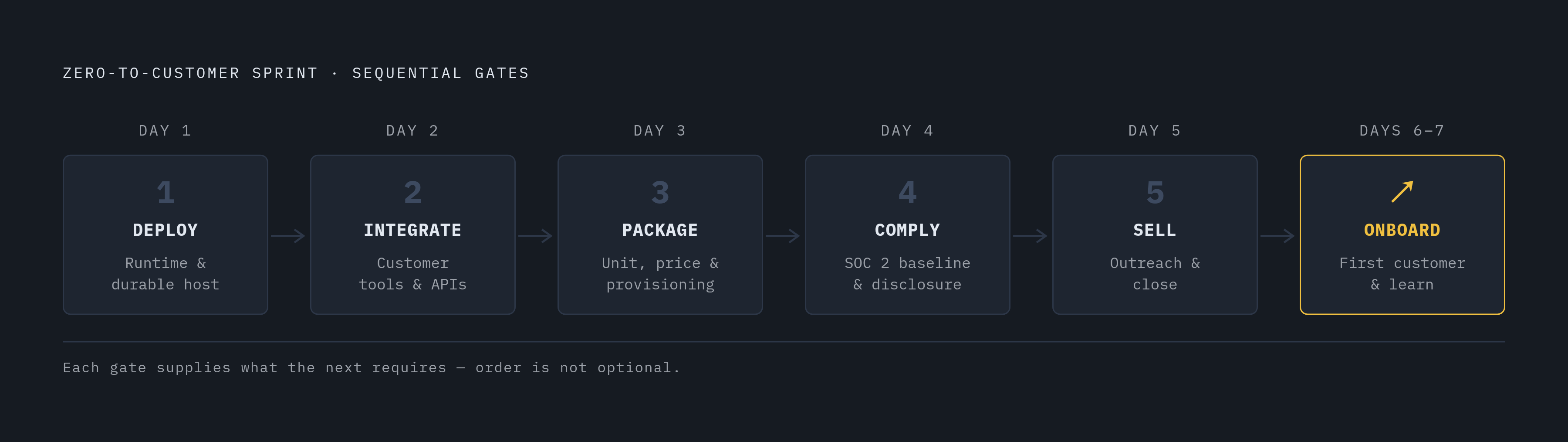
Day 1 is for runtime choice and durable deployment. Choose Hermes for operational continuity, Claude Code for coding, or OpenClaw when no strong reason points elsewhere, then deploy on a managed platform. Check that the agent keeps running without someone having to step in. It should be live before the day ends.
Day 2 is for the customer's essential connections. Connect the two or three tools the workflow genuinely requires, rather than using the integration catalogue as a checklist. Confirm that the agent can act in the customer's real environment. Day 3 then turns that working workflow into an offer, with a defined product unit, a price that accounts for token usage, and automatic provisioning at signup. The customer should not need a bespoke setup project.
Day 4 is the compliance check before outreach. Confirm the platform's SOC 2 Type I baseline, address the disclosure requirement, and remove unnecessary tools and scopes. If the buyer requires more than that baseline supplies, the gap needs to be visible even under the pressure of the launch deadline. Day 5 belongs to sales. With the operational gates cleared, further solo engineering is no longer the route to the first payment.
Days 6–7 are for onboarding and learning from real use. The first customer's session should guide the highest-value workflow or integration improvement, leaving a prioritized next step. The finish line is a stranger paying for the product. Deployment, integrations, packaging, compliance, and outreach were the obstacles between the working agent and that payment. Treating the supporting infrastructure as something to buy, rather than more code to write, leaves the founder time to cross the final gate and sell.