Managed Hosting vs. Self-Hosting Cost Comparison for AI Agents
Hidden labor costs often make self-hosting more expensive than managed platforms.

Advertisement
Self-hosting an AI agent costs $6 a month. That claim is true, but it is the wrong number to build a decision around. The $6–$35 a month range most people compare is a VPS bill, the price of renting a server. It says nothing about the hours someone has to spend setting that server up, keeping it running, fixing it when it breaks, and locking it down so it doesn't become someone else's problem. A total-cost-of-ownership frame fixes this by adding every recurring input, labor, downtime risk, incident recovery, security patching, into one number that can actually stand next to a managed hosting price. Running an agent on a laptop at home pushes this to its limit: there's no server bill at all, but the agent goes offline the moment the laptop does, which makes it fine for testing and personal use and unworkable for anything with real users depending on it.
What self-hosting an AI agent requires you to do
Self-hosting is a standing job, one that shows up every week and gets harder every time the agent, its dependencies, or an API it talks to changes underneath it.
The one-time setup alone involves provisioning a VPS, installing Docker, configuring environment variables, generating API keys for each messaging platform the agent touches, setting up webhooks, configuring SSL, and establishing log rotation and auto-restart so the thing doesn't silently die. For someone already comfortable with Linux, that's 4 to 10 hours. For a first-timer, it runs longer, and for some, it never actually gets finished.
Then the job keeps going. A stable setup still needs 1 to 3 hours a month of recurring maintenance: OS security updates, agent version upgrades, watching disk and memory usage, restarting crashed containers, and tracking down why something broke when an upstream API changed its behavior without warning. That last one isn't a hypothetical. WhatsApp changed its webhook format twice in a three-month window, and if you're self-hosting, the only signal you get is a cryptic error buried in Docker logs. About 15 to 20 agent updates land per month, and you need to test each one across every messaging platform the agent connects to before it can go live. The self-hoster has to run that testing alone.
Incidents sit on top of all of this. A single crash or bad config can eat an entire afternoon, and incidents aren't rare surprises in a self-hosted stack, because they're a built-in part of running one.
Security adds its own separate line item: firewall rules, key-based SSH hardening, rotating API keys, reviewing logs, roughly 30 to 60 minutes a month just for monitoring, before anything has even gone wrong. And things do go wrong at scale. A misconfigured gateway binding has left more than 40,000 self-hosted instances exposed to the public internet, with some counts running as high as 220,000. That's what happens predictably when setup is manual and nobody's checking the defaults.
Managed hosting platforms like Agent37 remove this entire task list from the operator's plate: server provisioning, Docker configuration, automatic updates, webhook management, and multi-channel integration maintenance all get handled on the platform side, which frees operators to spend their time improving the agent instead of babysitting the infrastructure under it.
Pricing the labor: what the maintenance hours cost
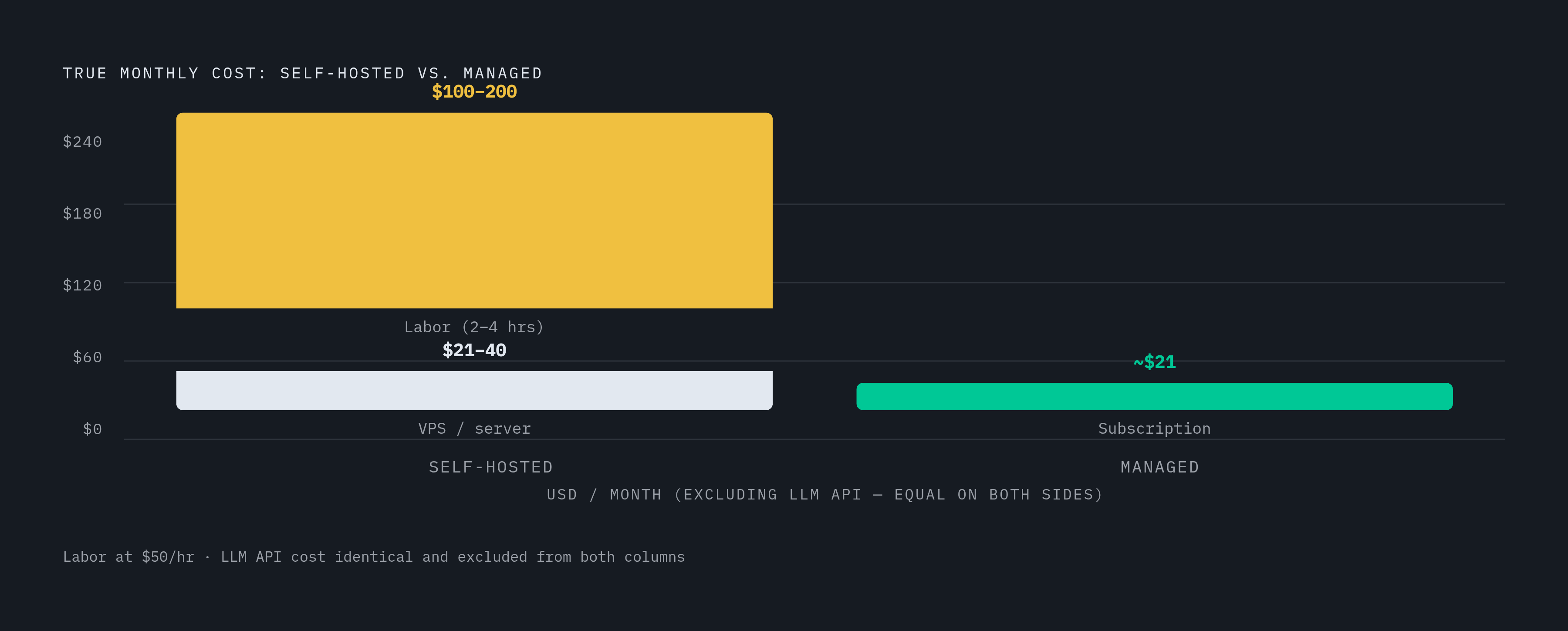
If you put a dollar figure on the maintenance hours above, you'll see the server bill isn't the real number.
A capable VPS, the kind that can actually run an agent in production, 4 vCPUs, 8 GB of RAM, plus storage, a domain, and SSL, runs $21 to $40 a month. But the 2 to 4 hours a month of maintenance work documented in the last section doesn't disappear just because it isn't on an invoice. Price that at a conservative developer rate of $50 an hour, and the labor adds another $100 to $200 a month, before anything actually breaks.
$50 an hour is the floor, not the real cost. Founders and operators who self-host are usually pulling that time away from sales, product work, or customer conversations, so the opportunity cost under the wage rate is almost always higher than $50 an hour in practice.
Add it up: the server costs plus the labor costs put the realistic monthly cost of self-hosting well above the server price alone. When those 2 to 4 hours get priced at a realistic rate, the true cost of self-hosting often ends up higher than the all-in price of a managed platform built to absorb that same labor, turning what would be scattered operator hours into one predictable monthly fee.
What managed hosting costs and what that fee covers
You don't pay a managed hosting fee on top of what you already pay to self-host. It replaces most of them.
Everything listed in the self-hosting checklist, server provisioning, Docker configuration, automatic updates and version testing, webhook and SSL management, 24/7 uptime monitoring, automatic crash recovery, security patching, multi-channel integration maintenance, gets folded into a single subscription on a managed platform. None of it disappears. It just moves from the operator's calendar to the platform's.
With Agent37's Cloud API, one call is all it takes to spin up an isolated, persistent, per-user agent sandbox. For founders building a product on top of an agent, that's the unit that actually matters: one agent per customer, provisioned automatically the moment that customer signs up. Agent37's pricing starts low enough to sit close to a budget VPS, so the comparison is really about what that price buys. A $21 VPS buys a server. A managed subscription at a comparable price buys a server plus the maintenance, monitoring, and security work that would otherwise cost $100 to $200 a month in labor.
One cost holds steady no matter which path gets chosen: the LLM API bill. You pay your model provider the same amount whether your agent runs on a self-hosted box or inside a managed platform. So that line item doesn't tilt the comparison either way, and you can set it aside when you weigh self-hosting against managed hosting.
Where self-hosting's math improves: scale, compliance, and model control
Self-hosting does come out ahead, but only under specific conditions, and if you're reading a cost comparison, you probably don't fall inside them.
Volume is the first lever. If you process fewer than 200 AI requests a day on mid-tier models, managed platforms will almost always come out cheaper once you count your engineering time honestly. Past that line, self-hosted setups start showing real cost advantages that only grow as volume climbs. At enterprise-scale request volume, self-hosting can end up materially cheaper than any managed alternative. That crossover assumes DevOps staff already sit on payroll. If reaching that volume means hiring someone first, the savings that made self-hosting attractive get eaten by the hire needed to run it.
Compliance is the second lever, and it's absolute, not a matter of degree. Some regulatory regimes require physical custody of data, so you can't let it leave machines your organization directly controls. No vendor's policy document satisfies that requirement, no matter how strong the vendor's security posture is. Defense contracts, certain categories of health records, and air-gapped environments fall here, and for teams operating under those rules, self-hosting is a compliance requirement, not a cost decision.
Model control is the third. Pinning an exact model version for reproducible output, running a fine-tune trained on proprietary data, or swapping model weights on a custom schedule all require owning the serving layer directly. Managed platforms choose and upgrade their models on their own timeline, and that timeline won't always match what a team needs when it's building around a specific model version.
What ties all three together is the same honest prerequisite: self-hosting is an operating commitment, not a one-time install. If nobody on the team is already running production services, reaching any of these advantages means hiring for it, and hiring resets the entire cost comparison back to zero.
The security cost that neither a hosting invoice nor a labor estimate captures
The moment an agent connects to Gmail, GitHub, Slack, or any outside service, the integration layer becomes the most security-critical part of the whole setup. Neither self-hosting nor managed hosting makes that risk go away. Each one just changes who's responsible for managing it.
Every one of those connections creates a credential custody problem. OAuth tokens, API keys, and session credentials all have to live somewhere, and wherever that is becomes a target worth attacking. Self-hosters carry that burden alone: one VPS is one point of failure, and a security incident that hits at 3 a.m. is the operator's to diagnose and fix, with no one else to call.
Managed platforms handle this differently by consolidating credentials across many customers at once, and that consolidation creates its own risk profile: concentrating credentials in one place makes that place worth attacking harder. The Composio incident, on May 21, 2026, shows what that risk looks like in practice. An attacker got in through an internal agentic monitoring tool, used it to escalate into the platform's own automated remediation systems, achieved code execution inside the tool-execution sandbox, and reached thousands of GitHub tokens along with cached API keys. For a category of credentials like that, a managed platform can't fully undo the exposure on a customer's behalf. Only the customer can rotate API-key credentials directly with the provider that issued them.
The root cause traces back to standing privilege inside internal automation that went ungoverned: the systems meant to be watching the credentials were themselves able to reach the credentials. That's a structural argument about what happens when credential stores get centralized without tight limits on what can touch them. It isn't a reason to write off managed hosting as a category.
But you still need to judge managed platforms on specific terms, not on general trust. Two criteria matter most for production deployments: a patching SLA of 48 hours or less, and an architecture that sandboxes the tool-execution layer away from production data. Those two questions matter before handing any platform credentials.
How the TCO math changes for product builders
Everything above compares one operator running one agent. Founders building an agent-powered product are running the same math across every customer they sign up, and that's where the labor cost stops being fixed and starts multiplying.
The single-agent case already tilts toward managed hosting for most operators. The product case makes that tilt decisive, because provisioning, securing, monitoring, updating, and recovering one agent per customer, repeatably, at scale, is the single hardest operational problem in running an agent-powered business. Hand-provisioning each customer's agent individually, the architecture that's actually required when an agent holds tools, files, and credentials, turns into hours of founder labor that grows with every new signup.
Shared infrastructure doesn't solve this problem either. Sub-accounts on a shared SaaS platform don't give your customers true isolation. When agents hold tools, files, and credentials, they need sandboxed separation, and shared platforms at the entry tier simply don't provide that.
The margin math here follows directly from the labor cost: client price minus delivery time minus the per-client platform fee minus usage cost. Delivery time is the variable that wrecks margin the moment provisioning has to happen by hand for each customer. Agent37's Cloud API answers that specific problem: a single API call spins up an isolated, persistent, per-user agent sandbox, provisioned automatically the moment a customer onboards, instead of configured by hand by a founder with a growing customer list and shrinking free time.
The comparison here is to Stripe, which let software companies accept payments without having to turn themselves into payments companies. A managed agent platform does the same thing for AI products: it lets a company give every customer their own agent without that company having to become an infrastructure business on the side. The time that would have gone into provisioning and babysitting servers goes into selling and building the product instead.
A decision framework: which TCO regime applies to your situation
The question of managed versus self-hosted comes down to four questions, and most founders and operators building agent-powered products will land on answers that put managed hosting clearly ahead on total cost.
Question 1: Is there a hard data-residency or physical-custody compliance requirement? If yes, self-hosting is likely the only option available, and the operational cost needs to be weighed honestly against what non-compliance would cost instead. If no, move to the next question.
Question 2: Does someone on the team already run production services, with capacity to spare? If yes, self-hosting just adds incremental work on top of what you're already doing, so the comparison gets close, and it depends heavily on volume. If no, the labor cost of self-hosting is a real hiring cost or a real opportunity cost, not a line item that reads as zero, and managed hosting wins the TCO comparison almost every time.
Question 3: Is the business serving paying customers, or building a product where every new customer needs their own agent? If yes, the labor multiplier from the previous section applies directly, and per-user provisioning through an API is the right architecture. The platform should be evaluated on whether it offers genuine per-user isolation and automated onboarding, not just a shared account structure.
Question 4: Does the use case require exact control over the model, a pinned version, a fine-tune, custom weights? If yes, a managed platform that upgrades models on its own schedule may not fit, so check for BYOK support or direct model selection before you commit.
For most founders and operators, the answers land on the same side: managed hosting, priced close to a budget VPS, removes $100 to $200 or more a month in labor costs and removes the incident-response and security-patching burden along with it. The sticker price of self-hosting understates what it actually costs to run. The sticker price of managed hosting, by contrast, overstates it, because that single number already includes everything the self-hoster would otherwise be doing by hand. For anyone building a product around agents specifically, Agent37's one-click deployment and Cloud API set the bar for what that experience should look like: any setup still requiring SSH access, manual Docker configuration, or hand-provisioning for each new customer is quietly shifting infrastructure work from the platform onto the founder.