What Out-of-the-Box Agent Provisioning Actually Means Across Today's Platforms
Few platforms cover runtime, isolation, auth, and onboarding together.
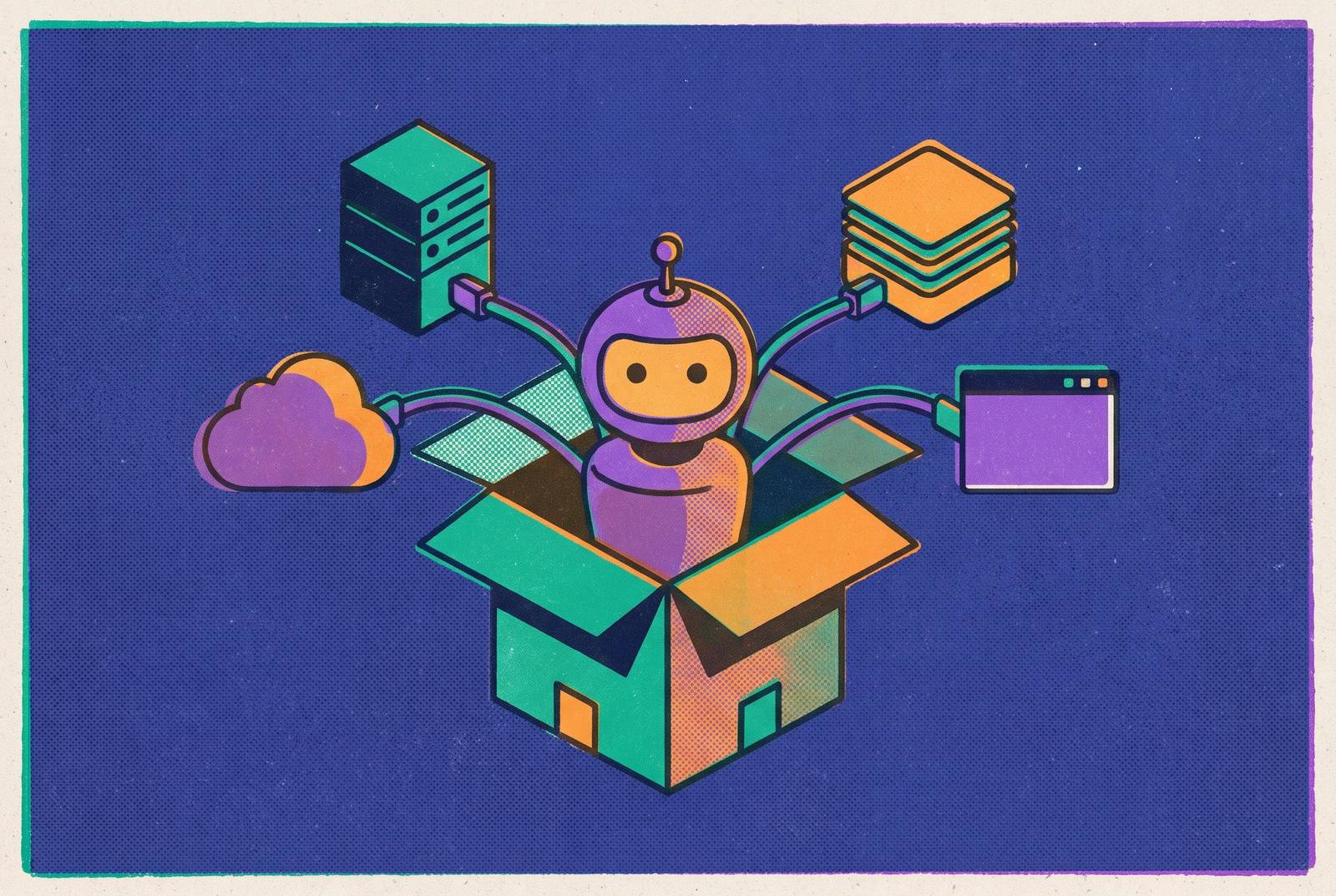
Automatically giving each new customer an AI agent at signup requires a runtime, an isolation layer, per-user authentication, and onboarding automation. “Out-of-the-box agent provisioning” rarely includes all four. Across self-hosted runtimes, managed clouds, and coding agents, the right choice depends on what the platform handles after setup and what your team must build to keep each customer’s agent private, persistent, and recoverable.
Why "out-of-the-box" is not a single thing in agent provisioning
At 3am, a failed background task exposes the boundary between what a platform promised and what it actually operates. The agent may still be available while no one picks up its unfinished work. Or the runtime may recover without the state needed to resume. Setup speed says little about either outcome. That makes responsibility central to an “out-of-the-box” claim alongside convenience.
The ambiguity grew as agents moved from interactive sessions, with a human watching, to scheduled and autonomous work. An unattended agent takes consequential actions without someone there to notice a stalled step. A silent failure becomes an incident. In production, an agent must start and keep working without supervision.
Self-hosted runtimes, managed cloud runtimes, and low-code builders cover different parts of that problem. They are not interchangeable steps on a ladder from difficult to easy. Each places different demands on the team for state, isolation, recovery, and customer-by-customer scale. Comparing them only on how quickly an agent starts talking rewards the demo and leaves the operational debt for later.
The four production requirements that expose what a platform actually handles
Durable state means a run can resume from its last step after a crash or restart, preserving completed steps and unfinished work. Keeping a session alive is not enough. A stateless API, a stateful session, and an event-driven background worker each require explicit decisions about logs, queues, and storage. The test is whether the work survives the process that was doing it.
Session isolation defines the boundary around untrusted or LLM-generated code. Standard containers share the host kernel and are insufficient for the generated-code and external-tool workloads described here. A user-space kernel intercept and a microVM isolate code in different ways. A microVM has its own guest kernel, while syscall interception places a boundary around calls into the system. The word “sandbox” alone does not identify either protection.
Autonomous recovery means detecting, logging, and replaying a half-finished task without a human restarting it. This is separate from keeping state. A platform can preserve information without taking the next action needed to finish the job. The practical distinction is whether an unattended failure waits for an operator or enters a recovery process.
Per-user scale means a new customer gets an isolated agent automatically, rather than waiting for a founder to configure an instance. That separation must extend to access credentials. With per-user OAuth, each customer grants a scoped, revocable token tied to their own account. Revoking one person’s access should not mean having to rotate a credential that everyone else shares.
What self-hosted runtimes actually hand you at setup — and what they leave to you
Self-hosted runtimes supply agent logic, tool-calling, orchestration primitives, and framework interoperability. They do not supply an operated service. Uptime, crash recovery, log retention, compliance certification, and per-user sandboxing remain separate layers for the team to build or attach. Owning the runtime gives the team control over those choices, but it also assigns the team responsibility for their failure.
Applied to the four requirements, that distinction is blunt. Orchestration primitives are not the same as durable recovery, and a working tool call does not establish a customer-specific credential boundary. Per-user isolation still needs infrastructure around the runtime. Automatic onboarding also remains a separate task. The framework can be part of the finished architecture without being the finished architecture itself.
Self-hosting has a legitimate place when sovereignty, audit rights, or an open licence are requirements. Those benefits do not erase operating costs. Running a self-hosted LLM stack usually takes part or all of an infrastructure engineer’s time, plus ongoing compute. For most teams below a very high daily token volume, managed SaaS APIs have a lower total cost of ownership once that labour is included.
Compliance follows the same ownership boundary. Self-hosting moves control onto the operator’s side, but it does not make the deployment compliant. SOC 2, HIPAA, and ISO 27001 still require audit trails, access reviews, and incident response. Those duties can become visible only after setup, when a team discovers that installing the runtime was the smaller job.
What managed cloud runtimes cover and where their session limits bite
Managed cloud runtimes take over much of the infrastructure work, including scaling, session state within defined limits, and security isolation. In most cases, they also provide OpenTelemetry tracing with token usage. The tradeoff is a service boundary with session limits and portability constraints. A managed runtime can keep a session healthy without promising that it will exist for as long as the application needs it.
Amazon Bedrock AgentCore documentation describes a dedicated microVM for each user session, with isolated CPU, memory, and filesystem resources. Its documentation also describes different long-running session windows, so a general statement about long-running support is not enough to establish workload fit. The release notes for Google Gemini Enterprise Agent Platform say it supports long-running asynchronous operations. These execution windows have time limits and come with no promise that they will persist indefinitely.
Microsoft Foundry Agent Service documentation distinguishes compute lifetime from state lifetime. After an idle window, the platform deprovisions compute and persists session state. It also permanently deletes sessions after a defined period of inactivity. A customer’s persistent agent cannot simply be assumed to have the same lifetime as its current runtime session.
Identity has a similar boundary. Google’s Agent Identity gives an agent a unique cryptographic ID scoped to the agent. That is not, by itself, automatic customer onboarding or per-user OAuth. Managed runtimes still leave teams to address runs outside supported windows, customer-specific provisioning, and framework portability. Their strongest fit is generally within their native cloud ecosystem.
How coding agents like Claude Code and Codex provision their own execution environments
Coding agents introduce another provisioning model because they manage execution permissions and sandboxing internally. They read repositories, plan changes, execute shell commands, run tests, iterate on failures, and deliver committed code. Their execution environment runs on top of the deployment platform. As a result, choosing the host and choosing the agent harness are related but separate decisions.
Claude Code and OpenAI Codex both have production-ready multi-agent support. Codex shipped subagents to general availability on March 16, 2026. Support for multiple cooperating agents and isolation between multiple customers concern different boundaries. One governs how an agent system divides up work, while the other governs who can access each customer’s execution environment and data.
Claude Code offers multi-cloud availability across Bedrock, Vertex AI, and Foundry, together with Zero Data Retention options, HIPAA-ready Enterprise plans, and role-based access controls. That helps teams meet compliance requirements without tying them to one vendor’s infrastructure. Codex is written in Rust and is open-source under Apache 2.0. Its open harness fits teams that need to audit the code, have an open licence, or deploy on infrastructure they control.
When a coding agent becomes a customer-facing product, those differences inform the platform choice but do not complete it. Someone must still provision each user’s agent instance and recover it when it fails. Internal sandboxing does not replace deployment isolation between customers. Multi-agent support also leaves teams to provide durable customer history, separate credentials, and automatic activation at signup.
Why authenticated reach into real tools is the provisioning gap no tier fully solves out of the box
An agent can run well and still be unable to act in Gmail, Slack, GitHub, or another tool a customer uses. Authenticated access is a separate provisioning layer. It sits above the runtime and below the agent logic, and it must remain tied to the right person. A running runtime does not show whether a tool connection is authorised or whether an expected trigger arrives.
Composio addresses this layer with pre-authenticated tools connecting agents to more than 1,500 applications. Developers do not have to write each integration or manage each OAuth token themselves. Composio stores users’ OAuth credentials in “connected accounts,” allowing the agent to act on behalf of the right person. Its Shared Connections, introduced September 2026, also let a company account be made available without passing credentials around.
That integration layer has its own failure modes. In April 2026, Composio’s API degraded over time, and webhook triggers for several apps were unavailable for an extended period. A cleanup job had stopped pruning a trigger-processing table, creating a growing backlog.
A runtime can remain healthy while that layer is unavailable. So even after a move to a managed cloud, teams still need to check integration authentication and recovery on their own. The runtime, the execution sandbox, and authenticated tool access answer different questions. A provisioning claim that covers only the first two leaves out authenticated tool access, which lets an agent do useful work in a customer’s accounts.
How do you give each new customer an isolated AI agent automatically at signup?
Automatic agent provisioning at customer onboarding requires the signup process to activate an agent with its own credentials, session state, and conversation history. Those must stay separate from every other customer’s. Revoking one customer’s access must require no changes to another customer’s agent. This is the structural shift from running an agent internally to delivering agents as a product.
The architecture combines a runtime, an isolation primitive, an integration authentication layer, and onboarding automation. Each component has a distinct job. The runtime executes the work, while the isolation layer bounds the execution environment. The authentication layer ties tool access to the customer, and onboarding automation removes the founder from the provisioning path. None of those roles disappears because another component is managed.
Agents that execute LLM-generated code or call external tools need more separation than standard shared-kernel containers provide. MicroVMs provide a separate guest kernel, while gVisor uses syscall interception. These mechanisms are not interchangeable descriptions of the same implementation. A product built for customers needs to make clear which boundary its agent environment uses.
White-label infrastructure meets another product need by letting an operator offer a branded, persistent agent while keeping the underlying platform out of view. But branding does not supply isolation or recovery. None of the self-hosted, managed cloud, or low-code tiers described here delivers the entire architecture out of the box. The available capabilities support a comparison by responsibility.
How to read a platform's "out-of-the-box" claim before you build on it
The practical evaluation starts by replacing the broad claim with specific questions about responsibility. Ask how long a session lasts and how its state is handled when that limit expires. Ask whether a run that stops partway through resumes from its last completed step and recovers without a person having to restart it. A “durable state” checkbox does not answer those questions. The response needs to describe behaviour.
Next, ask which isolation primitive the agent’s code runs in. The answer should identify a shared-kernel container, gVisor, or a microVM and apply to the specific product being purchased. A vendor’s broader infrastructure is not proof of that product’s boundary. The same discipline applies to compliance. Ask which certifications cover the purchased tier, because the provider’s SOC 2 does not cover the application, prompt logs, or tool integrations.
For customer delivery, ask whether onboarding automatically provisions a new agent instance or leaves a person configuring each one. Then ask whether every customer gets private, persistent state and separately revocable tool access. Audit integration authentication for failures that can happen on their own. A platform that starts an agent but leaves these steps manual answers only part of the startup’s actual requirement.
A productization platform must address automatic activation, persistence, isolation, and independent access for each customer. When those capabilities must be put together, the decision should name who is responsible for each missing part. That ownership is what turns “out-of-the-box” from a sales phrase into a usable production commitment.