Gross Margin Targets for Vertical Agent SaaS
Vertical agents hit higher margins by owning irreplaceable workflows, not just wrapping models.

Vertical agent SaaS gross margin targets should follow workflow ownership. The practical ranges are 50–60%, 60–75%, and 70–85%, with higher targets earned through deeper integration, stronger pricing, and lower delivery costs. Managed infrastructure such as Agent37 can help with delivery, but owning a process that customers cannot easily replace does the most to lift margins.
The three P&L profiles that define AI SaaS margin expectations today
AI SaaS has three distinct profit-and-loss profiles, defined by where AI sits in the product and its costs. AI-Augmented companies use AI to help employees internally, so inference is an operating expense rather than a cost of goods sold, or COGS. Their gross margin target is roughly 80%, closest to traditional SaaS. AI-Enabled companies put AI into customer-facing features, which moves inference into COGS and brings the target to 60–79%. AI-Native companies sell a product built around inference itself, so AI makes up most of the cost of delivery and the target is 50–60%.
ICONIQ's directional benchmark puts the 2026 AI-Native average at roughly 52%. As inference becomes more central to delivery, AI costs need their own tracked lines rather than a place inside generic infrastructure spending. Those lines include inference, customer-facing eval engineering, and observability. Inference includes model API fees and per-call costs, while the cost of customer-facing evaluation runs goes on the eval engineering line. Observability adds model monitoring and vector database infrastructure, making the model bill only part of the delivery cost.
Why vertical agent SaaS does not fit cleanly inside the AI-Native tier
The AI-Native label says how a product works, but not enough about what customers will pay for it. A vertical agent can control a multi-step workflow, embed domain expertise, and use proprietary data that a general model cannot replicate. Its pricing power comes from the process it owns. A workflow that customers cannot easily reproduce with a general-purpose tool can support value-based pricing at $100–$2,000+/month. That revenue leaves room for higher gross margins even when inference keeps taking a large share of spending.
A thin wrapper has a different problem. When the product adds only a UI layer over a foundation model, customers can approximate its output elsewhere and switching costs are near zero. API costs then consume a large share of revenue without a strong reason for customers to pay more. A vertical agent that handles a complete process is harder to remove because the customer must replace the process. Applying the same margin expectation to both products misses that distinction.
Jevons Paradox describes how people use more of a resource when it gets cheaper, so lower inference prices can lead teams to run more tasks while their bills stay the same. More importantly, workflow integration, customer data built up over time, and regulatory expertise still have value when inference gets cheaper. Those advantages sit above the model layer. Model-price declines can help delivery economics, but they cannot substitute for a product customers have a strong reason to keep.
The three margin tiers vertical agent founders should actually target, and what drives each one
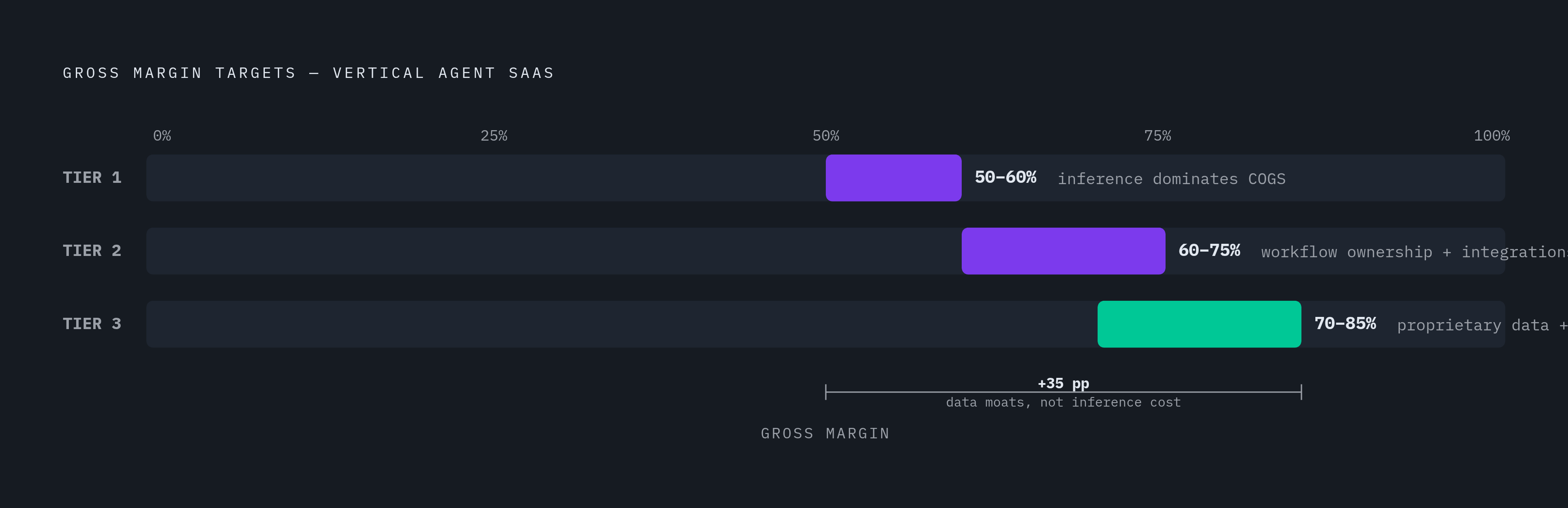
Tier 1 has a realistic gross margin target of roughly 50–60%. Here, the agent wraps one or two model calls around a domain-specific prompt and delivers an output, while most of the workflow remains outside the product. Inference dominates COGS, and pricing stays constrained because customers can approximate the result with general-purpose tools. Proprietary data inputs, multi-step workflow ownership, and integrations that create switching costs are the path toward the next tier.
Tier 2 targets roughly 60–75% by owning a complete, repeatable process. The agent handles intake, processing, output, and handoff through integrations with the customer's CRM, ERP, or industry software. Removing it now means rebuilding the process, which supports value-based pricing and lowers inference cost as a share of revenue. Model routing also becomes useful because simpler sub-tasks can go to cheaper models while complex reasoning uses more expensive inference. The economic gain combines a stronger reason to pay with more selective spending on delivery.
Tier 3 targets roughly 70–85%, supported by data and domain requirements that are difficult to copy. The agent generates or consumes assets such as historical transaction data, regulatory filing history, or domain-specific training. It also handles requirements such as HIPAA, FDA submission standards, or industry-specific frameworks, where correctness has consequences. Pricing rests on that specialized responsibility. Persistent customer context strengthens this position by allowing workflow history to accumulate across sessions.
These ranges overlap because workflow ownership is not a clean switch between categories. An integrated product can still have costly workloads, and a defensible product still needs sound pricing. Moving up the tiers is a strategic objective. Replaceable output, incomplete process ownership, or delivery costs that consume the value captured can each be the dominant constraint today.
Why pricing model choice determines whether a founder hits or misses their tier target
Strong workflow ownership does not protect a product from a pricing model that ignores usage. A fixed per-seat subscription works when customers use about the same amount of service. Agents can have enormous variation, with light users and power users running thousands of tasks per month paying the same price while creating very different inference bills. Under that structure, a valuable customer can also be a negative-margin customer.
Pure usage-based pricing ties revenue to how much customers use and can keep gross margin steady across users. Its trade-off is uncertainty for both the vendor forecasting revenue and the customer worried about a runaway bill. Hybrid pricing adds usage overages to a base subscription, which puts a floor under margins and brings in more revenue from heavier workloads. That makes it a safer baseline when consumption varies widely. The choice is not simply between predictable subscriptions and flexible billing, but between different ways of carrying usage risk.
The billing unit shapes how well customers understand that trade-off. Charges per task, outcome, or workflow completion connect the bill to something the customer values. A completed insurance claim or filed regulatory document is easier to defend than an opaque token or minute charge. Outcome-based pricing can support the highest margins when results are measurable and attributable, because efficiency gains stay with the vendor and the bill remains unchanged. Pricing governs which delivery costs the business agrees to absorb and whether those costs remain covered.
How per-user agent architecture compresses COGS beyond what model-price declines alone can deliver
The right pricing model needs an architecture that makes each customer's economics visible. A blended margin can hide profitable light users subsidizing loss-making heavy users. One sandboxed, persistent agent per customer gives the business a clear unit around which to track cost-to-serve and apply billing controls. Shared-session delivery does not provide that same isolated unit of operation.
Persistence adds another margin lever. An agent that retains session context and workflow history can reduce redundant inference rather than reconstruct that context at every new session. The same history deepens the customer-specific data advantage that supports higher pricing. Per-customer spend caps, usage alerts, and automatic cutoffs then help prevent a heavy workload from turning a profitable contract into a loss. Isolation also supports the security and compliance needs behind Tier 3 pricing, though it does not replace the domain expertise those products require.
Agent37's Cloud API sets up isolated, persistent, per-user agent sandboxes with a single API call, starting at $4.76/month. That makes managed per-customer delivery a practical option for founders who need persistence and billing controls without hand-provisioning instances. The comparison with self-hosting still needs to include both infrastructure fees and operating labor. Isolation has a platform cost, but manually configuring and recovering each customer's environment has a cost too. The architectural advantage is strongest when customer-level control does not bring customer-by-customer manual work.
The operational labor that managed hosting eliminates, and why it is a gross margin line item
ApolloClaw shows how large that manual burden can become. Founder David Oralevich sold private agents to firms under the ApolloClaw brand, provisioning each client on a physical Mac mini that he configured by hand. The work took about a day and a half per client. The cost of that work belongs alongside the hardware bill.
Provisioning, SSH access, Docker configuration, uptime monitoring, and instance recovery are work required to deliver the product to a specific customer. The delivery-cost calculation should count engineering time spent on those tasks, even when founders do the work for free. Unpaid founder hours may not appear as an expense on the P&L, but they still suppress the product's true economic margin. They also consume the time needed to build the integrations and domain depth that move a product beyond Tier 1.
With Agent37's one-API-call provisioning model, a new customer's isolated agent can be activated at onboarding without manual configuration. Its one-click deployment starts at $3.99/month and comes with uptime, billing controls, security, and integrations. With managed hosting, teams pay a platform expense that is easier to predict in place of running the infrastructure themselves. Self-hosting remains an approach whose case depends on volume and the full cost of operating it, including server price. For early teams, removing delivery labor can improve gross margin more than another round of inference optimization.
White-label economics make this distinction especially clear when the platform fee is flat. Revenue can grow as more clients sign up while that platform cost stays fixed, so each new client beyond break-even has much more room to add to margin. The infrastructure fee no longer brings a matching increase in provisioning labor, while inference and other customer-specific delivery costs remain.
A staged framework for setting and advancing gross margin targets as a vertical agent product matures
Before product-market fit, the useful starting target is the Tier 1 range of 50–60%. Usage patterns are unknown, prompts are not yet efficient, and pricing has not faced real power users. The first priority is to instrument cost-to-serve at the customer level. Founders should gather at least one month of data on how usage is spread across customers before committing to flat subscription pricing, and a hybrid baseline is the safer place to start. Managed hosting is the stronger fit at this stage because infrastructure work competes with the workflow and domain investment needed to reach Tier 2.
Once usage patterns are known, the task is to separate margin-positive customers from those whose delivery costs outrun revenue. Model routing and caching repeated query patterns become worthwhile because the team can see where expensive reasoning is unnecessary. Usage overages can correct flat subscriptions that lose money on power users. At the same time, deeper integrations with customers' core tools create switching costs and support a pricing step-up. Together, those moves combine cost cuts and pricing gains to build toward the 60–75% range.
The move toward 70–85% requires deliberate investment in proprietary data and regulatory or domain expertise. Customer interactions should enrich a dataset that competitors cannot access, making the agent more useful over time. Outcome-based pricing becomes viable when the product can measure and attribute its results. At that point, delivery efficiency can improve margin without forcing a matching reduction in customer pricing.
Benchmarkit's 2026 SaaS and AI-native metrics report finds median software gross margins holding above 80%, but a broad median includes companies that have not absorbed AI delivery costs at material scale. The Rule of 40 benchmark used for traditional SaaS at 80%+ gross margin also does not apply cleanly to AI SaaS at 50%–65%+. Vertical agent founders need benchmarks that reflect the product they are actually delivering. The tier ranges show which product, pricing, or operating change comes next.