Scaling AI Agents in Production Without General-Purpose Cloud Compromises
Most organizations pilot agents successfully but struggle to operate them reliably at scale.

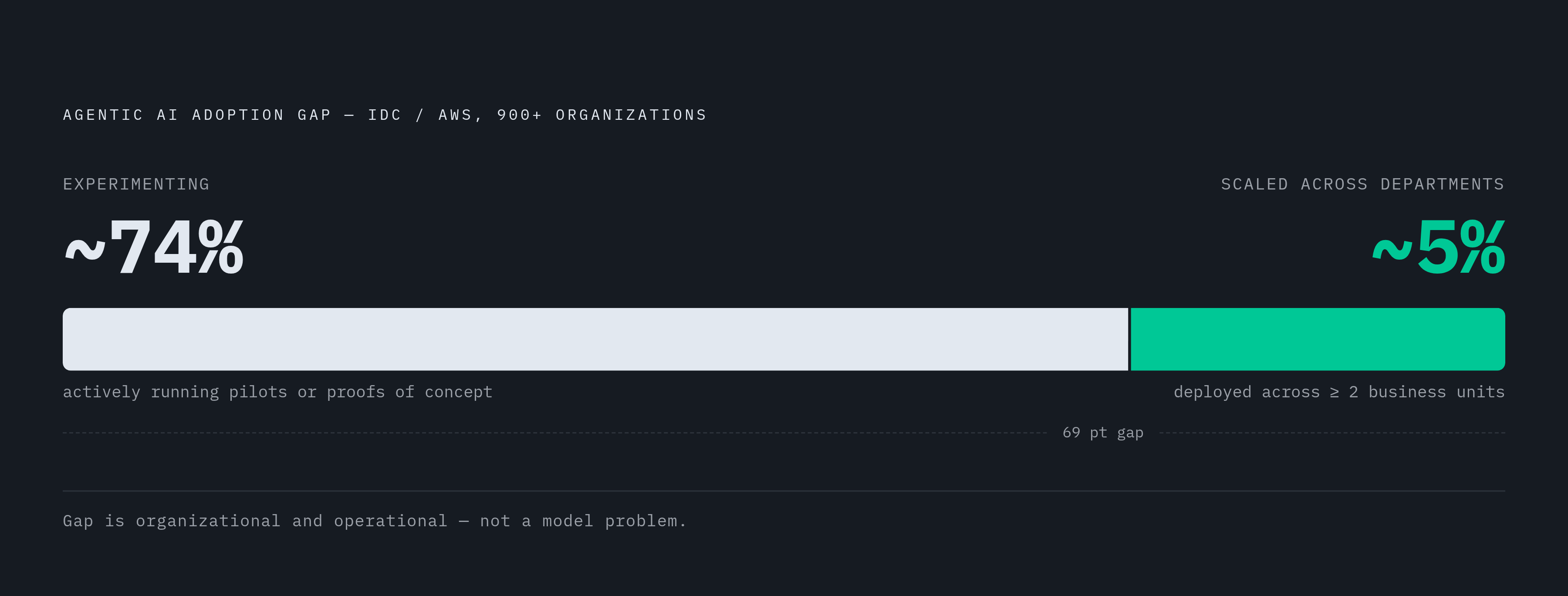
The models work. That's not in dispute anymore. The dominant failure mode for AI agents in 2026 is not building them, it's operating them reliably once real customers depend on them. A survey of 650 enterprise technology leaders found that most organizations have active pilots running, but only a small fraction have reached production scale, and that gap has widened even as the underlying models have gotten better. A separate survey of over 900 organizations, run by IDC and AWS, found that most were actively experimenting with agentic AI, but only a tiny fraction had managed to scale it across multiple departments. The survey is direct about the cause: the gap is organizational and operational, not a model problem. Most teams lack evaluation infrastructure, monitoring tooling, and dedicated ownership structures, and that's an infrastructure question as much as a management one.
What general-purpose cloud was built for
Major providers built general-purpose cloud infrastructure over the past two decades, and they built it for workloads that are stateless and predictable. A web server handles a request, returns a response, forgets everything. That design has served the software industry well for twenty years because most software behaves that way. They're stateful, non-deterministic, multi-step systems, and they break nearly every assumption that stateless design rests on.
Consider what a typical REST API does when something goes wrong: it returns an error code. An agent doesn't have that luxury of clarity. Agent workflows have also grown longer and more branched over the past year. Per-execution SaaS pricing compounds the problem financially, because it scales linearly with workflow complexity, so the longer and more useful the chain gets, the more it costs, in direct proportion.
None of this means general-purpose cloud is poorly built. It means it was built for a different job. Trying to retrofit stateless cloud primitives onto stateful, unpredictable agent workloads is adapting the wrong tool to the task, and the mismatch appears first, and most expensively, in how agents hold state.
Session persistence and stateful execution as cloud infrastructure's weakest point
Picture a user who is partway through a task, say filling out a multi-step form with an agent's help, when the underlying container restarts. On a general-purpose cloud setup, that user's progress is often just gone. AI agents stay stateful across sessions, so when infrastructure treats every request as independent, it breaks that continuity, and you won't see it happen right away. They compound quietly until a production incident finally forces someone to notice.
A demo agent running against a handful of test users and controlled data doesn't really test this. It has no meaningful state requirements to speak of. The same agent at production volume, with dozens or hundreds of concurrent users each mid-task, needs durable, isolated session state that survives restarts, scaling events, and infrastructure changes. When a cloud container restarts or scales horizontally, an agent's in-progress task context is typically lost. The agent might retry, loop, or fail silently, and standard cloud monitoring will log a clean 200 response the whole time, blind to the fact that the user's actual task just evaporated. Branching agent chains make this worse: a state loss partway through a chain triggers cascading rework or corrupted output, not the kind of clean, traceable error that an operations team can triage in five minutes.
Those are infrastructure design constraints. They have nothing to do with whether the underlying model is good. Purpose-built platforms solve session continuity by treating durable, isolated per-user state as a first-class primitive rather than something bolted on after the fact, an approach Agent37 takes by design: agent context on its platform survives restarts, scaling events, and infrastructure changes without requiring manual intervention or a custom state management layer built in-house.
Per-user isolation as the correct architectural unit for agent-powered products
Running multiple customers' agents inside shared infrastructure isn't a shortcut that saves money, because it means one user's runaway task can become a threat to every other user's session and data. You need an AI agent sandbox so you can enforce strict boundaries around what an agent can access, modify, and execute. The point of the sandbox is risk containment, not speed.
What matters here is the specific security architecture, not just the general idea of isolation. Each sandbox keeps its own filesystem and its own hard disk quota, so tenants stay apart because the structure makes them, not because a policy says they should.
IDC's research names "agent sprawl," the uncontrolled proliferation of agents without isolation or governance, as one of the primary risks enterprises face as they scale, with observability gaps and access control failures as the direct consequences on the ground. One isolated, persistent agent per customer, provisioned automatically at onboarding rather than configured by hand after a sale closes, is the correct unit of scale for an agent-powered business.
Purpose-built agent hosting versus general-purpose cloud operator burden
Provisioning, monitoring, recovery, updates, and billing controls for every customer's isolated agent: this is the operational labor that actually kills agent-powered products, and it's precisely what managed agent hosting exists to take off a founder's plate. Agent37, for example, offers one-click deployment of agents including OpenClaw, Hermes, Claude Code, Codex, OpenCode, and Grok, each running in its own isolated, persistent sandbox, starting at $3.99 a month. You can provision a new customer's agent with a single call to its Cloud API. Operators who want to run their own branded agent business can do that too: white-label infrastructure means every customer gets a private, branded agent activated automatically at onboarding, with billing controls and model-spend caps set per customer, and no model training happens on user data.
A few examples make this concrete. Boon, a grant fundraising product for nonprofits, gave every client their own Hermes agent in three days, and cut the cost per agent from $85 a month down to $4.94 on equivalent hardware. David Oralevich runs ApolloClaw, selling private agents to firms under his own brand at apolloclaw.ai: clients talk to an assistant they named themselves, while Oralevich holds one API key and sets a model-spend cap per customer, all built on Agent37's white-label infrastructure.
The comparison that keeps surfacing is Stripe. The same logic applies here: this kind of platform lets AI companies give every customer their own agent without having to become infrastructure companies themselves. Founders should be spending their time selling and improving the agent, not provisioning and recovering a separate instance for every new customer who signs up.
The true cost of self-hosting versus managed agent hosting across different scales
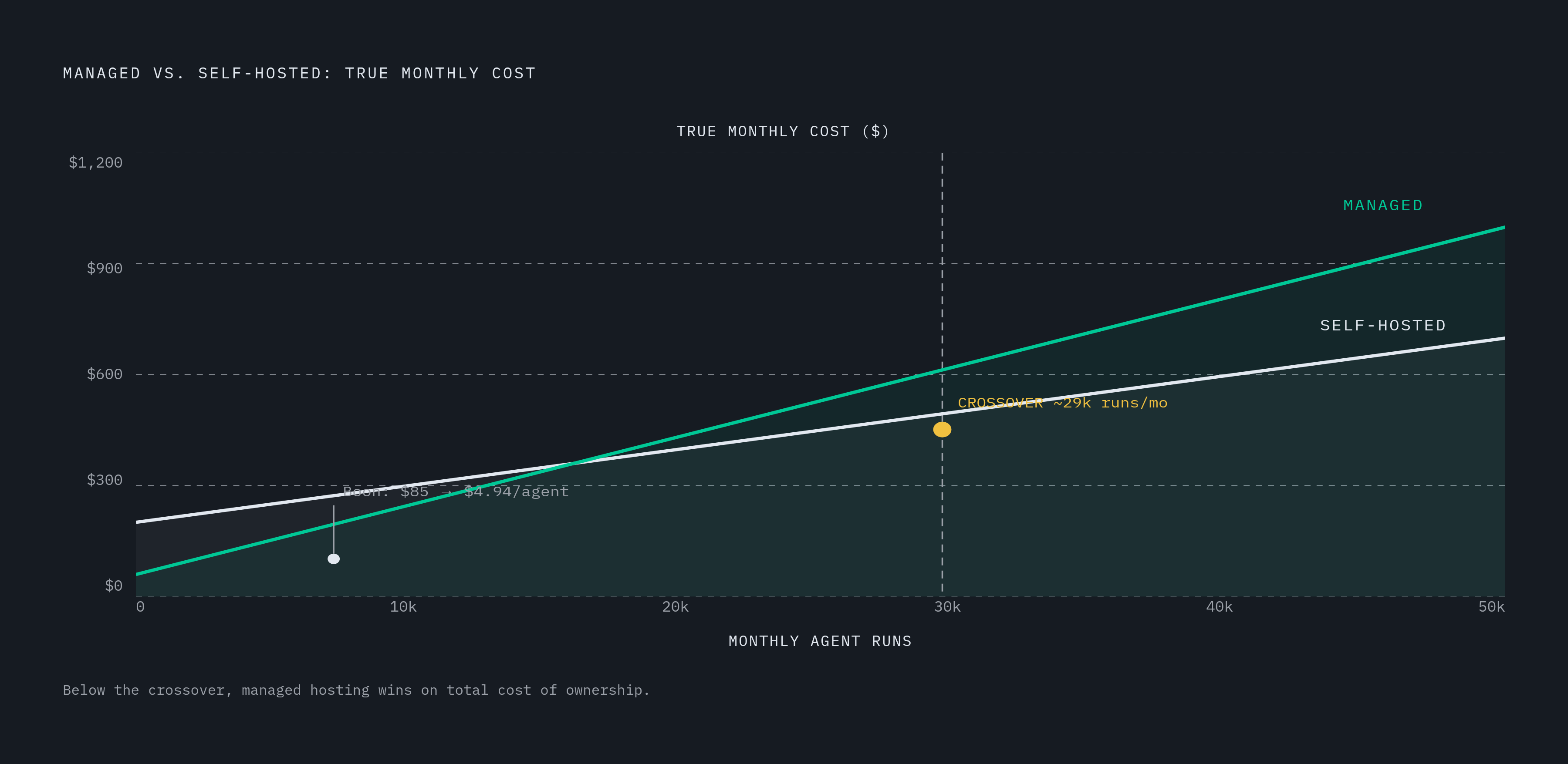
The invoice for self-hosting a single agent looks small next to the real cost of keeping it running. Most managed platforms start between $20 and $50 a month per agent, which puts managed hosting below the true self-hosted cost right up until volume gets substantial.
At very high run volumes, tens of thousands of agent runs a month, per-execution SaaS pricing can become meaningfully more expensive than self-hosted infrastructure. If you add total cost of ownership to the comparison, not just the server bill, the numbers look different than the raw crossover suggests.
The monitoring and observability gap that general-purpose cloud tooling cannot close
Standard cloud monitoring is good at catching infrastructure failures: a crashed container, a maxed-out CPU, a dropped connection. It's blind to the failure modes that actually take down agent-powered products: hallucination cascades, tool-call loops, silent quality drift, and cost runaway. A conventional health check only confirms that a container is alive and returning HTTP 200. It has no way to tell that the agent inside is looping through tool calls, generating confident-sounding wrong answers, or climbing steadily toward its spend ceiling.
IDC's research on agent sprawl names observability gaps as a direct operational consequence of scaling without the right controls in place: teams lose track of what their agents are actually doing, what data they're touching, and how they're arriving at decisions. A team can't patch this with a dashboard plugin on top of a general-purpose cloud account. Agent-aware monitoring, spend caps per customer, session health tracking, tool-call auditing, needs to exist as a platform primitive from the start. Purpose-built agent hosting builds these in as defaults rather than leaving them as a project for the operator to design from scratch.
Security and compliance obligations that are underspecified in general-purpose cloud deployments
Agents carry a security threat model that looks nothing like a standard web application's, and building adequate controls on a general-purpose stack can cost enough to change whether building it yourself makes sense. As of August 2, 2026, the EU AI Act's transparency obligations are enforceable and apply directly to systems that interact with people. Article 50 requires generative outputs to be marked in a machine-readable format so they're detectable as AI-generated, and a standard SaaS compliance checklist doesn't cover that requirement.
SOC 2 Type II matters as a baseline. Treat it as the entry requirement, not as the finished answer. Reaching SOC 2 Type II or ISO 27001 on a self-built stack takes 12 to 18 months of engineering effort and dedicated security personnel, a cost that's easy to underestimate when a team is still in pilot mode and hasn't budgeted for it. That timeline is a structural advantage for infrastructure that already carries the certification. Agent37, for instance, is SOC 2 Type I certified, encrypts data in transit and at rest, and holds to a clear stance that agent conversations, files, and sessions are never used to train models.
Integration depth as the operational ceiling for agent-powered products
Integration complexity is the reason enterprise AI agent projects stall out most often, and more effort won't solve it the way it solves a data-cleaning problem. The March 2026 survey found that when organizations' scaling attempts stalled or failed, they named integration complexity with legacy systems as the blocking factor most often. Gartner forecasts that over 40% of agentic AI projects will be canceled by the end of 2027, and it cites escalating costs, unclear business value, and inadequate risk controls as the primary reasons.
Traditional middleware passes structured data between deterministic services, and that model doesn't map cleanly onto agents. An agent-native integration layer like Composio is built instead for context preparation, managing state, constraints, and context for a reasoning system that behaves non-deterministically by design. Agent37's platform includes these integrations through Composio, covering Gmail, Slack, WhatsApp, GitHub, and over a thousand additional tools, available to operators without having to build or maintain individual connectors themselves. The architectural mismatch between stateless cloud primitives and the stateful, long-running, non-deterministic nature of agent workflows is why infrastructure built specifically for agent hosting, rather than adapted from general compute services, has become the dividing line between pilots that stall and systems that reach production.
The organizational ownership condition that no infrastructure layer can substitute for
Infrastructure isn't really the problem, people and governance are. That objection has real support. Successful scalers in the survey shared one structural practice in common: they built a dedicated AI operations function, separate from both IT and the business unit, responsible for evaluation frameworks, production monitoring, and incident response. No platform, however well built, replaces that function.
Scope discipline reinforces the same lesson. Agents scoped to a single, well-defined task with measurable outputs scaled more reliably than broad, multi-function agents trying to do everything at once. That makes adequate governance achievable for a two-person founding team, rather than something that requires a dedicated platform engineering group before a product can responsibly scale. Start narrow, prove the narrow version works, and only then widen the scope. Hoping infrastructure will cover for an agent that was too broad from day one is a bet that keeps losing.
From working agent to scalable customer-delivery product
Going from "my agent works" to "every customer has their own agent running right now" is a product architecture decision, not a server upgrade. Getting it right from the start avoids the entire category of scaling failures this piece has walked through. A handful of decisions need to be made before volume arrives: per-user isolation as the basic architectural unit, durable session persistence, agent-aware monitoring with real spend caps, integration depth through a managed layer, and a compliance posture established before customers are depending on it, not scrambled together after an incident.
Productizing agent delivery means turning what used to be bespoke, hand-provisioned work into a fixed, repeatable offer: fixed scope, fixed price, automatically provisioned the moment a customer signs up, not hand-configured by the founder every single time. White-label infrastructure is an underserved model in its own right. If operators host agents under their own brand for their own customers, they need isolated, persistent, branded per-user environments, not shared infrastructure with their customers' data sitting next to each other. Agent37's Cloud API is built around exactly this: spinning up a new isolated, persistent agent sandbox for a customer with a single API call, provisioned automatically at onboarding instead of by a founder repeating the same manual setup more than 30 times, the way Chris Nguyen did before switching over at ETEC+.
The trajectory ahead makes the timing of these decisions matter. Gartner's August 2025 forecast projects that 40% of enterprise applications will be integrated with task-specific AI agents by the end of 2026, up from a baseline below 5% in 2025, a dramatic acceleration in under eighteen months. The infrastructure decisions made right now, around session persistence, per-user isolation, monitoring, compliance, and integration depth, will determine which teams are standing on the production side of that shift and which are still stuck running pilots when it arrives.