Role-Based Access Control Inside Agent Tenancies
Agents force RBAC into a four-layer architecture or risk leaking data across tenants.
Advertisement
Role-based access control was built for a world where humans click buttons and systems wait for the next click. AI agents broke that world, and inside a multi-tenant agent platform, RBAC stops being a permissions checklist and turns into an architecture decision. The roles, the data boundaries, and the enforcement points have to get built into each tenant from day one. Not patched in after something goes wrong.
Under the old model, a role gets assigned to a user, permissions get assigned to that role, and a login event triggers the check. One decision, one human, one moment in time. Agents don't work that way: a single agent can fire off hundreds of access decisions a minute with nobody in the loop consciously asking for anything. A misconfigured permission can leak data across an entire customer base before a single person notices. Worse, agents take instructions from everywhere at once, user prompts, scraped web pages, database rows, the output of some other tool call. Every external input becomes a place an attacker could plant a command.
Multi-tenancy makes all of this worse. A boundary failure in a single-tenant app returns the wrong row to the wrong person. In a tenant-based agent platform, that same failure gets absorbed into the agent's reasoning chain, and the agent can act on it across dozens of downstream tool calls before anyone catches it. The blast radius is set by where the consequences land, not where the mistake happened. It's set by everything the agent's tools can reach. Gartner projects that 40% of enterprise applications will have AI agents built in by the end of 2026, up from under 5% in 2025. That gap is the window teams have to get tenancy architecture right, before it gets forced on them under pressure.
Where classic RBAC and ABAC break down in multi-agent workflows
RBAC assigns permissions to roles and roles to users. That's the whole model. It has no way to describe relationships between resources, and no built-in way to handle one party delegating access to another. Try to express something as simple as "this agent can touch this dataset, but only while it's acting for this specific user, inside this specific workflow," and RBAC has no vocabulary for it. The granularity is wrong for how multi-agent systems actually work, a limitation laid out plainly in recent work on multi-agent authorization (arxiv.org/pdf/2605.05440).
ABAC does better on paper. It looks at attributes, who's asking, what resource, what action, what environment, and makes a call. But it evaluates every decision on its own, in isolation. It can't track the chain of calls that make up a multi-agent workflow, and it can't put a limit on what happens when a string of individually fine accesses adds up to something that shouldn't have been allowed at all.
Then there's the layer most teams still lean on by default: enforcement written straight into the application code. This is the weakest of the three, and picking it is the wrong call almost every time. It fails in predictable ways. A developer adds a new query path and forgets the tenant filter. An ORM gets upgraded and the way parameters get bound quietly changes. An agent builds a SQL query on the fly, and the tenant filter that should've been baked into the template just isn't there anymore. IBM's 2025 Cost of Data Breach Report found that among organizations that had an AI-related security incident, 97% had no proper AI access controls in place. That's not the exception. That's the norm.
There's a second, subtler failure hiding in multi-agent pipelines. As a task passes from one agent to the next, it gets fuzzy which role is actually supposed to be governing which step. Without an explicit check at every handoff, permissions ride along with the context, unchecked, all the way down the chain.
Enforcement has to sit below the agent and below the app layer. It has to be structural. Advisory doesn't cut it, and code comments telling developers to "remember the tenant filter" are not a security model.
The four layers RBAC must cover inside a tenant: identity, data, tool access, and audit
These four layers aren't separate modules built one at a time. A failure in one bleeds into the next, which is exactly why all four need to get designed together, not stapled on in sequence.
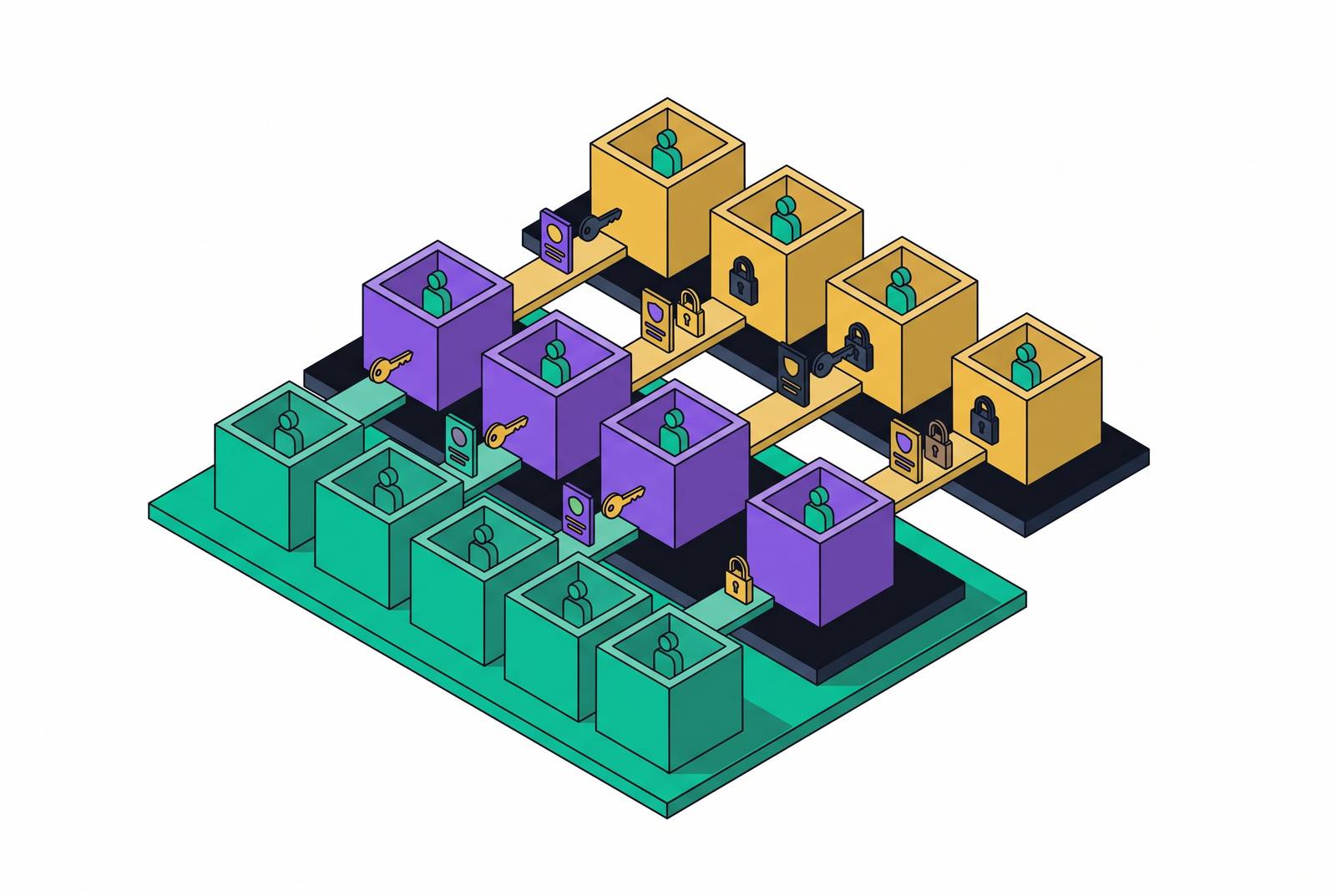
Identity. Every agent needs its own explicit identity and its own assigned role, or roles. Treating an agent as some invisible background process is where this starts to go wrong. That identity also has to be scoped to the tenant: run the same agent template for two different customers, and it needs to resolve to two completely separate identity contexts, not one identity wearing two hats. A specific risk shows up when an agent runs on a user's behalf and inherits that user's full session permissions. If the user happens to have elevated access, the agent silently picks it up too, way beyond what the actual task needs. The fix is to scope the agent's permissions to the task at hand, not to the user's entire access profile. AWS's reference pattern for this uses Amazon Cognito to manage user and tenant identity, with IAM scoped per tenant context.
Data. A WHERE clause filtering by tenant ID in every query sounds fine until it isn't. Every single code path has to get that check right, and an agent generating SQL at runtime can drop the filter without anyone noticing. Row-level security fixes this by moving the check into the database engine itself: the policy runs on every query no matter what the application layer does or forgets to do. A prompt injection can't talk its way around a boundary enforced at the data layer. A developer can't forget to add it. An ORM upgrade can't quietly strip it out. Tenant data, documents, conversation history, agent memory, audit logs, all of it belongs in partitions separated at the architecture level, not filtered after the fact.
Tool access. Agents decide which tools to call at inference time, in the moment, which means a static list of allowed tools written at deployment can never cover every situation a live workflow throws at it. This needs real-time policy checks at the moment of action. Permissions have to get scoped per tenant, too: an agent cleared to read Tenant A's CRM records has no business touching Tenant B's, even if it's the exact same tool. Platforms like Composio handle the credential and authentication side of this per integration, so managed auth scopes access separately from the question of whether the agent should be calling that tool at all. AWS AppConfig, in the same reference architecture, lets teams change agent behavior per tenant or environment without redeploying anything.
Audit. Most agent frameworks today produce nothing close to a traditional RBAC audit trail. Without a log showing which agent, under which role, touched which resource, compliance reviews and incident investigations have nowhere to start. Telemetry needs to roll up by tenant, because a cross-tenant view with no single dashboard means incidents sit undetected longer than they should. A proper audit record captures the agent, the role it acted under, the resource it touched, the tenant context, and the timestamp, the whole chain, not just the last step. AWS Organizations and Service Control Policies handle the cross-account version of this governance in AWS's own reference setup.
What real boundary failures look like when enforcement is missing at any layer
Three incidents from 2025 map cleanly onto these layers.
Salesforce's Agentforce had a flaw disclosed by Noma Security, rated CVSS 9.4, that came down to a missing check at the identity and context layer. Attackers stuffed malicious instructions into Web-to-Lead form submissions. Agentforce couldn't tell the difference between a legitimate data field and an attacker's embedded command, and it leaked sensitive CRM records out to endpoints the attacker controlled. There was no enforcement point separating trusted instructions from attacker-supplied input.
ServiceNow's Now Assist showed the tool-access and identity handoff version of the same problem. A low-privilege agent read a crafted prompt hidden in content it was allowed to access, then used that prompt to recruit a more privileged agent, which copied and exfiltrated the sensitive data the first agent couldn't touch directly. Built-in prompt injection defenses were switched on. They didn't stop it. And the whole thing played out completely out of view of the organization it happened to.
The Salesloft/Drift breach showed what happens when tool-access scope is the failure point instead. More than 700 organizations were hit, Cloudflare, Palo Alto Networks, and Zscaler among them. Attackers got into Salesloft's GitHub repositories, moved into the Drift AWS environment, then rode AI-enabled integrations outward into every organization connected to it. The damage wasn't bounded by where the attackers first broke in. It was bounded by what the compromised integration could reach.
Same pattern, three different entry points. Blast radius tracks scope, and scope tracks how well each layer got enforced. Database isolation alone would not have stopped any of these three, which is the strongest argument against treating any single layer as sufficient. The case for layered enforcement rests on concrete evidence. It's already sitting in the incident reports.
How enforcement must be structured per tenant at provisioning time, not patched in later
Each tenant needs its own namespace, its own data store, its own configuration, and its own access policy, set up at onboarding, not hand-wired in afterward by an engineer scrambling to fix a support ticket. Bolting isolation onto a system after launch is the mistake to avoid here, not one option among several worth weighing.
Agent memory, session state, and tool configuration all need to be scoped to the tenant the moment the agent gets instantiated. Sharing all of that across tenants and trying to filter it later at query time is the exact pattern that produces the failure mode described earlier. Each tenant should define its own roles, permissions, and access scopes, with platform admins, tenant admins, and end users all operating inside boundaries that can't be crossed no matter what. ibl.ai runs this pattern in production across more than 400 organizations and 1.6 million users.
A centralized policy engine with config-based toggles lets an operator change behavior per tenant, say, a compliance agent adjusting its logic for a different country's regulations, without redeploying code or spinning up a separate build for every customer.
Retrofitting isolation onto something that started life as a single-tenant app is where teams get burned. Every new code path, every ORM bump, every agent-generated query becomes one more place a boundary can quietly fail, because the policy is a suggestion written in application code rather than something structural underneath it. AWS's own guidance frames agent deployment as a service: internal teams or customers consume agent capabilities through governed APIs, and the isolation lives in that service contract instead of getting bolted on as an afterthought filter.
Spend controls need the same per-tenant treatment. A spend cap set per sandbox, a model gateway metering usage against a shared balance with limits set per tenant, not one shared quota that any single customer can burn through and starve everyone else. Running dozens of disconnected deployments with no central governance means operational overhead grows right alongside tenant count. Designing multi-tenancy in from the start is the only way to avoid a pile of siloed instances nobody can actually govern.
Where real-time policy enforcement fits into the stack: the role of specialist access control layers
Static role definitions written at deployment time can't predict every tool call, every data access, or every context shift a live agent will run into. Enforcement has to run continuously, not as a one-time check at setup.
Protecto works as a dedicated enforcement layer sitting between AI agents and sensitive data, plugged into whatever identity stack a company already runs. When an agent handles a request, Protecto checks the user's Active Directory role and decides on the spot what data the agent is allowed to show: a support rep sees masked account numbers, a senior analyst sees the full record. That decision gets made by weighing who's asking, what the agent's actually doing, and what the underlying data contains, not by consulting a fixed table someone wrote six months ago. The masking has to preserve enough structure that the model's reasoning doesn't fall apart, since masked data that breaks an LLM's context defeats the entire purpose of running the agent in the first place. Protecto manages tenants independently within a single instance, with policies cleanly separated between them. One case study, a Fortune 100 technology company, plugged Protecto into its existing planning tools and AD setup and had real-time policy enforcement running within days, which matters because a long integration slog is its own kind of risk. Enforcement covers prompts, context, API calls, and outputs, not just the initial request.
Database-layer enforcement covers different ground. CockroachDB's row-level security turns tenant isolation into a property of the data layer itself, rather than a convention every application path has to remember to follow. The policy lives inside the database engine and runs on every query. Tenant data sits together in shared tables, but access gets controlled row by row based on tenant identity: structural, not a rule someone has to remember to apply.
Integration authentication is its own layer again. Composio manages the OAuth flows, API keys, and token refresh for agents connecting to outside accounts, with permissions scoped per connection. As of August 2026, Composio lists a large catalogue of toolkits covering more than 20,000 individual tools. At that scale, handling credentials by hand for every tenant and every tool just isn't realistic. Managed auth is the only approach that holds up. Composio's custom-actions support lets teams wrap their own internal APIs in that same managed layer, so the enforcement boundary covers proprietary systems too, not just common SaaS tools. The managed cloud service carries SOC 2 Type II certification.
None of these three layers, policy enforcement, database RLS, integration auth, does the other's job. Each one catches a failure mode the others miss entirely. Swapping one in for another instead of running all three is how teams end up with the exact gaps this section just walked through.
How per-user sandbox isolation changes what RBAC has to do at the platform level
The strictest version of tenant isolation gives each user their own agent instance entirely: its own disk, its own memory, its own URL, with nothing shared between sessions by default. That changes what RBAC actually has to do at the platform level. Instead of leaning on filters and checks to keep one user's data from bleeding into another's inside a shared runtime, the isolation is already physical before a single permission gets evaluated.
RBAC's job shrinks under this model. It no longer polices a shared memory space that every tenant's agent quietly runs inside at the same time. It governs what a given identity can do inside its own sandbox, and it controls the handful of places where a sandbox is allowed to reach out, such as a tool call, an API, or a shared resource. That's a smaller job, and a more honest one.
Sources
- Why Role-Based Access Control For AI Is The New Security Imperative
- Agentic AI: Role-Based Access Control For Agents - Protecto
- Multi-Tenant AI Agent Data Isolation | CockroachDB
- Focus area 3: Architect for multi-tenancy and control - AWS Prescriptive Guidance
- Multi-Tenant AI Architecture for Enterprise AI | ibl.ai
- Authorization Propagation in Multi-Agent AI Systems: Identity Governance as Infrastructure
- automationatlas.io
- Securing Multi-Agent AI: Real-World Challenges in Authorization and Access Control | by Chayan Ray | Medium